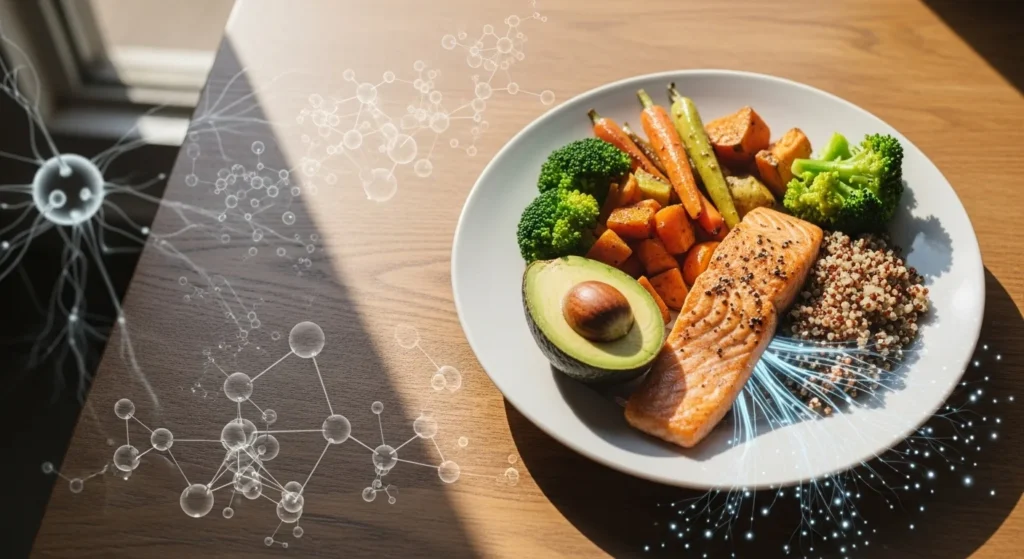
Food Is Doing More Than You Think
Most people think food has one job:
Give energy.
Stop hunger.
But inside your body, every meal does far more than that.
It sends instructions.
It adjusts systems.
It restores equilibrium.
In fact, one of food’s most important roles isn’t to change your body—it’s to keep it steady.
When that balance is present, life feels manageable.
When it’s missing, everything feels harder.
Understanding how the body uses food to maintain balance explains why:
- Nutrition often feels subtle
- Results appear slowly
- Consistency matters more than intensity
And why food works best when it’s boring, reliable, and supportive.
Balance in Biology: What the Body Is Always Trying to Protect
Biology runs on balance.
The scientific term is homeostasis—the ability to keep internal conditions stable despite constant external change.
Your body constantly regulates:
- Blood sugar
- Body temperature
- Fluid levels
- Electrolytes
- Hormones
- Energy availability
Food is one of the strongest tools the body uses to maintain this internal calm.
Without reliable nutrition, balance becomes reactive.
Food as Information, Not Just Fuel
Calories provide energy.
But nutrients provide instructions.
Every meal tells the body:
- How much energy is available
- Whether resources are reliable
- Whether repair can proceed
- Whether stress responses can quiet down
When meals are consistent and adequate, these signals are clear.
When meals are erratic or low in quality, the signals become noisy.
The body responds accordingly.
How Food Stabilizes Blood Sugar (Without You Noticing)
Blood sugar balance is one of the clearest examples of food maintaining stability.
With regular, balanced meals:
- Glucose rises predictably
- Insulin responds efficiently
- Energy release is smooth
With inconsistent or low-quality meals:
- Blood sugar spikes and crashes
- Stress hormones intervene
- Fatigue and irritability appear
When food supports balance, you don’t feel energized—you feel steady.
Why Hormones Depend on Nutritional Reliability
Hormones are messengers, not magic.
They respond to patterns.
Consistent nutrition helps:
- Cortisol follow a healthy daily rhythm
- Insulin remain sensitive
- Thyroid signaling stay efficient
- Hunger hormones stabilize
Erratic eating forces hormones into constant adjustment.
That adjustment is felt as:
- Mood swings
- Energy dips
- Sleep disruption
Food doesn’t “boost” hormones.
It reduces the need for compensation.
The Nervous System Uses Food to Decide Safety
Your nervous system is always asking:
“Are we safe?”
Food helps answer that question.
Reliable nourishment signals:
- Resources are available
- Scarcity isn’t imminent
- Stress responses can relax
Unreliable eating signals uncertainty—even if calories are adequate.
This is why consistent meals often lead to:
- Calmer mood
- Better sleep
- Improved stress tolerance
Nutrition doesn’t calm the mind directly.
It calms the biology underneath it.
Real-Life Example: When Balance Returns Quietly
Consider someone who stops skipping meals.
They don’t change food quality much.
They just eat consistently.
Over weeks, they notice:
- Fewer energy crashes
- Less irritability
- Better focus
- Reduced cravings
Nothing dramatic happened.
Balance did.
How Food Supports Digestive Balance
Digestion is rhythmic.
It expects:
- Regular timing
- Familiar inputs
- Predictable volume
Consistent nutrition helps:
- Coordinate enzyme release
- Stabilize gut motility
- Support microbiome balance
When digestion is balanced, it’s quiet.
When it’s stressed, it demands attention.
The Body Uses Nutrients to Buffer Stress
Stress consumes resources.
It increases the need for:
- Magnesium
- B vitamins
- Vitamin C
- Zinc
When food replenishes these consistently, stress responses are buffered.
When it doesn’t, stress feels sharper—even if life hasn’t changed.
Food doesn’t remove stress.
It increases resilience to it.
Balance vs. Change: A Key Distinction
Many people expect nutrition to change how they feel.
But its first job is balance.
| Nutrition Role | What It Feels Like | What It Does |
|---|---|---|
| Creating balance | Subtle, calm | Stabilizes systems |
| Forcing change | Dramatic | Triggers compensation |
| Supporting repair | Quiet | Builds resilience |
| Chasing results | Exciting | Often unsustainable |
If nutrition feels uneventful, it’s often doing its job well.
Why Modern Diets Disrupt Balance
Modern eating patterns often include:
- Irregular timing
- Processed foods
- Stimulant reliance
- Inconsistent nutrient density
At the same time, modern life increases stress and nutrient demand.
This combination makes balance harder to maintain—even with “healthy” foods.
Population-level insights summarized by organizations like the World Health Organization and the National Institutes of Health consistently show that dietary patterns and consistency matter as much as food quality for long-term health.
Subtle Signs Food Is Restoring Balance
Look for:
- Fewer cravings
- More predictable hunger
- Steadier energy
- Better sleep continuity
- Improved stress recovery
These aren’t flashy wins.
They’re foundational ones.
Common Mistakes That Undermine Nutritional Balance
Even well-intentioned people often:
- Skip meals to be “disciplined”
- Chase constant novelty
- Eat reactively
- Expect immediate feedback
- Overcorrect when results feel slow
Balance requires trust.
And trust requires consistency.
Why This Matters Today
Life is already unpredictable.
Work.
Stress.
Sleep.
Schedules.
Food shouldn’t add to that chaos.
When nutrition provides balance, the body becomes a stable platform for everything else.
That stability makes:
- Decision-making easier
- Stress less overwhelming
- Health more sustainable
How to Use Food to Support Balance (Not Control)
You don’t need extremes.
You need reliability.
Actionable steps:
- Eat at roughly consistent times
- Prioritize complete meals over constant snacking
- Repeat foods you digest well
- Match nutrition to stress load
- Measure success by stability, not excitement
Balance builds quietly—but powerfully.
Key Takeaways
- The body uses food to maintain internal balance
- Nutrition sends signals of safety and reliability
- Stability comes before visible change
- Consistency matters more than intensity
- Calm is a biological success signal
Frequently Asked Questions
1. Why doesn’t healthy eating feel dramatic?
Because nutrition’s main role is stabilization, not stimulation.
2. Can food really affect mood and stress?
Yes. Through blood sugar, hormones, and nervous system signaling.
3. Is balance more important than variety?
Balance comes first; variety works best once stability exists.
4. How long does it take to restore balance?
Often weeks, as systems gradually recalibrate.
5. What’s the biggest sign food is helping?
Life feels less reactive—even without obvious changes.
Conclusion: Balance Is the Result Most People Miss
Food doesn’t shout.
It steadies.
It buffers.
It restores.
When nutrition is doing its job, the body feels predictable, resilient, and calm. And that quiet balance is what allows every other improvement to happen.
Not overnight.
But sustainably.
Disclaimer: This article is for general educational purposes only and does not replace personalized medical or nutritional advice. Individual needs may vary.

Pingback: Why Oranges Support Your Immune System So Well (The Science Behind This Everyday Fruit)
Pingback: The Hidden Health Power of Lemons Most People Completely Overlook
Pingback: Why Avocados Are Considered the Gold Standard of Healthy Fats
Pingback: The Hidden Power of Kiwi: The Superfruit Most People Overlook
Pingback: Watermelon Isn’t Just Water: The Hidden Health Benefits Most People Don’t Know
Pingback: The Surprising Heart Benefits of Grapes (And Why Doctors Love Them)