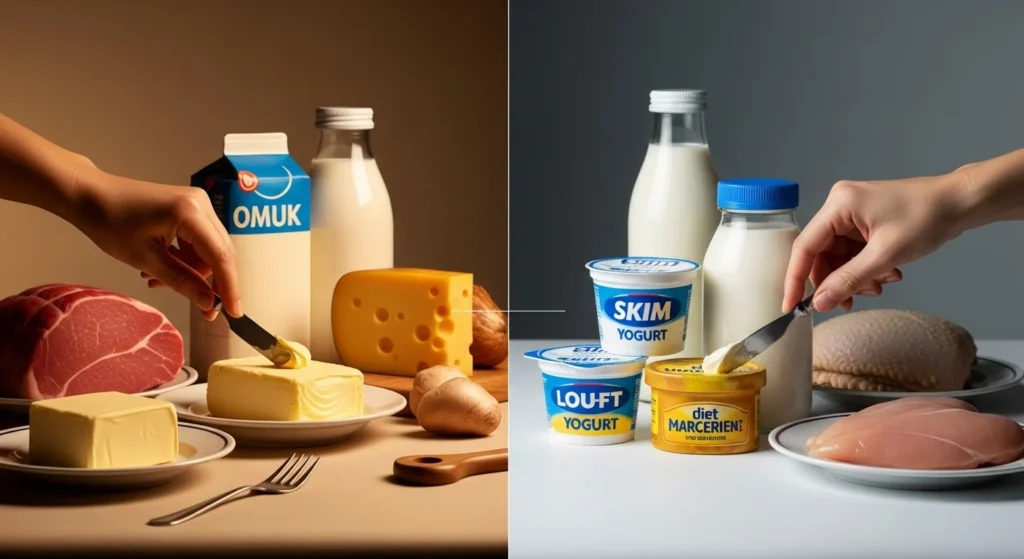
The Label That Felt Instantly Safe
Walk through any supermarket aisle and your eyes still land on the same words:
Low Fat. Fat-Free. 0% Fat.
They feel reassuring.
Responsible.
Almost medically approved.
For decades, these two words quietly signaled “this is the healthier choice”—no deep thinking required.
But here’s the uncomfortable truth most people never hear:
“Low fat” didn’t become popular because it always made food healthier.
It became popular because it was easy to sell.
To understand how one label reshaped modern eating habits, we need to look at where the fear of fat came from, how marketing stepped in, and why the consequences still show up on plates today.
How Fat Became the Villain in the First Place
Before the 1970s, fat wasn’t automatically seen as dangerous.
Butter was normal.
Egg yolks were celebrated.
Full-fat dairy was standard.
The shift began when early heart-disease research suggested a connection between saturated fat and cholesterol. Influential researchers like Ancel Keys helped popularize the idea that dietary fat—especially saturated fat—was the main driver of heart disease.
Soon, government bodies such as the USDA and organizations like the American Heart Association began recommending lower-fat diets.
The message reached the public in a simplified form:
Fat is bad. Less fat is better.
That single idea changed everything.
When Nutrition Advice Became a Sales Opportunity
Food companies didn’t invent the fear of fat—but they capitalized on it brilliantly.
Removing fat from a product instantly allowed brands to:
- Make a bold health claim
- Appeal to weight-conscious consumers
- Avoid complex nutrition education
- Stand out visually on packaging
And most importantly:
They didn’t need to prove the food was healthy—just that it was lower in fat than before.
This is where “low fat” transformed from a nutritional guideline into a marketing shortcut.
Why “Low Fat” Was the Perfect Shortcut
From a marketing perspective, “low fat” checked every box:
- ✅ Easy to understand
- ✅ Emotionally reassuring
- ✅ Backed by mainstream advice
- ✅ Simple to print on labels
- ✅ Rarely questioned by consumers
Compare that to claims like balanced macronutrients or metabolic health—which require explanation and trust.
“Low fat” sold itself.
And consumers, trying to make better choices, naturally leaned toward it.
What Had to Replace the Fat
Here’s the part many people still don’t realize:
Fat makes food taste good.
When manufacturers removed it, something had to take its place.
Usually, that meant:
- Added sugar
- Refined starches
- Artificial flavor enhancers
- Thickeners and gums
So while the label improved, the internal composition often worsened.
A “low-fat” cookie didn’t become broccoli.
It became a sugar-heavy, highly processed snack with a health halo.
Low Fat vs Whole Fat: What Actually Changed
| Aspect | Low-Fat Products | Whole-Fat Foods |
|---|---|---|
| Taste | Often dulled | Naturally satisfying |
| Satiety | Lower | Higher |
| Added sugar | Common | Rare |
| Processing level | High | Low |
| Blood sugar impact | Spikes more likely | More stable |
| Label appeal | Strong | Often misunderstood |
This comparison reveals the real issue:
Removing fat didn’t automatically make food healthier—it often made it less satisfying and more processed.
The Psychological Power of the “Low Fat” Halo
One of the most damaging effects wasn’t nutritional—it was psychological.
Studies consistently show that when people see “low fat” on a label, they tend to:
- Eat larger portions
- Snack more frequently
- Feel less guilt while overeating
- Ignore other ingredients
This is known as the health halo effect.
The label didn’t just change what people bought.
It changed how much they ate—and how safe they felt doing it.
Why This Shortcut Still Works Today
Even though nutrition science has evolved, the label hasn’t disappeared.
Why?
Because:
- Many people still associate fat with weight gain
- Labels influence decisions more than ingredient lists
- Busy consumers want quick signals
- Diet culture hasn’t fully let go of fat fear
“Low fat” remains a shortcut because it reduces thinking—and thinking is effort.
Mistakes Most People Make With Low-Fat Foods
If you’ve ever tried to eat “healthier” and felt constantly hungry, this may be why.
Common mistakes include:
- Assuming low fat = low calories
- Ignoring sugar content
- Eating larger portions because it feels “safe”
- Avoiding healthy fats altogether
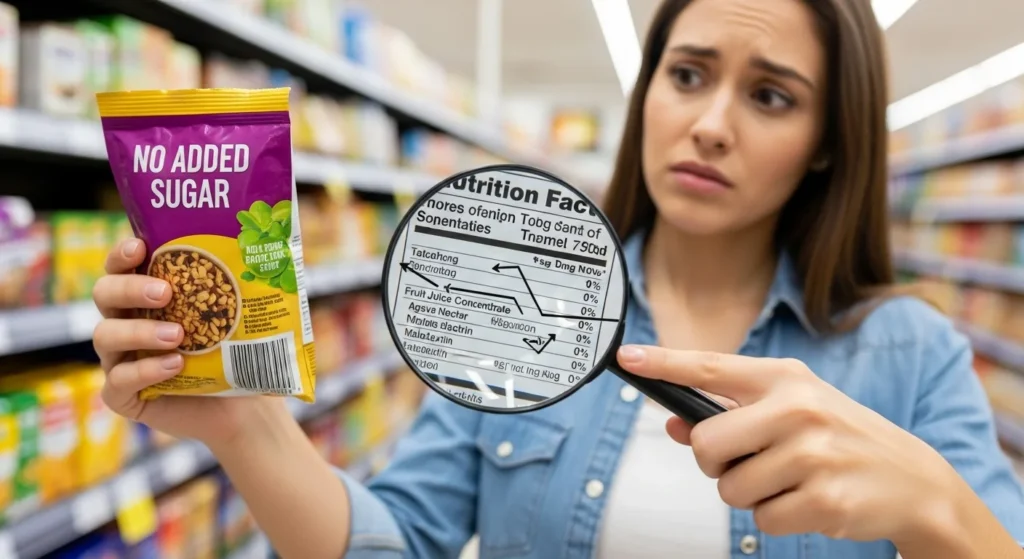
- Trusting front-of-pack claims over ingredient lists
These mistakes aren’t personal failures—they’re predictable outcomes of clever marketing.
How to Read Past the Label (Without Overthinking)
You don’t need to fear fat—or food labels—but you do need context.
Here’s a simple, practical approach:
- Check the ingredient list
If sugar is one of the first three ingredients, be cautious. - Notice how full you feel
Foods that leave you hungry quickly often lack fat or protein. - Compare versions
Sometimes the full-fat version has fewer ingredients overall. - Focus on food form, not claims
Whole foods rarely need health slogans. - Ask what was removed—and what replaced it
This one question changes everything.
Why This Matters Today (More Than Ever)
Modern diets struggle less with fat excess—and more with:
- Overprocessing
- Blood sugar instability
- Constant hunger
- Emotional eating
- Label-driven decisions
Understanding why “low fat” became a shortcut helps you step out of autopilot and make choices based on how food actually affects your body, not how it’s marketed.
Key Takeaways
- “Low fat” rose from simplified nutrition advice, not complete science
- Food companies used it as a powerful marketing shortcut
- Fat removal often led to more sugar and processing
- The label created a health halo that changed eating behavior
- Reading beyond the claim restores control and clarity
Frequently Asked Questions
1. Are low-fat foods always unhealthy?
No. Some are appropriate. The problem is assuming they’re healthier by default.
2. Is fat actually good for you?
Certain fats are essential for hormones, satiety, and nutrient absorption.
3. Why do low-fat foods make me feel hungry faster?
Fat slows digestion and increases fullness. Removing it often reduces satiety.
4. Should I avoid low-fat labels entirely?
Not necessarily—just don’t let the label make the decision for you.
5. What matters more than fat content?
Overall food quality, ingredient simplicity, and how your body responds.
A Clear, Calm Conclusion
“Low fat” didn’t become dominant because it told the full nutritional story.
It became dominant because it was easy, comforting, and profitable.
Once you see it as a shortcut—not a guarantee—you gain the freedom to choose foods that truly nourish rather than just reassure.
And that shift, quietly, changes everything.
Disclaimer: This article is for general educational purposes and is not a substitute for personalized medical or nutritional advice.

Pingback: How “Healthy” Food Claims Quietly Lead to Overeating