Why Two People Can Eat the Same Food—and Feel Completely Different
Two people eat the same meal.
Same calories.
Same nutrients.
Same portion size.
One feels energized and calm.
The other feels tired, bloated, or irritable.
What changed?
Not the food itself.
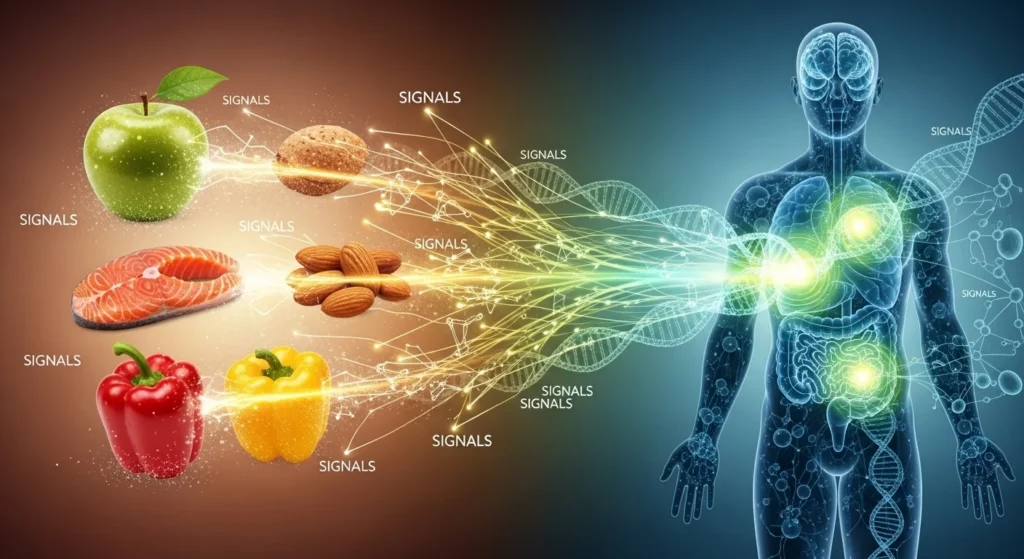
The difference lies in how the body interprets the signal that food sends.
This is the missing layer in most nutrition conversations.
We’re taught to think of food as a collection of substances—proteins, fats, carbohydrates, vitamins. But the body doesn’t experience food as a spreadsheet.
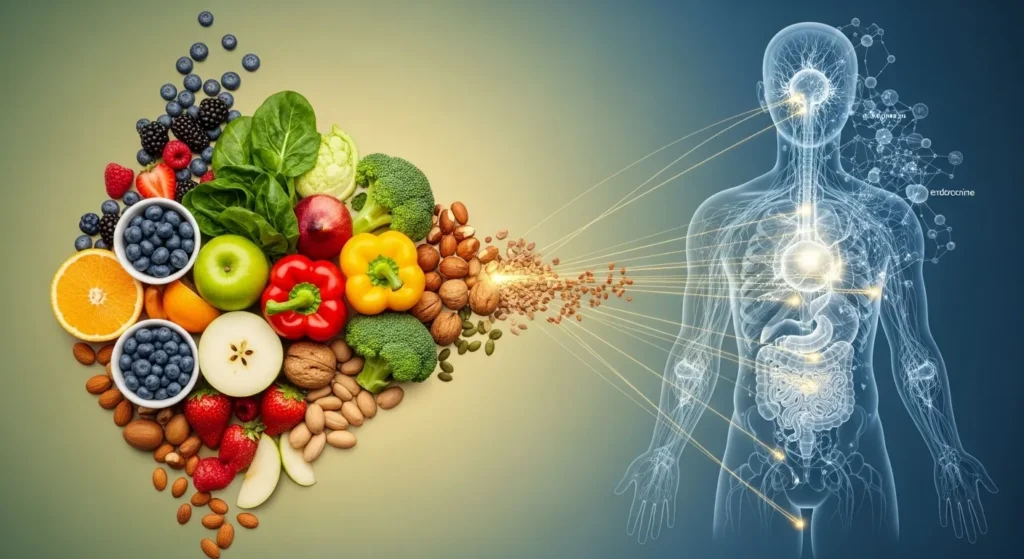
It experiences food as information.
And that information shapes metabolism, hormones, stress responses, and long-term health far more than most people realize.
Nutrition as Communication, Not Chemistry Alone
Yes, nutrients are chemical substances.
But biology is not passive chemistry—it’s responsive signaling.
Every meal answers key biological questions:
- Is food reliable or scarce?
- Should energy be spent or conserved?
- Is it safe to grow, repair, and recover?
- Should stress systems stay active?
Calories supply energy.
Signals decide what that energy is allowed to do.
This is why nutrition outcomes depend on patterns, timing, and context—not just nutrient totals.
The Body Is Always Interpreting, Not Just Absorbing
Digestion isn’t a factory line.
It’s a feedback system.
When food arrives, the body immediately evaluates:
- Timing (early, late, irregular)
- Composition (balanced or skewed)
- Frequency (consistent or sporadic)
- History (familiar or unpredictable)
These factors shape hormone release, enzyme activity, and nervous system tone.
The same nutrients can produce different effects depending on the signal environment.
Calories vs. Signals: A Crucial Distinction
Calories answer one question:
“How much energy is available?”
Signals answer deeper ones:
- “Should I use or store it?”
- “Is this temporary or reliable?”
- “Can I afford repair and growth?”
This is why calorie-matched diets can lead to very different outcomes.
| Focus | Calories Only | Signal-Aware Nutrition |
|---|---|---|
| What it measures | Energy quantity | Biological meaning |
| Predicts | Short-term weight change | Long-term regulation |
| Affects | Fuel supply | Hormones, stress, metabolism |
| Sustainability | Often low | High |
Ignoring signals is why many diets technically “work” but feel terrible.
How Food Signals Safety or Stress
The body evolved to survive uncertainty.
Irregular food availability historically meant danger.
So the body learned:
- Predictable meals = safety
- Erratic intake = potential scarcity
Consistent nutrition sends calming signals:
- Lower stress hormone output
- Improved insulin sensitivity
- Greater metabolic flexibility
Unpredictable eating—even with enough calories—sends low-grade stress signals.
This is why people can feel “off” despite eating enough.
Why Timing Is a Signal, Not a Preference
Meal timing isn’t just habit.
It’s information.
Regular timing tells the body:
- When to release digestive enzymes
- When to expect glucose
- When recovery can occur
Irregular timing forces constant adjustment.
The result isn’t dramatic—it’s subtle instability:
- Energy dips
- Hunger spikes
- Mood reactivity
Nutrition works best when the body can anticipate, not react.
Real-Life Example: Same Diet, Different Signal
Consider two people eating identical foods.
Person A
- Eats at regular times
- Eats complete meals
- Rarely skips meals
Person B
- Skips meals unpredictably
- Snacks constantly
- Eats late under stress
Same substances.
Very different signals.
Person A’s body receives:
“Resources are reliable.”
Person B’s body receives:
“Resources are uncertain.”
Hormones, digestion, and energy respond accordingly.
Why Micronutrients Act Like Messengers
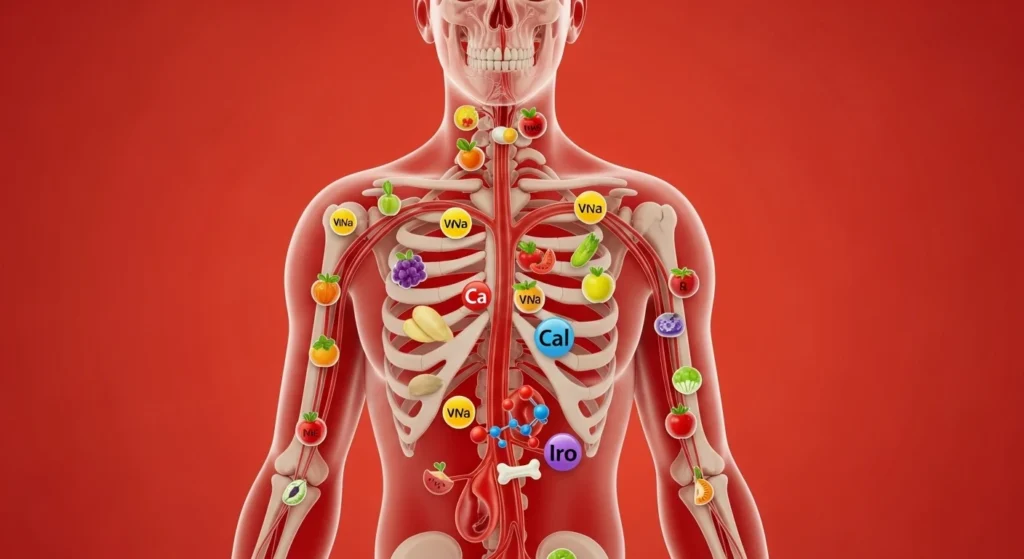
Micronutrients don’t just “fill gaps.”
They regulate processes.
Examples:
- Magnesium signals nervous system calm
- Zinc supports immune decision-making
- B vitamins influence energy pathways
- Iron affects oxygen signaling
When micronutrients are inconsistent, the body doesn’t panic—it compensates.
That compensation feels like:
- Fatigue
- Brain fog
- Low stress tolerance
Again, this is signaling—not deficiency drama.
Hunger vs. Signal Confusion
True hunger is a clear signal:
“Energy is needed.”
Signal confusion feels different:
- Eating doesn’t satisfy
- Cravings repeat
- Energy feels unstable
That confusion often comes from mixed signals:
- Calories without nutrients
- Nutrients without consistency
- Timing without adequacy
The body isn’t broken.
It’s receiving unclear instructions.
Why Supplements Can’t Replace Signals
Supplements provide substances.
But they don’t always replicate signals.
For example:
- Swallowing magnesium ≠ stress relief if meals are chaotic
- Taking protein powder ≠ muscle support without energy reliability
Signals come from patterns, not pills.
Supplements can assist—but they can’t override contradictory messages from inconsistent eating.
The Nervous System Is Reading Every Meal
The nervous system doesn’t care about macros.
It cares about predictability.
Food reliability influences:
- Fight-or-flight activation
- Sleep depth
- Emotional regulation
- Stress recovery
This is why consistent meals often improve sleep and mood—even without dietary perfection.
Nutrition doesn’t calm the mind directly.
It calms the biological threat detection system underneath it.
What Research Shows About Patterns Over Parts
Large-scale nutrition research summarized by organizations like the World Health Organization and the National Institutes of Health consistently shows that dietary patterns and regularity predict health outcomes better than individual nutrients.
The body responds to:
- Repetition
- Consistency
- Adequacy over time
Not isolated “perfect” meals.
Common Mistakes That Ignore Nutrition Signals
Many well-intentioned people:
- Chase superfoods but skip meals
- Obsess over macros while eating irregularly
- Change diets weekly
- Eat reactively instead of rhythmically
- Expect immediate feedback
These approaches provide substances—but confuse signals.
Why This Matters Today
Modern life is noisy.
Stress is constant.
Sleep is inconsistent.
Attention is fragmented.
Food becomes one of the strongest stabilizing signals available.
When nutrition sends clear, calm messages, the body handles everything else better.
This isn’t optimization.
It’s relief.
How to Eat for Clear Signals (Not Just Nutrients)
You don’t need extremes.
You need coherence.
Actionable steps:
- Eat complete meals at roughly consistent times
- Reduce constant snacking
- Repeat foods you digest well
- Match intake to stress load
- Track stability, not excitement
When signals improve, outcomes follow.
Key Takeaways
- Nutrition communicates information, not just nutrients
- Patterns and timing shape biological responses
- Calories fuel—signals decide usage
- Consistency reduces internal stress
- Clear signals create long-term balance
Frequently Asked Questions
1. Can the same food affect people differently?
Yes. Signal context—timing, consistency, stress—matters.
2. Is eating regularly more important than eating “perfectly”?
For signaling, yes. Regularity builds trust.
3. Why don’t supplements fix everything?
They add substances, not behavioral signals.
4. How fast do nutrition signals work?
Some stabilize within weeks; deeper effects take longer.
5. What’s the clearest sign signals are improving?
Life feels less reactive—without dramatic change.
Conclusion: Food Is a Language Your Body Understands
Your body isn’t counting nutrients.
It’s listening.
To patterns.
To timing.
To reliability.
When food sends calm, consistent signals, the body responds with stability, resilience, and quiet health. Not overnight—but in ways that last.
Nutrition works best when it’s not loud.
It works when it’s clear.
Disclaimer: This article is for general educational purposes only and does not replace personalized medical or nutritional advice. Individual needs and responses may vary.