The Label That Instantly Feels Like the Right Choice
You’re choosing bread.
One package says:
- Whole Grain
- Made with Whole Wheat
- Heart-Smart Choice
The other doesn’t.
You barely hesitate.
Whole grain feels like the responsible option.
The “good carb.”
The choice you’re supposed to make.
But here’s the uncomfortable truth:
“Whole grain” describes an ingredient — not the overall quality of the food.
And that gap between expectation and reality is where confusion begins.
What “Whole Grain” Actually Means
By definition, a whole grain contains:
- The bran
- The germ
- The endosperm
In theory, this preserves:
- Fiber
- Some vitamins
- Minerals
Regulatory guidance around whole-grain terminology is shaped by authorities like the U.S. Food and Drug Administration, with public-health recommendations often referenced by the World Health Organization.
But here’s the key point:
A food can contain whole grains and still be heavily processed, low in fiber, and metabolically unbalanced.
Why “Whole Grain” Feels So Trustworthy
Whole grain messaging has been reinforced for decades.
It’s associated with:
- Heart health
- Digestive health
- Long-term wellness
So when people see “whole grain,” their brain often assumes:
- Slow digestion
- Stable blood sugar
- High fiber
- Better quality
That assumption isn’t irrational.
It’s just incomplete.
The Hidden Gap Between Whole Grain and Whole Food
Whole grains and whole foods are not the same thing.
A food can:
- Start as a whole grain
- Be finely milled
- Be reassembled
- Be sweetened or refined
By the time it reaches your plate, the grain’s structure—not just its parts—has changed.
Structure matters because it affects:
- How fast carbohydrates digest
- Blood sugar response
- Satiety
Whole grain on paper doesn’t always behave like whole grain in the body.
Real-Life Example: Whole Grain Bread
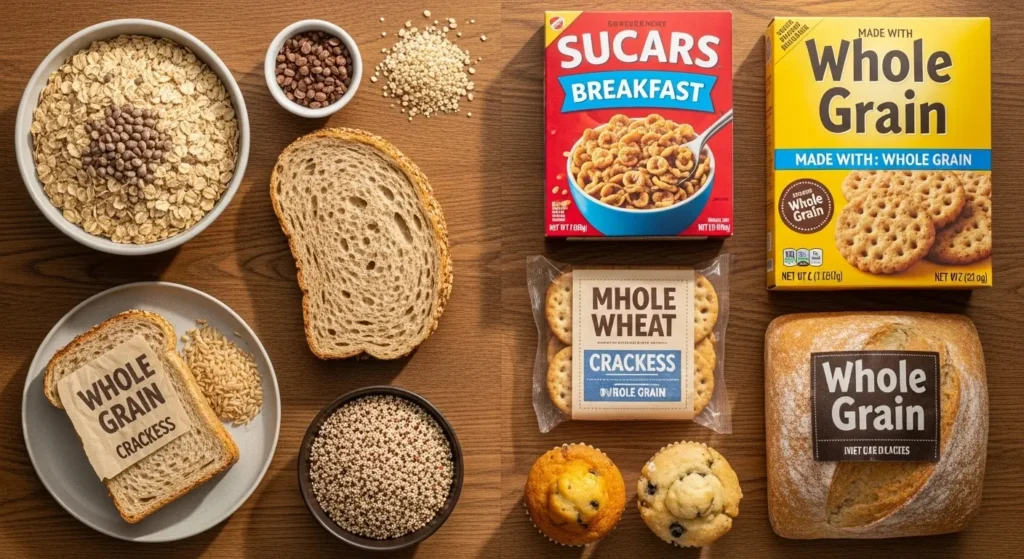
Many “whole grain” breads:
- Use finely ground whole-wheat flour
- Add sweeteners for taste
- Contain minimal intact grain structure
Even with whole grain listed, the bread may:
- Digest quickly
- Spike blood sugar
- Feel less filling
The grain is technically whole.
The experience is not.
Why Fiber Numbers Matter More Than the Label
Here’s a practical truth:
Fiber content often tells you more than the words “whole grain.”
Some whole-grain products contain:
- 1–2 grams of fiber per serving
Others contain:
- 6–10 grams
Both can legally say “whole grain.”
That difference changes:
- Digestion speed
- Appetite control
- Gut health impact
The label doesn’t show this contrast clearly.
The nutrition panel does.
Comparison Table: “Whole Grain” Claim vs Real-World Impact
| Factor | Whole Grain Label | What Actually Matters |
|---|---|---|
| Ingredient | Contains whole grain | Amount and structure |
| Fiber | Assumed high | Often variable |
| Processing | Not indicated | Can be extensive |
| Blood sugar | Assumed stable | Depends on refinement |
| Satiety | Assumed high | Depends on fiber + structure |
The label tells part of the story—not the ending.
Why Processed Foods Can Still Wear the Whole-Grain Badge
Food manufacturing allows flexibility.
Whole grains can be:
- Pulverized
- Reconstituted
- Mixed with refined starches
As long as whole grain is present, the claim can appear.
This is why you’ll see:
- Whole-grain crackers with very low fiber
- Whole-grain cereals high in sugar
- Whole-grain snacks that behave like refined carbs
The grain’s identity remains.
Its function often doesn’t.
The Health Halo Effect of Whole Grain Claims
Whole-grain labeling creates a health halo.
People tend to:
- Eat larger portions
- Assume lower calorie impact
- Skip deeper label checks
“I chose whole grain, so it’s fine.”
This mindset can quietly:
- Increase total carb intake
- Reduce dietary variety
- Crowd out more intact foods
The label simplifies decision-making—but not digestion.
When Whole Grain Is Actually a Strong Signal
Whole grain isn’t meaningless.
It’s genuinely beneficial when:
- The grain remains intact or minimally processed
- Fiber content is high
- Added sugars are low
- The food supports balanced meals
Whole grains work best in context, not isolation.
Common Mistakes People Make With Whole-Grain Foods
Mistake #1: Assuming All Whole Grains Are Equal
Processing level matters as much as grain type.
Mistake #2: Ignoring Fiber Numbers
Fiber reveals how the grain behaves.
Mistake #3: Overeating Because It Feels “Healthy”
Health halos lower natural stopping cues.
Mistake #4: Replacing Variety With Labels
Balance comes from diversity, not one category.
How to Choose Truly Better Whole-Grain Foods
You don’t need to avoid whole grains.
You need to choose them more intelligently.
Actionable Steps
- Check fiber per serving (aim higher, not just present)
- Look for intact or less-refined grain forms
- Watch added sugars carefully
- Pair grains with protein and fat for balance
- Think in meals, not labels
This turns “whole grain” from a promise into a tool.
Why This Matters Today (And Long-Term)
Carbohydrates are often misunderstood.
Whole-grain messaging was meant to help—but oversimplification created new confusion.
Understanding the limits of the label helps you:
- Stabilize energy
- Improve satiety
- Reduce blood sugar swings
- Build sustainable eating patterns
Nutrition works best when structure, context, and balance are respected—not just ingredient names.
Key Takeaways
- “Whole grain” describes an ingredient, not overall food quality
- Processing level and fiber matter more than the label
- Many whole-grain foods digest like refined carbs
- Health halos can increase portions and reduce scrutiny
- Whole grains work best as part of balanced meals
Frequently Asked Questions
1. Are whole-grain foods unhealthy?
No—but not all whole-grain products offer the same benefits.
2. Is whole wheat the same as whole grain?
Whole wheat is one type of whole grain, but processing still matters.
3. How much fiber should whole-grain foods have?
Higher is generally better; compare products within the same category.
4. Do whole grains spike blood sugar?
They can if finely processed or low in fiber.
5. What’s better than relying on labels?
Looking at fiber, ingredients, and overall meal balance together.
Final Thought
“Whole grain” isn’t a lie.
It’s a partial truth.
When you understand what the label includes—and what it leaves out—you stop chasing comforting words and start choosing foods that actually work for your body.
And that’s where nutrition becomes calmer, clearer, and far more effective.
Disclaimer: This article is for general educational purposes and does not replace personalized nutrition or medical advice.