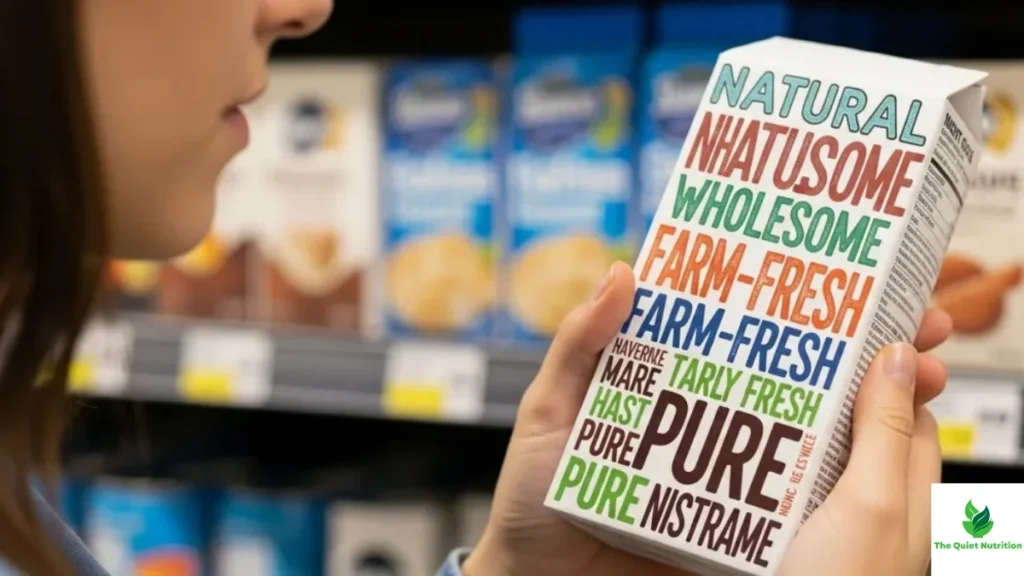
“Grandma’s Kitchen.” “Farmhouse Recipe.” “Old-Fashioned.” “Garden Fresh.” None of these phrases describe a nutrient, a certification, or a verifiable fact about a product. They’re something subtler: words chosen specifically because they feel warm, familiar, and easy to trust before a shopper has processed a single actual detail about what’s inside the package. That feeling isn’t incidental. It’s a well-understood psychological effect, and food marketing leans on it constantly.
Easy-to-Process Words Feel More Trustworthy, Regardless of Content
There’s a documented phenomenon in cognitive psychology called processing fluency: the easier a piece of information is for your brain to process, the more true, familiar, and trustworthy it tends to feel — independent of whether it actually deserves that trust. Names and words that are simple, familiar, and easy to pronounce trigger this effect reliably. Research on branding has found that fluent, easy-to-process names are subconsciously associated with honesty and reliability, making people more likely to trust whatever is attached to that name, purely because of how effortlessly it landed.
This is precisely why food packaging leans so heavily on plain, homely, familiar language rather than technical or unfamiliar terms. A word like “farmhouse” requires zero cognitive effort to process and arrives pre-loaded with warm associations. A word like “maltodextrin” requires effort, sounds unfamiliar, and carries no built-in warmth — even though, nutritionally, it’s simply a starch-derived carbohydrate, no more inherently dangerous than plenty of words that sound comforting. The feeling of trust or suspicion these words generate has almost nothing to do with what they actually mean.
Concrete, Familiar Language Shapes Perception on Two Separate Dimensions
Research digging into food naming specifically has found something worth understanding: the concreteness or abstractness of a food name shifts perception along two distinct tracks. Highly concrete, specific-sounding names give an advantage in how delicious a food seems, because they engage direct sensory imagination more effectively. Vaguer, more abstract names, by contrast, actually come across as healthier, because they leave more room for a favorable inference rather than pinning down a specific, potentially less flattering detail.
This helps explain why food labels are so carefully worded rather than accidentally so. A specific, concrete claim like “farm-raised chicken” pulls sensory imagination toward a wholesome mental picture. A vaguer phrase like “wholesome goodness” avoids being pinned to any verifiable claim at all, while still generating a favorable, healthy-sounding impression. Neither wording is neutral. Both are doing calculated psychological work, just along different perceptual channels.
Nostalgic Language Reaches Even Deeper Than Simple Trust
Beyond fluency, a second and even more powerful mechanism is at play with words like “grandma’s,” “old-fashioned,” or “homestyle”: nostalgia. Research on food and memory has found that nostalgic recollections triggered by taste and smell are especially self-relevant, emotionally positive, and carry genuine psychological benefits — including a greater sense of social connectedness and personal meaning. This effect, sometimes called the Proust effect after the famous literary description of memory triggered by taste, activates real emotional and even physiological responses; research has found that reminiscing about positive past experiences can measurably dampen stress hormone responses like cortisol.
Food marketing built around nostalgic language and imagery isn’t guessing that this works — industry analysis of recent food trends describes brands deliberately leaning into nostalgia as consumers seek emotional grounding during periods of economic and social uncertainty, treating nostalgic products as a kind of “affordable luxury” people are willing to pay a premium for specifically because of the emotional payoff, separate from anything about the product’s actual composition.
None of This Requires the Product to Actually Be Different
Here’s the uncomfortable part: none of these linguistic effects require the underlying product to change at all. A cereal doesn’t need different ingredients to benefit from a “grandma’s recipe” label — it just needs the label. The warmth, trust, and positive expectation generated by familiar, fluent, nostalgic language operates almost entirely upstream of anything nutritional, triggered by word choice alone rather than by anything happening in the ingredient list underneath it.
This is worth sitting with, because it means the emotional response a label generates and the nutritional reality of what’s inside the package are, structurally, completely separate things. A product can be simultaneously heavily processed and wrapped in language engineered to feel like it came from an actual farmhouse kitchen. The two facts don’t contradict each other from a marketing standpoint — they’re not even answering the same question.
What This Means When You’re Shopping
None of this is a reason for cynicism about every product with a warm-sounding name — plenty of genuinely good products also happen to use comforting language, because comforting language works regardless of quality. The distinction worth making is noticing when a feeling of trust arrived before any actual information did. If a product feels safe, wholesome, or familiar the moment you glance at it, it’s worth asking whether that feeling came from the ingredient list — or from a carefully chosen handful of words designed to produce exactly that feeling before you ever got that far.
Sources:
- Frozen Lemons — How Brand Names Influence Buying Behavior (Processing Fluency)
- NCBI/PMC — The Influence of Food Names With Different Levels of Concreteness on Evaluations of Deliciousness and Healthiness
- ScienceDirect — The Proust Effect: Scents, Food, and Nostalgia
- The Food Institute — Nostalgia Meets Neurogastronomy: The Psychology and Science of Flavor Recreation

Aarti Solanki, B.Sc. (Food Science), is a food science writer passionate about making nutrition simple and evidence-based. She creates well-researched, easy-to-understand articles on healthy eating, food science, and nutrition, using information from trusted scientific and public health sources.

Pingback: How Food Labels Downplay Processing — And Why “Healthy-Looking” Foods Aren’t Always What They Seem
Pingback: How Marketing Language Quietly Shapes Food Identity — And What You Think You’re Eating
Pingback: “Free From” Doesn’t Mean Healthy: Why Food Labels Obsess Over What’s Missing Instead of What Matters