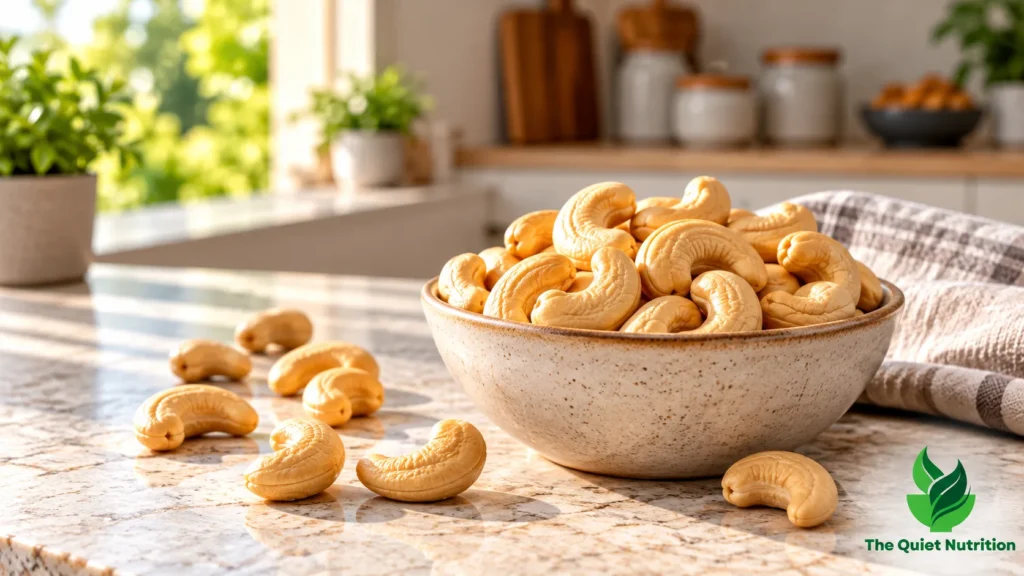
A small handful of cashews can make an ordinary snack more satisfying, but eating them every day raises an interesting question: does this creamy, slightly sweet nut do anything measurable for your health, or is it simply a convenient source of calories and minerals?
The answer depends partly on what cashews replace in your diet. Replacing a packet of chips or a sugary snack with unsalted cashews can improve the nutritional quality of your eating habits. Eating them on top of everything else, however, adds energy that your body still has to account for.
Cashews also have a nutritional profile worth understanding. They provide unsaturated fats, plant-based protein, magnesium and copper, yet research on their effects on cholesterol and blood pressure is more mixed than you might expect.
Here is what regular cashew consumption may do, what the research has actually established, and how much makes sense to eat.
1. You get a useful combination of protein, fats and minerals
Cashews are not particularly high in protein compared with foods such as chicken, Greek yogurt or lentils, but they offer several nutrients in a compact serving.
A one-ounce serving (28 grams) of raw cashews provides approximately the following amounts. Values are rounded and can vary slightly with preparation.
| Nutrient | Approximate amount |
|---|---|
| Calories | 155–160 |
| Protein | 5 g |
| Total fat | 12–13 g |
| Carbohydrates | 9 g |
| Dietary fiber | 1 g |
| Magnesium | 82 mg |
| Copper | 0.6 mg |
The fat content deserves particular attention. Much of the fat in cashews is monounsaturated or polyunsaturated, the types of unsaturated fats commonly emphasized in heart-conscious eating patterns.
Their protein and fat can also make cashews more satisfying than a snack consisting mostly of refined carbohydrates. However, satiety varies between people, and cashews alone do not guarantee that you will eat less later.
One detail is easy to overlook: cashews contain relatively little fiber compared with almonds, pistachios and many seeds. They can contribute to a balanced diet, but they are not among the most fiber-rich snack options.
2. Your magnesium intake may improve
Magnesium supports hundreds of processes in the body, including normal muscle and nerve function, energy production, bone health and the regulation of blood glucose and blood pressure.
A one-ounce serving of dry-roasted cashews contains about 74 mg of magnesium, or roughly 18% of the US Daily Value for adults. That makes a handful a meaningful contributor to daily intake.
This is particularly useful when cashews are part of a varied diet that also includes whole grains, legumes, leafy vegetables and other nuts.
The distinction between nutrient intake and health outcomes matters here. Eating cashews supplies magnesium, but that does not mean eating more cashews will automatically lower your blood pressure, prevent muscle cramps or improve sleep. Those outcomes depend on many factors, including your overall nutritional status and existing health conditions.
The practical takeaway: Cashews can help you meet your magnesium needs through food, but variety remains important. No single nut supplies every nutrient you need.
3. You get copper that supports normal body functions
Copper receives less attention than magnesium, even though your body needs it in small amounts.
It contributes to energy production, the formation of connective tissue and blood vessels, and the normal functioning of the nervous and immune systems. Nuts, including cashews, are recognized dietary sources.
A one-ounce serving of cashews provides approximately 0.6 mg of copper, compared with an adult recommended intake of 0.9 mg per day in the United States.
That is a substantial contribution from a relatively small serving.
However, copper is an essential nutrient, not a reason to consume unlimited amounts of cashews. More is not necessarily better, and people with Wilson’s disease, a genetic disorder that interferes with copper handling, may need specific dietary guidance.
For most people, the sensible approach is to obtain copper from a mixture of foods rather than relying on one ingredient.
4. Your cholesterol levels might improve, but the evidence is mixed
This is one of the more interesting areas of cashew research because the findings are not entirely consistent.
In a randomized crossover trial published in the American Journal of Clinical Nutrition, researchers studied 51 adults, many of whom had elevated LDL cholesterol. Participants followed diets containing cashews or potato chips for four weeks, with a washout period between the two phases.
The cashew diet produced more favorable changes in total and LDL cholesterol than the potato-chip diet. The researchers concluded that replacing a high-carbohydrate snack with cashews could be a useful dietary strategy for managing cholesterol.
However, another randomized controlled feeding study involving 42 adults found that consuming 42 grams of cashews daily for four weeks did not significantly change LDL cholesterol, HDL cholesterol, triglycerides or blood pressure compared with the control diet.
A systematic review and meta-analysis of randomized trials also found no statistically significant overall changes in total cholesterol, LDL cholesterol, HDL cholesterol or triglycerides from cashew supplementation alone.
Why do these findings differ?
One important consideration is the comparison diet. Replacing a less nutritious snack with cashews is not the same as adding cashews to an already balanced diet while keeping everything else unchanged. The overall dietary pattern can influence the results.
The studies were also relatively small and short, limiting what researchers can conclude about long-term cardiovascular outcomes.
For readers, the most defensible conclusion is that cashews can fit into a heart-conscious eating pattern, particularly when they replace snacks high in refined carbohydrates or less favorable fats. But the evidence does not establish that eating cashews every day will reliably lower your cholesterol.
5. Your blood pressure may benefit from the broader dietary pattern
Cashews contain magnesium and potassium, both involved in normal blood pressure regulation. Their unsaturated fats can also fit into dietary patterns designed to support cardiovascular health.
But the presence of these nutrients does not prove that cashews themselves lower blood pressure.
A 2020 systematic review and meta-analysis of randomized controlled trials, involving 392 participants in its analysis, found a modest reduction in systolic blood pressure with cashew consumption. It did not find significant overall effects on blood lipids or diastolic blood pressure.
Other trials have not found a significant blood pressure benefit.
This means the evidence is promising in some respects but not strong enough to treat cashews as a blood pressure intervention.
If you enjoy them, they can be one component of a diet rich in vegetables, fruit, legumes, whole grains and other minimally processed foods. They should not replace prescribed medication or established treatment for hypertension.
6. Your weight depends on whether cashews replace food or add to it
Cashews can be a useful snack, but their calorie content is worth understanding if you are trying to manage your weight.
One ounce contains approximately 157 calories. That is a reasonable amount of energy for a snack, particularly when it replaces another food. Eating several handfuls throughout the day, however, can add up quickly.
For example, consider two different habits:
- Replacing a snack: You swap a packet of chips for a measured serving of unsalted cashews. You may improve the nutrient profile of your snack without substantially changing your overall calorie intake.
- Adding a snack: You continue eating your usual snacks and add cashews between meals. Your daily energy intake increases unless you compensate elsewhere.
Neither scenario guarantees weight loss or weight gain. Long-term weight changes depend on total energy intake, expenditure, appetite and other individual factors.
There is also an important nuance: nuts do not necessarily affect the body in exactly the way their calorie counts might suggest. Their structure, the effort involved in chewing and the degree to which their fat is absorbed can influence how much usable energy you obtain. Nevertheless, cashews still contribute calories and should not be treated as unlimited food.
If weight management is your goal, portion size and food substitution matter more than the idea of eating a particular nut every day.
7. You may find it easier to build a more balanced snack
A handful of cashews can make a snack more substantial, particularly when paired with foods that contribute fiber or additional protein.
For example, you could combine them with:
- An apple or pear for fruit and fiber.
- Plain Greek yogurt for additional protein.
- Oatmeal for a more filling breakfast.
- A small portion of raisins or other dried fruit for sweetness.
These combinations are not medically necessary, and there is no special benefit to pairing cashews with a particular food. The advantage is practical: combining foods with different nutritional profiles can help create a more varied eating pattern.
Cashews are also useful in cooking. Chopped cashews can add texture to salads and grain bowls, while blended cashews can give sauces a creamy consistency. Their versatility makes them easy to use beyond snacking.
The best choice is the one that fits your usual meals and helps you eat a wider range of nutritious foods.
8. You could consume more sodium than you realize
Plain cashews contain very little sodium naturally. Salted, flavored and heavily seasoned varieties can contain substantially more.
This distinction matters if you are monitoring sodium intake because of high blood pressure or another medical reason.
Check the nutrition label rather than assuming all cashews have the same sodium content. Dry-roasted, unsalted cashews are a straightforward option if you want to control added salt.
Sweetened or coated varieties may also contain added sugar, while oil-roasted versions can differ in their fat and calorie content depending on the preparation.
None of these products is automatically unsuitable, but plain or lightly seasoned varieties make it easier to understand what you are eating.
How many cashews should you eat each day?
For many adults who enjoy cashews and tolerate them well, about one ounce (28 grams) is a practical starting portion. That is roughly a small handful, although the actual number of nuts varies with size.
You do not need to eat cashews every day to have a healthy diet. Other nuts, seeds, legumes and whole foods can provide overlapping nutrients.
A simple guide:
| Your goal | Practical approach |
|---|---|
| Everyday nutrition | About 1 oz (28 g), if it fits your diet |
| Weight management | Measure a portion and use it to replace another snack |
| Heart-conscious eating | Choose unsalted cashews and focus on the overall dietary pattern |
| Higher protein intake | Pair cashews with a more protein-rich food |
| Lower sodium intake | Check labels and favor unsalted varieties |
These are general suggestions, not a prescribed dose. Your needs may differ according to your overall diet, energy requirements and health circumstances.
Who should be careful with cashews?
For most people without a relevant allergy or medical restriction, ordinary food portions of cashews can fit into a balanced diet. A few situations call for additional care.
People with a cashew allergy: Cashew allergy can cause reactions ranging from hives and swelling to life-threatening anaphylaxis. Anyone with a known allergy should avoid cashews and follow their clinician’s advice. Symptoms such as breathing difficulty, throat swelling or faintness after eating require emergency medical attention.
People managing their calorie intake: Cashews are energy-dense, so large, unmeasured portions may make it harder to maintain a planned calorie intake.
People who need individualized dietary advice: Those with conditions requiring specific dietary restrictions should discuss suitable portions with their healthcare professional or dietitian rather than assuming that every nutrient-rich food is appropriate in unlimited quantities.
For everyone else, there is no compelling reason to avoid cashews simply because they contain fat or calories. Their nutritional value depends on how they fit into the diet as a whole.
Frequently asked questions
Is it okay to eat cashews every day?
Yes, most people without a cashew allergy or a relevant dietary restriction can eat a moderate portion daily. What matters most is the amount, preparation and overall balance of the diet. Daily consumption is optional, not a nutritional requirement.
Are raw or roasted cashews healthier?
Both can contribute useful nutrients. Dry-roasted, unsalted cashews are a convenient option, while raw cashews also provide protein, fats and minerals. Added salt, sugar and oils can change the nutritional profile of prepared varieties.
Do cashews increase blood sugar?
Cashews contain carbohydrates, but they also provide fat and protein. The effect on blood glucose depends on the portion, the rest of the meal and individual metabolic factors. Current evidence does not justify claiming that cashews prevent diabetes or guarantee better blood sugar control.
Are cashews good for heart health?
They can be part of a heart-conscious diet, especially when they replace less nutritious snacks. However, randomized trials examining cashews specifically have produced mixed results for cholesterol and blood pressure. They should not be considered a standalone treatment for cardiovascular risk factors.
Can eating cashews help you lose weight?
Cashews do not directly cause weight loss. A measured serving may help make a snack satisfying, and replacing a higher-calorie or less nutritious snack may support a person’s overall eating plan. Adding large portions without accounting for their calories may work against weight-management goals.
The bottom line
Eating cashews every day can be a practical way to obtain unsaturated fats, plant protein, magnesium and copper. They can make snacks and meals more satisfying, and replacing less nutritious snack foods with cashews may improve the overall quality of your diet.
What they cannot do is guarantee lower cholesterol, reduce blood pressure or produce weight loss on their own. Research on cashews and cardiovascular risk factors remains mixed, and the effects of a food depend partly on what it replaces and the rest of your eating habits.
If you enjoy cashews, start with a small handful of unsalted nuts and fit them into your usual meals. You do not need to eat more to obtain their nutritional benefits, and you do not need to eat them every day to eat well.

Aarti Solanki, B.Sc. (Food Science), is a food science writer passionate about making nutrition simple and evidence-based. She creates well-researched, easy-to-understand articles on healthy eating, food science, and nutrition, using information from trusted scientific and public health sources.