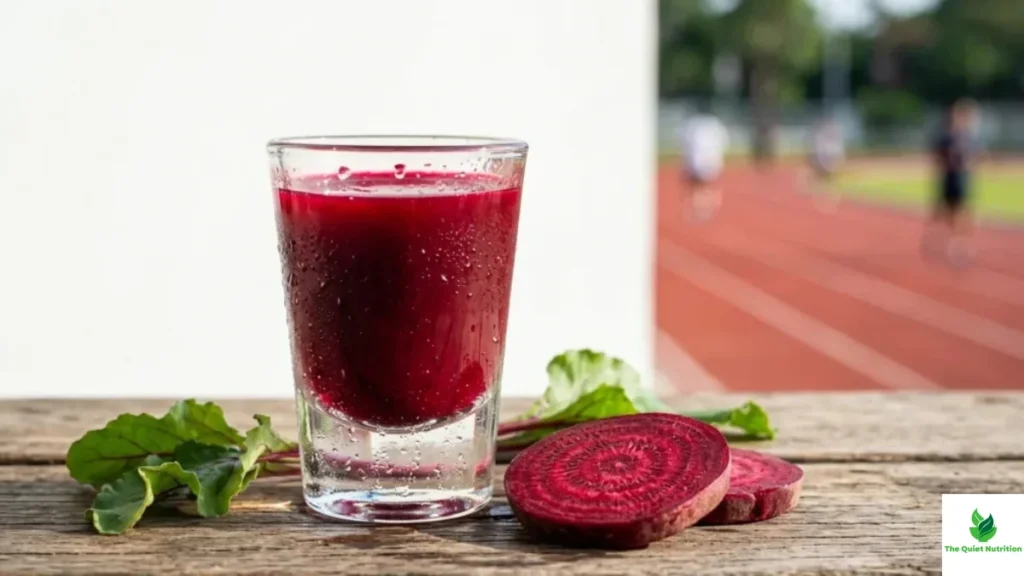
There’s something almost ritualistic about elite athletes in the moments before a big race. The deep breathing. The warm-up laps. The headphones going in. And, increasingly, a small shot glass of something thick, dark, and the color of a bruise.
Beetroot juice.
It doesn’t look glamorous. It doesn’t taste like something you’d order twice by accident. But if you’ve ever wondered why professional cyclists, marathon runners, and even Premier League footballers have added it to their pre-race routine, the answer is rooted in some genuinely fascinating science — and it applies just as much to you, a regular person trying to get through a hard gym session, a long workday, or a 5K on a Saturday morning.
Let’s get into all of it.
Why Beetroot Juice, of All Things?
The story starts in 2009, when researchers at the University of Exeter published a study that genuinely surprised the sports science world. They found that cyclists who drank beetroot juice before exercise could ride significantly longer before exhaustion than those who didn’t. Not marginally longer. Meaningfully longer — around 16% more, at the same effort level.
That’s a big number. In competitive sport, 1% can be the difference between a podium and oblivion.
The researchers weren’t just documenting a curiosity, though. They were chasing a mechanism. And what they found made the whole story even more interesting.
The Real Reason It Works: Nitrate → Nitric Oxide
Beetroot is one of the richest dietary sources of inorganic nitrate (NO₃⁻) on the planet. When you drink beetroot juice, bacteria that naturally live on your tongue and in your gut convert that nitrate first into nitrite (NO₂⁻), and then — inside your blood and muscle tissue — into nitric oxide (NO).
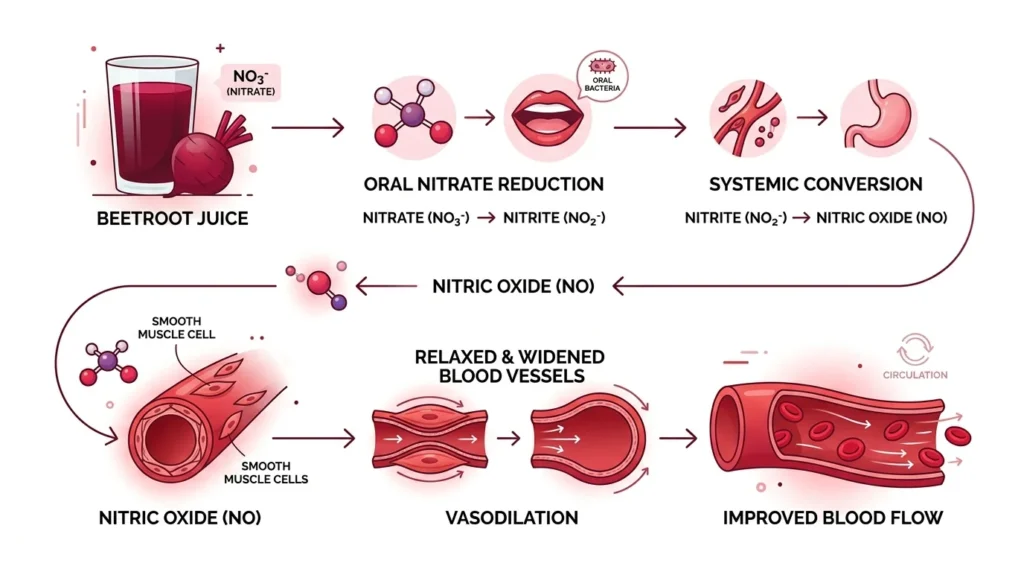
And nitric oxide? It is, without exaggeration, one of the most important molecules in the human body.
Nitric oxide is a gas that signals the smooth muscle cells lining your blood vessels to relax. When they relax, your vessels dilate. When your vessels dilate, more blood flows through them — carrying more oxygen and nutrients to the muscles that need them, faster.
But that’s just the beginning.
Research published in the Journal of Applied Physiology found that dietary nitrate from beetroot juice actually reduces the oxygen cost of exercise. Your muscles essentially become more efficient at using the oxygen they receive. You do the same amount of work for less energy expenditure. In physiological terms, your VO₂ — the volume of oxygen your body needs — drops. You get more output per breath.
For an athlete, that is everything.
What Happens Inside the Muscle
Dig a little deeper and the picture gets richer. During high-intensity exercise, your muscles rely on two types of fibers: slow-twitch fibers (efficient, built for endurance) and fast-twitch fibers (powerful, built for speed, but expensive in oxygen).
Nitric oxide appears to target fast-twitch fibers in particular. Research from Maastricht University found that beetroot supplementation improved performance specifically during high-intensity, short-burst efforts — exactly the kind of explosive power that fast-twitch fibers generate. This is why you’ll see its use not just in long-distance runners, but in sprinters, rowers, and team sport athletes who need repeated short bursts of maximum effort.
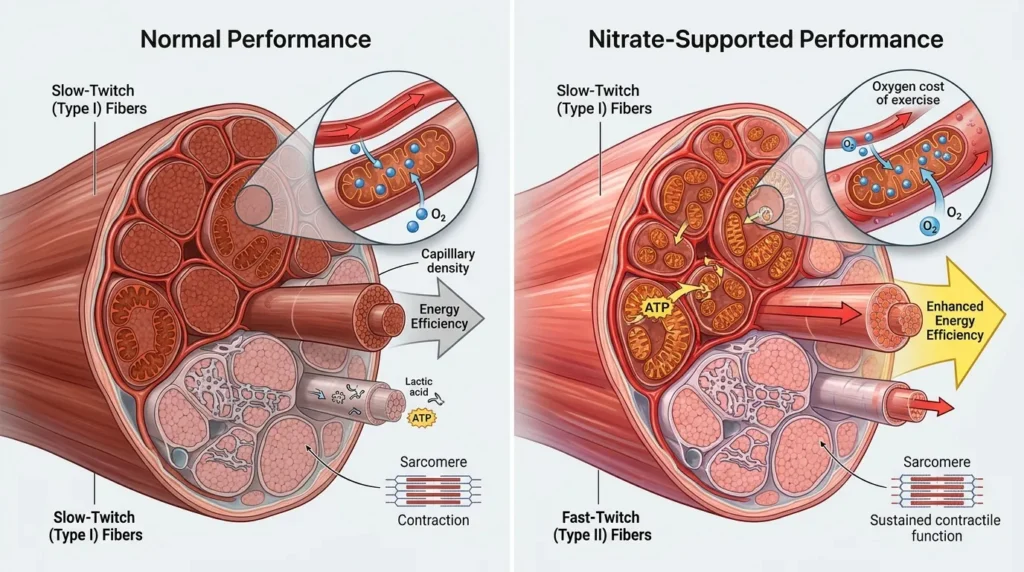
There’s also a mitochondrial angle. Some researchers believe dietary nitrate improves the efficiency of the mitochondria — the tiny energy factories inside every cell. The mitochondria essentially “waste” less energy as heat when nitric oxide is present. More of the fuel you put in actually gets converted to mechanical movement.
Think of it like a car engine that suddenly becomes 10% more fuel efficient. You don’t change the fuel. You change what happens to it.
The Timing That Actually Matters
Here’s something most people don’t know: gulping beetroot juice thirty seconds before a race doesn’t really do much. The nitrate-to-nitric oxide conversion takes time.
Most studies point to a peak performance window of around 2 to 3 hours post-consumption. Athletes who drink their beetroot shot the night before, or who load with smaller amounts across multiple days, tend to see even more consistent results. Some research suggests that 5–6 days of daily supplementation with approximately 300–400mg of dietary nitrate (which is roughly 70–140ml of a concentrated beetroot shot) produces the most robust improvements.
This matters practically. The athletes you see pounding shots before a race have usually already been loading for days. The pre-race ritual is more habit than strategy, though it certainly doesn’t hurt.
What the Research Actually Says About Performance Gains
Let’s be specific, because this matters.
A 2017 meta-analysis published in the European Journal of Sport Science reviewed 33 clinical trials on dietary nitrate and exercise. The consensus? Beetroot juice supplementation was associated with measurable improvements in time-to-exhaustion and time-trial performance, particularly in recreational to moderately trained athletes.
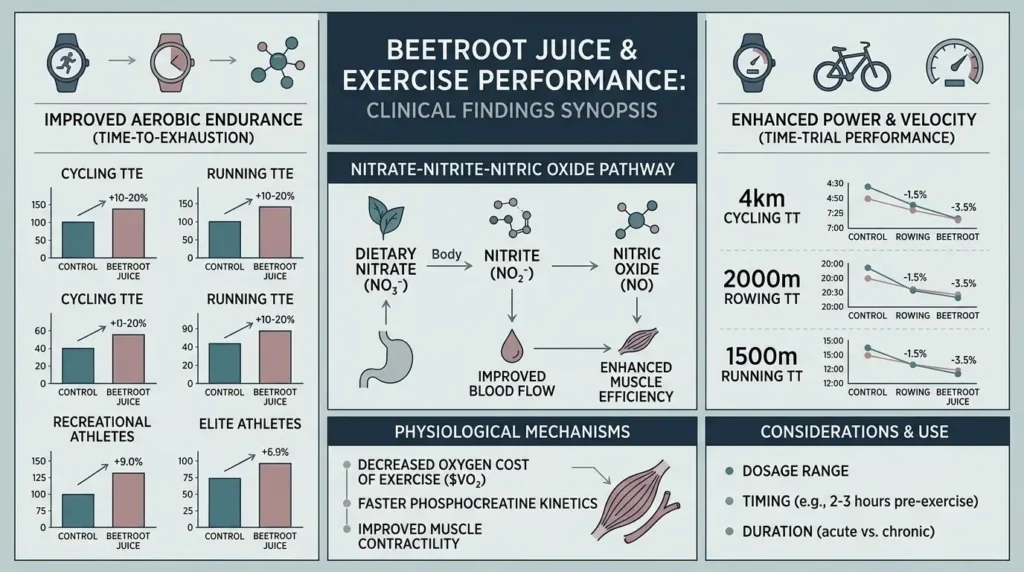
Crucially, the effects were most pronounced in people who weren’t already elite. The fitter you are, the more efficient your cardiovascular system already is — so the marginal benefit from nitric oxide is smaller. For someone who’s moderately active, hasn’t been training for years at a high level, or is simply trying to exercise more effectively, beetroot juice can offer a genuine and meaningful performance lift.
And unlike many sports supplements, its safety profile is excellent. It’s a vegetable. It contains natural compounds. The side effects are mostly limited to a harmless reddish coloration of urine and stools — which, the first time it happens without warning, can be alarming.
So What Does It Actually Do for Regular People?

This is the part of the beetroot story that gets far less attention than it deserves.
You don’t need to be lining up at a starting gun to benefit from the nitric oxide pathway. The same vasodilation that helps a cyclist on a mountain stage also has significant implications for everyday cardiovascular health — and there’s real science behind this.
Blood pressure. Multiple studies, including a well-known trial published in Hypertension by researchers at Queen Mary University of London, found that people with high blood pressure who drank one cup of beetroot juice daily saw a reduction in systolic blood pressure of around 7–10 mmHg over four weeks. For context, that’s comparable to some pharmaceutical interventions. The nitric oxide-mediated relaxation of blood vessel walls reduces the force your heart has to pump against.
Brain blood flow. Your brain is arguably the most demanding organ in your body when it comes to blood supply — it consumes about 20% of your total oxygen despite being only 2% of your mass. A study from Wake Forest University found that older adults who consumed a high-nitrate diet showed increased blood flow to the frontal lobe — the part of the brain responsible for decision-making, focus, and working memory. The implication? Beetroot juice could support cognitive function, especially as we age and cerebrovascular efficiency naturally declines.
Exercise tolerance in everyday life. One particularly compelling study looked at people with heart failure — individuals whose ability to exercise is severely limited by cardiovascular inefficiency. Even in this clinical population, beetroot juice improved the distance they could walk in a six-minute test. If it can help people with compromised hearts do more, the potential for healthy adults with busy lives — who find themselves winded on stairs or tired halfway through a gym session — is worth taking seriously.
Beetroot’s Other Nutritional Tricks
Beyond the nitrate-nitric oxide mechanism, beetroot is quietly loaded with other compounds that work in the background of your health.
Betalains are the pigments that give beetroot its dramatic red-purple color. They’re also potent antioxidants and anti-inflammatory compounds. Chronic low-grade inflammation is increasingly linked to everything from cardiovascular disease to cognitive decline to poor recovery from exercise. Regular betalain intake contributes meaningfully to keeping that inflammatory load in check.
Folate (Vitamin B9) is abundant in beets. Folate is critical for DNA synthesis and repair, and it plays a central role in converting homocysteine — an amino acid associated with cardiovascular risk at high levels — into harmless methionine.
Potassium is present in useful amounts and supports healthy blood pressure in the same way reduced sodium does: by helping your kidneys excrete excess fluid and relaxing blood vessel walls. The connection between potassium-rich plant foods and heart health is one of the most consistent findings in nutrition science — something explored in depth in the work on how daily food choices quietly shape your long-term health.
Fiber is present in whole beetroot (though largely removed in juice). Fiber feeds gut bacteria, supports healthy digestion, and helps regulate blood sugar. If you eat whole beets rather than drinking the juice, you get all of this as a bonus.
Should You Eat Whole Beets or Drink the Juice?
Good question, and the answer depends on what you want.
For exercise performance, concentrated beetroot juice or a standardized shot is more practical — the research doses are based on specific nitrate concentrations, and eating that amount of whole beetroot in one sitting would be both difficult and a significant digestive event. Many sports nutrition brands now offer concentrated beetroot shots with standardized nitrate levels, which makes dosing much more predictable than guessing from whole vegetables.
For general health, whole beetroot is excellent and comes with the fiber bonus that juice lacks. Roasted, raw in salads, or blended into a smoothie — all fine options. The cooking process does slightly reduce nitrate content, but the difference is modest enough not to worry about unless you’re chasing a specific performance outcome.

One thing worth knowing: nitrate is absorbed through your tongue bacteria, so using antibacterial mouthwash just before or after drinking beetroot juice essentially destroys the bacteria that convert nitrate to nitrite. Studies have shown that people who rinse with antibacterial mouthwash after drinking beetroot juice see significantly blunted performance effects. It sounds almost absurdly specific, but it’s true — and it’s a reminder of how interconnected the oral microbiome is with the rest of your body’s chemistry.
The Bigger Picture: Natural Foods That Perform Like This
What makes beetroot juice compelling isn’t just the outcome — it’s the mechanism. A humble vegetable outperforming many synthetic supplements in controlled clinical trials, through a completely natural pathway that exists in your own body.
It sits alongside other high-nitrate vegetables — like spinach, rocket (arugula), celery, and lettuce — that have similar effects on the nitric oxide pathway, though usually at lower concentrations. The idea that spinach is more powerful than most people think isn’t just health-media hyperbole — in the context of dietary nitrate, dark leafy greens genuinely do things that contribute to vascular health in measurable ways.
Similarly, the flavonoids in foods like watermelon — which contains citrulline, another precursor to nitric oxide — follow a related pathway. It’s why watermelon isn’t just water and why there’s growing sports nutrition research around watermelon juice as a complementary pre-exercise drink. Nature, it turns out, has more than one route to better blood flow.
What About Beetroot Supplements vs. Real Juice?
The supplement market has responded enthusiastically to the research on beetroot, producing capsules, powders, and concentrated shots in every price range. The key variable to watch is nitrate content.
Many supplements are poorly standardized. A capsule labeled “beetroot extract” may contain insignificant amounts of actual nitrate. Look for products that specify nitrate content per serving (ideally 300–400mg for a pre-exercise dose) rather than just listing beetroot powder by weight.
Concentrated shots from brands that use cold-pressed juice and publish their nitrate content are generally more reliable than dry capsule forms. Palatability is also worth mentioning: concentrated beetroot shots taste… earthy. Aggressively so. The good news is that slightly diluted, mixed with a splash of apple juice or lemon, the experience becomes much more manageable.
Practical Takeaways
If you’re an active person who wants to actually use this information, here’s the condensed version:
For exercise performance, try 70–140ml of concentrated beetroot juice 2–3 hours before a hard session. If you can load for several days beforehand, even better. Don’t use antibacterial mouthwash in that window.
For daily cardiovascular support, a smaller daily amount — even 70ml of juice, or a portion of whole beets with meals several times a week — fits naturally into a food-first approach to heart and vascular health. There’s no need to make it complicated.
For brain health and mental sharpness — especially if you’re over 45, when cerebrovascular efficiency naturally begins to decline — the case for regular dietary nitrate from beets, leafy greens, and similar sources is growing more compelling every year.
None of this requires expensive regimens or dramatic lifestyle changes. It’s a vegetable. One that happens to have a surprisingly elegant, well-studied mechanism — and one that your blood vessels respond to in ways that a morning pill can’t replicate.
A Note on Caution
A few practical caveats.
People who take medication for low blood pressure should speak with their doctor before adding regular beetroot juice to their diet, as the additive blood pressure-lowering effect can be significant. Similarly, those with kidney stones who have been advised to limit dietary oxalate should know that beetroot is moderately high in oxalates. And people managing blood sugar closely should note that beetroot has a moderately high glycemic index — though a relatively low glycemic load in typical serving sizes.
None of these are dealbreakers for most people. They’re reasons to be informed, not afraid.
The Bottom Line
Athletes drink beetroot juice before a race because it genuinely works — not through caffeine stimulation or adrenaline tricks, but by improving how efficiently your body delivers and uses oxygen at the cellular level. That’s not a marketing claim. It’s documented in dozens of peer-reviewed trials and backed by a clear physiological pathway.
But the story doesn’t start and end at the finish line.
The same mechanism that helps a cyclist push harder up a mountain also helps a middle-aged person keep their blood pressure in a safer range, supports blood flow to an aging brain, and makes any physical effort — whether it’s a morning run or carrying groceries up three flights of stairs — a little more sustainable.
It’s a deeply unsexy vegetable that does something remarkable. And in a nutrition landscape full of noise and overpromised supplements, there’s something genuinely satisfying about that.
Sources & Further Reading:
- Dietary inorganic nitrate improves mitochondrial efficiency in humans — Cell Metabolism, 2011
- Beetroot juice and exercise performance: University of Exeter, 2009 — Journal of Applied Physiology
- Dietary nitrate and blood pressure: Queen Mary University of London — Hypertension, 2015
- Beetroot juice and brain blood flow in older adults — Wake Forest University
- Nitrate supplementation and high-intensity exercise meta-analysis — European Journal of Sport Science, 2017

Aarti Solanki, B.Sc. (Food Science), is a food science writer passionate about making nutrition simple and evidence-based. She creates well-researched, easy-to-understand articles on healthy eating, food science, and nutrition, using information from trusted scientific and public health sources.