You’ve probably stood in the produce aisle at some point, eyeing both options and quietly wondering — does it actually matter which one I grab?
They’re both potatoes. They both go in the oven. They’re both affordable, versatile, and filling. So what’s the big deal?
Here’s the truth: while sweet potatoes and regular potatoes share more than their name, the nutritional gap between them is genuinely surprising — and for certain health goals, choosing one over the other can make a real, measurable difference.
Let’s break it all down, clearly and honestly.
First, Let’s Talk About What They Have in Common
Before we pit them against each other, it’s worth recognizing that both sweet potatoes and regular (white) potatoes are whole, minimally processed foods. That alone puts them head and shoulders above most packaged alternatives.
Both provide:
- Complex carbohydrates for sustained energy
- Dietary fiber to support digestion and satiety
- Potassium, a mineral most people don’t get nearly enough of
- Vitamin C, which supports immunity and skin health
- Naturally low fat content
In fact, a medium white potato with the skin contains roughly 161 calories, 4 grams of fiber, and an impressive 897 mg of potassium — more than a banana. So no, regular potatoes are not the nutritional villains they’re sometimes made out to be.
But sweet potatoes? They bring something meaningfully extra to the table.
The Numbers Side by Side
Here’s a straightforward comparison for a medium-sized serving (approximately 130g):
| Nutrient | White Potato | Sweet Potato |
|---|---|---|
| Calories | ~130 | ~112 |
| Carbohydrates | 30g | 26g |
| Fiber | 2.5g | 3.8g |
| Protein | 3g | 2g |
| Vitamin A | <1% DV | 122% DV |
| Vitamin C | 28% DV | 22% DV |
| Potassium | 620mg | 438mg |
| Manganese | 14% DV | 30% DV |
| Glycemic Index | ~70–80 | ~44–70 |
(Source: USDA FoodData Central)
At first glance, they look fairly similar. But the win — and the gap — is in the details.
The Vitamin A Advantage Is Almost Unfair
This is where sweet potatoes genuinely dominate.
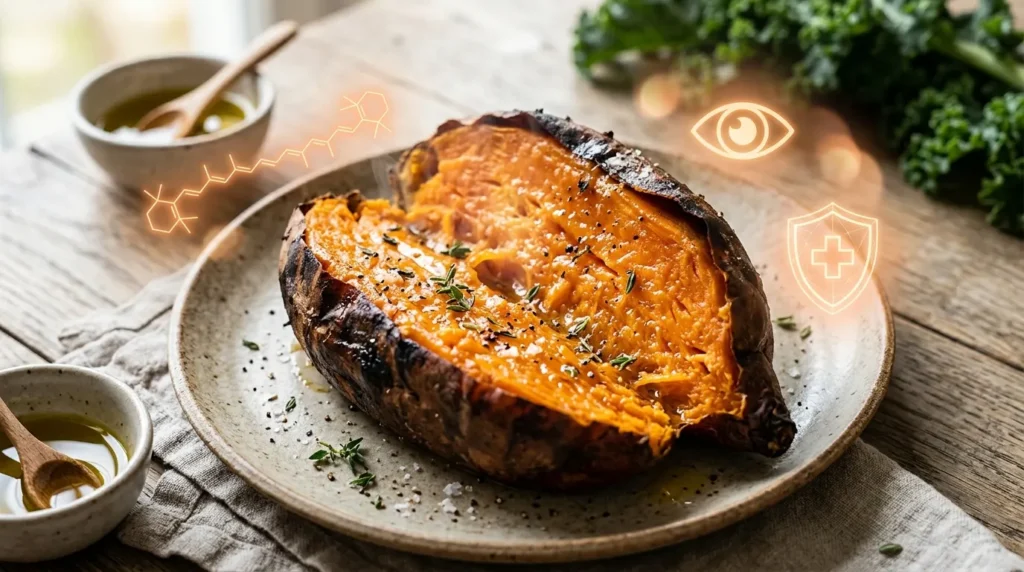
One medium sweet potato delivers over 120% of your daily recommended intake of Vitamin A, almost entirely in the form of beta-carotene — the same powerful antioxidant that gives sweet potatoes their deep orange color.
White potatoes? Virtually none.
Beta-carotene is a fat-soluble precursor to Vitamin A that your body converts as needed. It plays a critical role in eye health and vision, immune system strength, and cellular protection against free radical damage. It’s the same reason that carrots — another deeply orange vegetable — are so frequently studied for their effect on long-term vision and skin quality. Just as eating carrots every day quietly supports your eyes, skin, and immunity, sweet potatoes work through the same beta-carotene pathway to deliver those benefits at the dinner table.
Glycemic Index: A Difference That Actually Matters
The glycemic index (GI) measures how quickly a food raises blood sugar after eating. Lower is generally better for sustained energy and stable focus.
- White potatoes tend to have a GI of 70–80, placing them in the high range
- Sweet potatoes typically fall around 44–70, depending on preparation
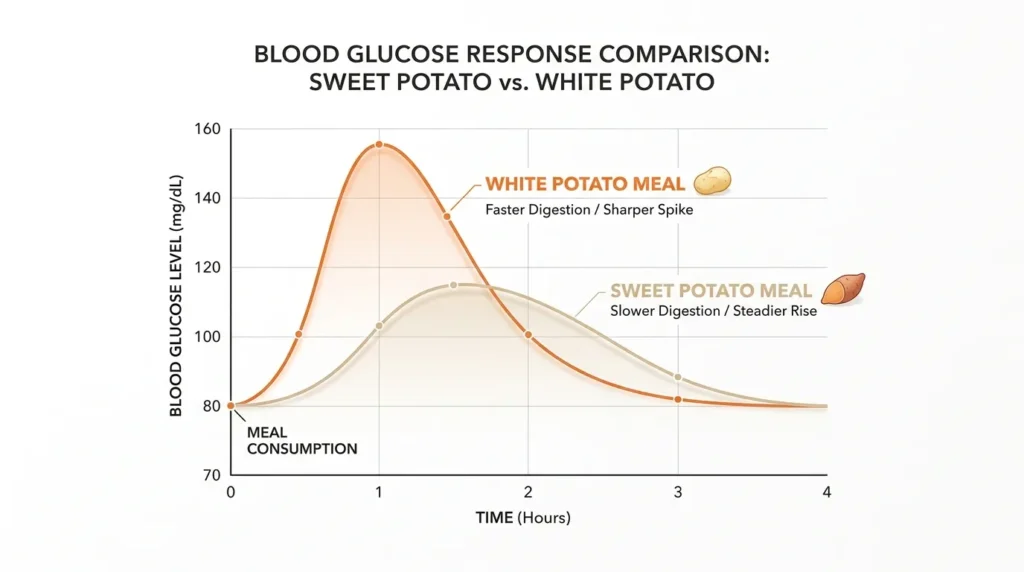
That gap has real consequences. When blood sugar spikes sharply, it crashes just as fast — leading to the familiar afternoon energy dip, sudden hunger, and difficulty staying focused. Your brain is especially sensitive to this instability. In fact, the reason your brain hates sugar spikes and craves steady fuel instead comes down to how glucose fluctuations disrupt neurotransmitter balance and cognitive performance throughout the day.
It’s also worth noting that cooking method significantly affects GI. Boiling a white potato lowers its index considerably compared to baking. Cooling cooked potatoes before eating increases resistant starch, which slows digestion further. So preparation matters — but as a starting point, sweet potatoes offer more natural blood sugar stability.
Fiber: A Small Gap with Meaningful Impact
Both are decent fiber sources, but sweet potatoes provide slightly more per serving — about 3.8g versus 2.5g in a comparable portion of white potato.
That difference accumulates meaningfully over time. Dietary fiber supports digestion, helps manage cholesterol, keeps you fuller for longer, and feeds the beneficial bacteria in your gut. According to research published in The Lancet, higher fiber intake is consistently associated with lower rates of colorectal cancer, heart disease, and type 2 diabetes.
Fiber is also one of the key reasons that whole foods like sweet potatoes work so differently from their processed counterparts. When a food is stripped of its fiber — turned into chips, instant mash, or packaged snacks — it loses the very quality that slows digestion and stabilizes energy. That transformation is exactly why food labels can highlight what sells rather than what truly nourishes you — the original whole food and the packaged version look similar on paper but behave very differently in your body.

Antioxidants: Two Different Profiles, Both Valuable
This is nuanced — and worth understanding rather than oversimplifying.
Sweet potatoes are extraordinarily rich in beta-carotene and carotenoids. Orange-fleshed varieties contain some of the highest provitamin A levels of any commonly eaten food.
White potatoes aren’t antioxidant-poor either — they contain chlorogenic acid and other phenolic compounds, particularly concentrated in the skin. Purple potato varieties can rival berries in antioxidant capacity, though they’re far less common.
The practical point? Their antioxidant profiles are different, not simply better or worse. But for the specific category of carotenoid antioxidants — linked to eye health, skin quality, and cellular protection — sweet potatoes are in a league of their own.
This matters especially when you consider that antioxidants don’t work in isolation. Foods like tomatoes, which deliver lycopene and other protective compounds daily, work through different pathways than beta-carotene — which is exactly why dietary variety across colorful vegetables tends to offer broader protection than any single food alone.
Potassium: Where White Potatoes Actually Win
Here’s where regular potatoes earn a well-deserved point.
A medium white potato contains roughly 620mg of potassium, compared to around 438mg in a sweet potato. Both contribute meaningfully toward the recommended 2,600–3,400mg daily, but white potatoes are genuinely impressive here — one of the best potassium sources in the entire produce section.
Potassium regulates blood pressure, supports nerve signaling, and maintains the fluid balance that keeps your cells functioning efficiently. Most adults are chronically under-consuming it — largely because processed foods that dominate modern diets contain almost none of it. Choosing whole potatoes over packaged snacks, even occasionally, quietly corrects a gap that many people don’t realize they have. This is part of a broader truth: the small food habits that seem minor are often the ones that shape long-term health more than any single dramatic change.

Does Preparation Change Everything?
Yes — dramatically.
Both potatoes can be made far healthier or significantly less healthy depending entirely on how you prepare them. This is one of the most underappreciated aspects of potato nutrition.
Preparations that preserve their benefits:
- Baked or roasted with minimal oil
- Boiled with the skin on
- Steamed and lightly seasoned
- Added to soups, stews, or grain bowls
Preparations that undermine their value:
- Deep frying (dramatically increases calorie and fat content)
- Loading with heavy cream, butter, or excess salt
- Processed forms — crisps, instant mash, frozen fries

A baked sweet potato with a little olive oil and a pinch of sea salt is one of the most nutrient-dense, satisfying meals you can eat for under 150 calories. A bag of potato chips? It barely resembles its source food in any meaningful nutritional way — and yet the packaging often makes both sound equally wholesome. That gap between reality and label perception is something worth staying alert to, because food packaging is specifically designed to create the illusion of clean ingredients even when the processing tells a very different story.
Calories, Weight, and the Bigger Picture
If you’re keeping an eye on calorie intake, sweet potatoes have a modest edge — roughly 112 calories compared to 130 in a similar serving of white potato.
But the calorie difference alone isn’t the most important factor. What matters more is nutritional density relative to calories — and by that measure, sweet potatoes deliver more beta-carotene, more fiber, and better blood sugar stability per calorie eaten.
That said, both potatoes are low in fat, satisfying, and meaningfully more nourishing than most convenience foods. The real issue isn’t choosing between two whole vegetables — it’s understanding that nutrition works through patterns, not individual meals. As the science consistently shows, your body never forgets what you eat — nutritional memory shapes how you feel and function over time, and the cumulative effect of eating whole foods consistently is far more powerful than any short-term swap.
Who Should Favor Which?
Lean toward sweet potatoes if you:
- Want to significantly boost Vitamin A and beta-carotene intake
- Are managing blood sugar, insulin sensitivity, or energy stability
- Have concerns around eye health or immune function
- Prefer a slightly lower-calorie, higher-antioxidant option
Don’t overlook white potatoes if you:
- Need a potassium-rich food for cardiovascular or nerve health
- Are an athlete or highly active person needing rapid glycogen replenishment
- Want a budget-friendly, widely available whole food
- Prefer a neutral flavor that works in savory dishes
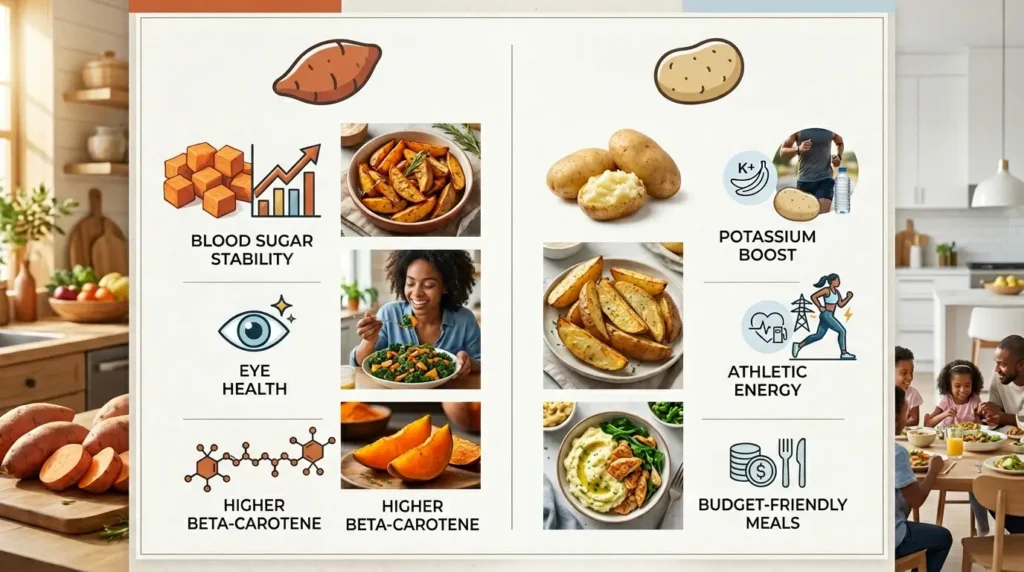
And here’s the most practical answer of all: you don’t need to choose just one. Alternating between them throughout the week gives you access to both profiles — the carotenoid richness of sweet potatoes and the potassium density of white ones. Dietary variety, not dietary perfection, is the foundation of long-term nourishment.
The Bottom Line
Sweet potatoes and regular potatoes are both genuinely good whole foods. If you had to award the nutritional edge to one, sweet potatoes earn it — primarily because of their extraordinary beta-carotene content, better glycemic stability, and slightly higher fiber per serving.
But white potatoes hold their own with superior potassium content, broader culinary versatility, and no shortage of beneficial compounds — especially when eaten with the skin and prepared simply.
The smartest approach? Rotate between them. Cook them whole. Keep the skin on. Pair them with other colorful vegetables, healthy fats to maximize fat-soluble vitamin absorption, and lean protein to round out the meal.
Neither potato deserves the bad reputation the diet industry has given it. Both are far better for you than almost anything that comes in a bag with a health claim printed on the front.
References & Sources:
- USDA FoodData Central – Sweet Potato
- USDA FoodData Central – White Potato
- The Lancet – Dietary Fiber and Human Health
- Harvard T.H. Chan School of Public Health – Potatoes
- NIH Office of Dietary Supplements – Vitamin A & Beta-Carotene

Aarti Solanki, B.Sc. (Food Science), is a food science writer passionate about making nutrition simple and evidence-based. She creates well-researched, easy-to-understand articles on healthy eating, food science, and nutrition, using information from trusted scientific and public health sources.