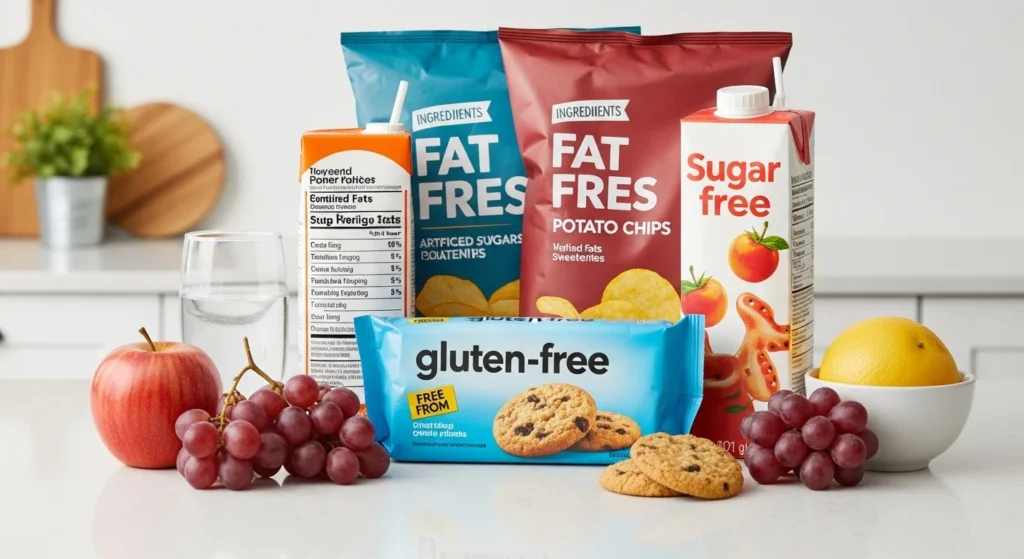
The Grocery Store Whisper That Shapes Your Choices
Pick up almost any packaged food today and you’ll notice something strange.
The loudest words on the front aren’t about what’s inside.
They’re about what’s not.
No sugar.
Fat-free.
Gluten-free.
No preservatives.
Zero guilt.
It feels reassuring, doesn’t it?
Like the food is doing you a favor.
But here’s the uncomfortable truth:
Food labels rarely emphasize what’s missing because it’s nutritionally important…
They do it because it’s psychologically powerful.
And once you see why, you’ll never look at packaging the same way again.
The “Free-From” Era: How Modern Labels Learned to Speak Fear
Food labeling didn’t always look like this.
Decades ago, packaging focused on:
- Taste
- Convenience
- Brand identity
Now it focuses on removal.
This shift happened because consumers became more health-conscious…
And food companies became more marketing-conscious.
When people started fearing ingredients like:
- Sugar
- Fat
- Carbs
- Gluten
- Additives
Labels adapted quickly.
Instead of saying:
“This is deeply nourishing.”
They began saying:
“This is safe because something is missing.”
Fear sells faster than nourishment.
The Health Halo Effect: The Psychology Behind What’s Missing
One of the strongest forces in food marketing is something behavioral scientists call:
The Health Halo Effect
When a label highlights one “good” feature, people assume the entire product is healthy.
For example:
- “Low fat” makes cookies seem better
- “Sugar-free” makes soda seem harmless
- “Gluten-free” makes snacks feel cleaner
Even when the product is still highly processed.
That single missing ingredient creates a halo.
And the brain fills in the rest:
“This must be a smart choice.”
But nutrition isn’t about absence.
It’s about overall quality.
Why “Missing” Claims Are Easier Than Real Nutrition
Here’s what food companies understand:
It’s hard to prove a food is truly nourishing.
But it’s easy to remove something and advertise it.
It’s easier to say:
- No sugar
Than to say: - Naturally balanced for long-term metabolic health
It’s easier to say:
- Low fat
Than to explain: - Contains healthy fats that increase satiety
These claims simplify health into one emotional message:
Less is better.
But nutrition isn’t subtraction.
It’s structure, balance, and context.
Real-Life Example: The Fat-Free Trap
One of the most famous examples is the “fat-free” craze.
People were taught:
Fat is bad → fat-free is good.
So companies removed fat…
And added sugar and starch to keep foods palatable.
Fat-free snacks often became:
- Higher glycemic
- Less filling
- More addictive to eat quickly
Fat wasn’t the enemy.
Ultra-processing was.
But the label didn’t say:
“Highly refined and engineered.”
It said:
“0g fat.”
And that was enough.
Why This Matters Today: The Label Game Is Louder Than Ever
Modern grocery stores are full of foods engineered to look healthier than they are.
This matters because most people aren’t overeating due to laziness…
They’re overwhelmed by messaging.
When every box screams:
- Free from
- Zero
- No
- Without
It creates the feeling that health is about avoiding.
Instead of building a diet based on:
- Whole foods
- Fiber-rich meals
- Natural satiety
- Long-term nourishment
Fear-based labeling keeps people stuck in confusion.
The Hidden Strategy: Labels Distract From Processing
Here’s what’s rarely said:
Many “free-from” foods are still ultra-processed.
A cookie can be:
- Gluten-free
- Sugar-free
- Vegan
And still be:
- Made of refined starch
- Stabilizers
- Industrial seed oils
- Artificial sweeteners
The label becomes the distraction.
It keeps your eyes away from what matters most:
The ingredient list and food structure.
Comparison Table: “Missing” Claims vs Reality
| Label Claim | What It Implies | What It Often Hides | Better Question to Ask |
|---|---|---|---|
| Sugar-Free | Better for health | Artificial sweeteners, ultra-processing | Is it still a whole food? |
| Low Fat | Weight-friendly | Added starch, less satiety | Does it keep me full? |
| Gluten-Free | Cleaner eating | Highly refined gluten-free flours | Is gluten actually the issue? |
| No Preservatives | Natural product | Still processed with additives | How long is the ingredient list? |
| Zero Calories | Guilt-free | Chemical substitutes, appetite disruption | Does it nourish or just trick? |
Common Mistake: Confusing “Free From” With “Good For”
One of the biggest modern nutrition mistakes is thinking:
If something is removed, the food becomes healthier.
But removing one ingredient doesn’t automatically create a nourishing product.
Health is not about the absence of one villain.
It’s about the presence of real food.
A snack isn’t healthy because it lacks sugar…
It’s healthy because it contains:
- Intact fiber
- Natural nutrients
- Minimal processing
- Balanced energy
The label rarely tells that story.
Hidden Tips: How to Read Labels Like an Expert
Here are practical strategies that work immediately.
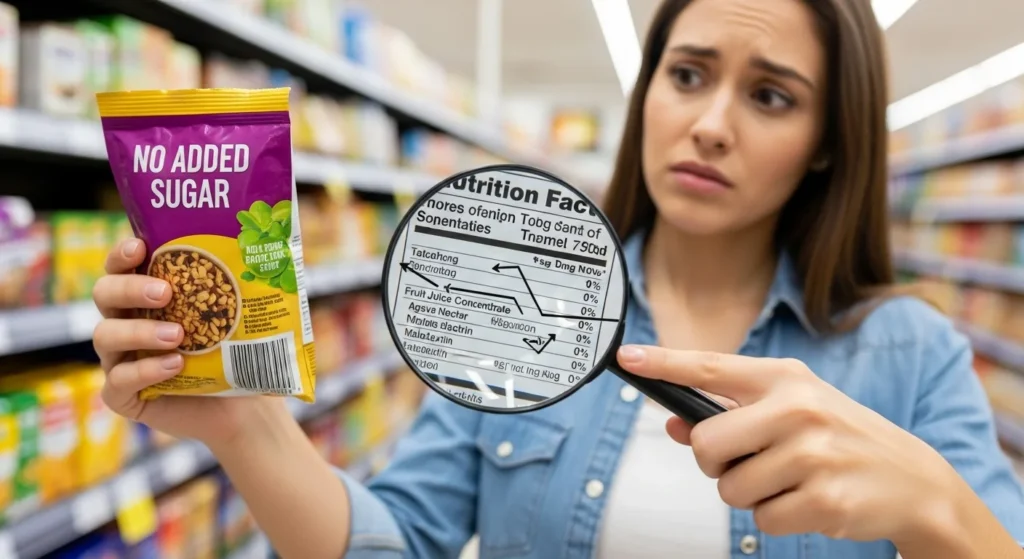
1. Ignore the front of the package first
Always flip it over.
2. Scan the ingredient list length
A good rule:
If it has more than 10–12 ingredients, it’s likely engineered.
3. Watch for replacement ingredients
When something is removed, something replaces it:
- Fat removed → sugar added
- Sugar removed → sweeteners added
- Gluten removed → starches added
4. Look for intact foods inside
Words like:
- Whole oats
- Nuts
- Lentils
- Seeds
Signal structure.
5. Ask the real question: Would this exist in a kitchen?
If not, it’s likely a factory food with a clean label costume.
Actionable Steps: How to Shop Beyond Missing Claims
Here’s a simple grocery mindset shift:
Shop for presence, not absence.
Look for foods rich in:
- Fiber
- Protein from real sources
- Healthy fats
- Whole ingredients
- Natural food structure
Instead of foods proud of what they removed.
A better shopping checklist:
- Choose foods with recognizable ingredients
- Prefer minimally processed staples
- Treat “free-from” snacks as treats, not health foods
- Focus on meals over products
- Remember: the simplest foods are often the most nourishing
Key Takeaways
- Food labels emphasize what’s missing because it triggers emotional trust
- “Free-from” claims create a health halo, not necessarily real health
- Many missing-ingredient foods are still ultra-processed
- Removing sugar, fat, or gluten doesn’t automatically improve food quality
- The best shoppers look past claims and focus on ingredient structure
- True nourishment comes from what food contains, not what it avoids
FAQ: People Also Ask
1. Are “sugar-free” foods always healthier?
Not always. Many replace sugar with artificial sweeteners and still encourage cravings.
2. Why do labels focus so much on “no fat” or “low carb”?
Because fear-based nutrients sell. These claims simplify health into one emotional message.
3. Is gluten-free better for everyone?
No. Gluten-free is essential for celiac disease, but for most people it’s not inherently healthier.
4. How can I tell if a product is truly healthy?
Check the ingredient list, processing level, and whether the food still resembles real ingredients.
5. What matters more than missing claims?
Food structure, whole ingredients, fiber content, and how satisfying the food is long-term.
Clean, Simple Conclusion: The Loudest Labels Aren’t the Truth
Food labels are designed to catch your fear faster than your wisdom.
They shout:
“No sugar!”
“No fat!”
“No guilt!”
But the healthiest foods rarely need to scream.
Real nourishment doesn’t come from what’s missing.
It comes from what’s whole.
So next time you shop, remember:
The front of the package is a story.
The ingredient list is the truth.
And your health is built on presence, not absence.

Pingback: “I Chose the Healthy One”… Or Did I? How Labels Manipulate Your Sense of Control