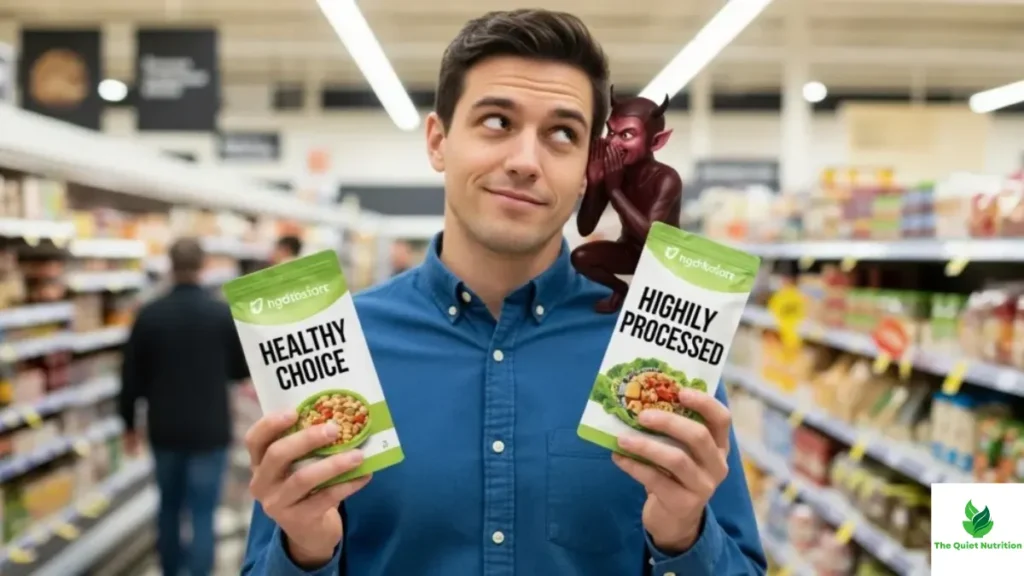
You stand in front of two nearly identical products, pick the one with the reassuring green label, and walk away feeling like you made a smart, deliberate choice. That feeling of control is real — but the decision behind it may have been shaped by your brain’s automatic wiring more than by careful thought. Here’s what neuroscience and behavioral research actually say about what’s happening when a label “helps” you choose.
Your Brain Reacts to Labels Before You Consciously Decide
Brain imaging research has found that food labels don’t just inform your decision — they physically activate it. One neuroimaging study identified that simple, color-coded labels engage the amygdala, a brain region involved in automatic emotional processing, in a way that nudges people toward the labeled “healthy” choice. Researchers describe this as a decision bias: the label doesn’t necessarily add new nutritional knowledge, it triggers an implicit emotional shortcut that steers the choice before deliberate reasoning fully kicks in.
This matters because it means the sense of having “reasoned through” a healthy choice can happen after the fact — your brain settles on the labeled option quickly, and the feeling of control follows the decision rather than driving it.
Color and Framing Change What You See in the Same Product
A separate brain-imaging study using a color-coded label similar to Europe’s Nutri-Score system found that adding a colored frame to a food item significantly changed how healthy and how tasty people rated the exact same product. The color cue activated brain regions tied to reward and value judgment, along with regions involved in cognitive control — meaning the label wasn’t just delivering information, it was actively reshaping how participants’ brains valued the food in real time.
In other words, changing a label’s color changed the felt experience of choosing, without changing anything about the product itself.
Labels Speed Up Decisions More Than They Deepen Them
Research using detailed choice and reaction-time modeling found that salient, color-coded nutrition labels caused people to weigh health information more heavily in their decisions compared to plain numeric labels. That sounds like a win for informed choice — except the same body of research notes this effect can also reflect something simpler: a quick mental cue of “I should choose the healthier item,” rather than genuine engagement with the underlying nutrition facts. The choice gets faster and feels more confident, but that confidence doesn’t necessarily reflect deeper understanding.
Feeling in Control Is a Bigger Predictor of Behavior Than Facts Are
Interestingly, psychological research on healthy eating has found that a person’s perceived behavioral control — how easy or difficult they believe healthy eating to be — is one of the strongest predictors of whether they actually eat healthily, often outweighing pure nutrition knowledge or attitudes toward health. One study found that perceived control and personal identity as a “healthy eater” predicted purchase intentions more strongly than general attitudes about health.
This helps explain why food labels are so effective at shaping decisions: they don’t need to teach you anything new. They just need to make the healthy choice feel easy and confident, which is often enough to drive the behavior regardless of how much label information was actually processed.
The Feeling of Choice Can Mask How Little Was Actually Compared
This combination — automatic emotional response, quick reward-based judgment, and a strong desire to feel in control of your health decisions — creates a powerful illusion. You genuinely feel like you evaluated the product, weighed the alternative, and picked the smarter option. But the underlying research suggests that a well-designed label can produce that same feeling of deliberate choice even when very little actual comparison took place, simply because the label activated the right emotional and reward pathways.
This Isn’t Necessarily a Bad Thing — But It’s Worth Knowing
Researchers studying this effect have noted that these labeling systems can be used deliberately as a public health strategy, sometimes described as “libertarian paternalism” — nudging people toward healthier choices through design rather than forcing the choice outright. Used well, this can genuinely help people eat better without requiring them to become nutrition experts. But the same mechanism that nudges you toward a genuinely healthier item can just as easily be used by a marketer to nudge you toward a product that only looks healthier, since the emotional and reward-based response doesn’t require the underlying nutrition to actually be different.
How to Reclaim the Decision
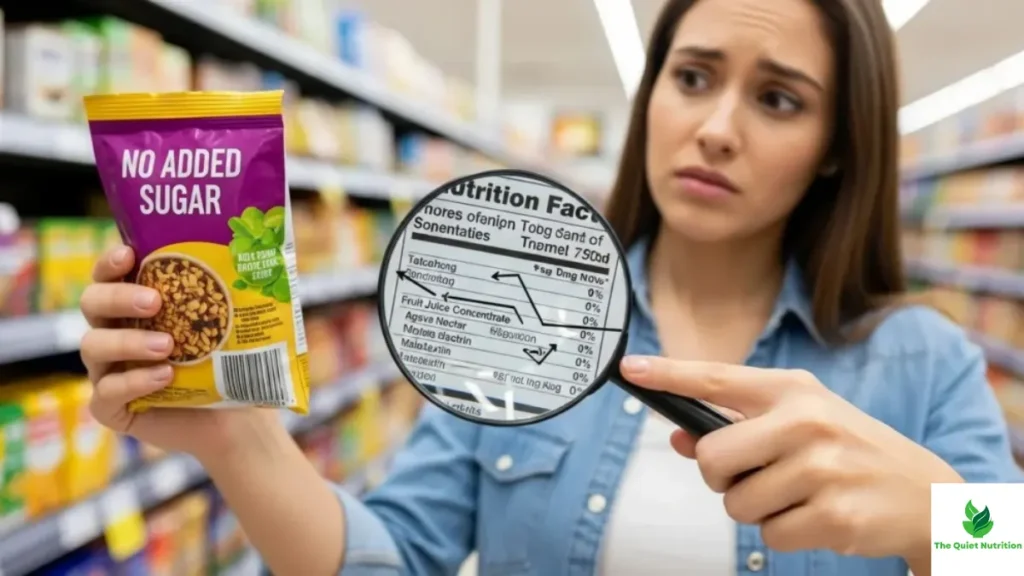
You don’t have to distrust every green checkmark or health claim you see, but it helps to notice the moment: if a decision suddenly feels easy and obvious the instant you spot a label, that’s often the automatic system doing the work, not a considered comparison. Pausing for even a few seconds to check the actual nutrition facts panel re-engages the slower, more deliberate part of decision-making — the part that can tell the difference between a product that’s genuinely better and one that simply looks that way.
The Bottom Line
The sense that “I chose the healthy one” is often real, but it isn’t always earned through careful comparison. Labels are engineered — sometimes for genuine public health benefit, sometimes purely for marketing advantage — to trigger fast, confident, emotionally satisfying choices. Recognizing that gap between feeling in control and actually being in control is the first step toward making label-reading a deliberate habit instead of an automatic reflex.
Sources
- ScienceDirect – Food Labels Promote Healthy Choices by a Decision Bias in the Amygdala
- PMC (NIH) – From Attributes to Value: Neural Correlates of a Front-of-Package Label on Food Decision-Making (fMRI Study)
- Cambridge Core – Salient Nutrition Labels Increase the Integration of Health Attributes in Food Decision-Making
- PMC (NIH) – Food Choice and Nutrition: A Social Psychological Perspective
- PMC (NIH) – Psychological Determinants of Healthy Food Purchase Intention

Aarti Solanki, B.Sc. (Food Science), is a food science writer passionate about making nutrition simple and evidence-based. She creates well-researched, easy-to-understand articles on healthy eating, food science, and nutrition, using information from trusted scientific and public health sources.

Pingback: One Says Low Sugar, One Says High Protein — Why Comparing Food Labels Often Backfires