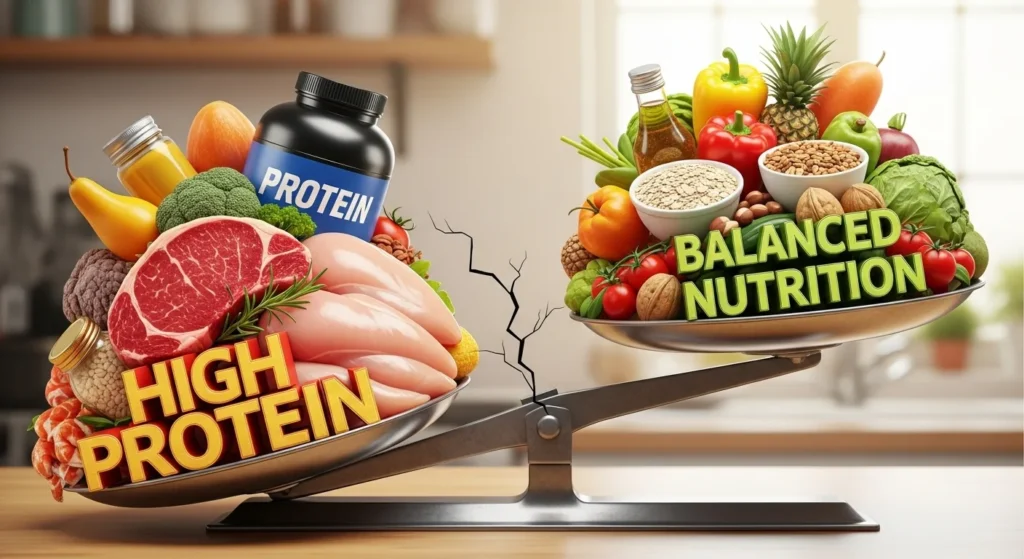
The Claim That Stops You From Reading Further
You’re scanning a shelf.
Your eyes lock onto three words:
“High Protein.”
You feel reassured.
Confident.
Almost finished with the decision.
You don’t check:
- Sugar content
- Fiber levels
- Degree of processing
Because protein already sounds like the answer.
That reaction is exactly why the claim works—and why it can quietly mislead.
How Protein Became the Most Trusted Nutrient
Protein earned its reputation for good reason.
It plays a key role in:
- Muscle repair
- Satiety
- Enzyme and hormone production
Decades of research and public guidance shaped protein as a positive, protective nutrient, reinforced by institutions such as the World Health Organization and dietary frameworks recognized by regulators like the U.S. Food and Drug Administration.
But trust in protein gradually turned into overreliance on protein claims.
Why “High Protein” Feels Like a Complete Solution
Your brain loves clarity.
“High protein” sounds:
- Specific
- Scientific
- Actionable
Balanced nutrition, by contrast, feels:
- Vague
- Complex
- Context-dependent
So the mind shortcuts:
“If it’s high in protein, it must be good for me.”
That shortcut is comforting—but incomplete.
What Balanced Nutrition Actually Means
Balanced nutrition is not about maximizing one nutrient.
It’s about:
- Macronutrient balance (protein, carbohydrates, fats)
- Fiber for digestion and satiety
- Micronutrients from diverse sources
- Food structure and processing level
Protein is a part of that system—not the system itself.
A food can be high in protein and still:
- Spike blood sugar
- Be ultra-processed
- Lack fiber
- Disrupt appetite regulation
Real-Life Example: The Protein Bar Paradox
A typical protein bar might advertise:
- 20–25g protein
- Added vitamins
- Low fat
But also contain:
- Refined syrups or sweeteners
- Minimal fiber
- Highly processed protein isolates
On paper, it looks impressive.
In practice, it may:
- Leave you hungry again quickly
- Act more like a snack than a meal
- Crowd out whole foods
Protein is doing the heavy lifting—while balance is missing.
Why High-Protein Foods Often Ignore Fiber
Here’s a critical mismatch:
Many high-protein packaged foods are low in fiber.
Why that matters:
- Fiber slows digestion
- Fiber supports gut health
- Fiber improves blood sugar stability
Protein without fiber:
- Digests faster
- Feels less satisfying over time
- Encourages grazing
Balanced meals rely on both, not one replacing the other.
The Health Halo Effect of Protein Claims
Protein claims create a powerful health halo.
Once people see “high protein,” they often assume:
- Lower sugar
- Better quality
- Weight-friendly
Even when those assumptions aren’t true.
Research consistently shows that foods with positive health claims are:
- Eaten in larger portions
- Judged less critically
- Associated with higher calorie intake overall
The claim doesn’t change the food.
It changes behavior.
Comparison Table: High Protein vs Balanced Nutrition
| Aspect | High-Protein Focus | Balanced Nutrition |
|---|---|---|
| Primary goal | Maximize protein | Support whole-body function |
| Fiber | Often low | Adequate and intentional |
| Processing | Often high | Usually lower |
| Satiety | Short-term | Sustained |
| Health impact | Narrow | Long-term and systemic |
Protein supports balance—but can’t replace it.
Why Food Companies Love Protein Claims
Protein is:
- Easy to measure
- Easy to market
- Easy to add via isolates
Manufacturers can boost protein without:
- Improving food quality
- Reducing sugar
- Changing processing
That makes “high protein” one of the most efficient marketing upgrades—even when the product itself remains unchanged.
When High Protein Actually Helps
High-protein foods can be useful when:
- Someone has increased needs
- Appetite is low
- Meals are otherwise balanced
They work best within context, not isolation.
Problems arise when:
- Protein replaces meals
- Claims replace judgment
- Balance is forgotten
Common Mistakes People Make With High-Protein Foods
Mistake #1: Treating Protein as a Health Guarantee
Protein doesn’t cancel poor food quality.
Mistake #2: Ignoring Carbohydrate Quality
Not all carbs are the enemy—fiber-rich carbs matter.
Mistake #3: Eating More Because It Feels “Safe”
Health halos encourage overconsumption.
Mistake #4: Building Diets Around Products, Not Meals
Balance happens across meals, not packaging.
How to Use Protein Claims Without Losing Balance
You don’t need to avoid high-protein foods.
You need to put them back in proportion.
Actionable Steps
- Check fiber alongside protein
- Look at ingredient lists, not just macros
- Use protein products as supplements, not foundations
- Prioritize whole protein sources when possible
- Think in meals, not numbers
These habits restore nutritional perspective.
Why This Matters Today (And Long-Term)
Modern diets don’t usually fail from protein deficiency.
They fail from:
- Poor balance
- Over-processing
- Simplified messaging
Protein-focused eating feels productive—but often drifts away from long-term health.
Understanding this helps you:
- Eat more intuitively
- Avoid diet swings
- Build sustainable habits
- Reduce confusion and guilt
Balance isn’t dramatic—but it works.
Key Takeaways
- “High protein” is a partial signal, not a full nutrition assessment
- Protein alone doesn’t guarantee balance, satiety, or quality
- Many high-protein foods lack fiber and context
- Health halos around protein increase overeating
- Balanced nutrition emerges from meals and patterns, not claims
Frequently Asked Questions
1. Is eating high protein unhealthy?
Not inherently—but it shouldn’t crowd out balance.
2. How much protein do most people need?
Needs vary, but most people already meet basic requirements.
3. Are protein bars good meal replacements?
Occasionally, but they rarely replace whole-food meals.
4. Does more protein mean better weight control?
Not without fiber, balance, and consistency.
5. What’s a better focus than protein alone?
Meal structure, fiber intake, and food quality together.
Final Thought
Protein is powerful—but it’s not magic.
When “high protein” becomes the whole story,
nutrition shrinks instead of improving.
Real health isn’t built by chasing one nutrient.
It’s built by balance—quietly, consistently, and over time.
Disclaimer: This article is for general educational purposes and does not replace personalized nutrition or medical advice.

Pingback: How Food Labels Quietly Shape Your Expectations — And Why Your Brain Believes Them Before You Take a Bite
Pingback: How Food Labels Emphasize Positives, Not Balance — The Nutrition Story You’re Rarely Told
Pingback: Why Nutrition Claims Focus on Single Nutrients — And Why That’s Rarely the Full Health Story