
Think about the last time you felt genuinely “off” — foggy, irritable, crashing by 3 p.m. for no clear reason. Most people chase that feeling back to sleep, stress, or a bug going around. Rarely does anyone connect it to what they ate two days earlier. And that’s a little strange, because food is arguably the single biggest lever your body has for staying predictable in the first place.
Predictability isn’t a glamorous word. It doesn’t sound like a health goal anyone puts on a vision board. But underneath every “good day” — steady energy, stable mood, a brain that focuses when you ask it to — is a body that’s managing to keep its internal environment remarkably consistent. Nutrition is one of the main tools it uses to do that.
Your Body Fights to Stay the Same, Not to Change
There’s a concept in physiology called homeostasis — the body’s constant effort to keep internal conditions within a narrow, stable range no matter what’s happening outside. Temperature, blood pH, hydration, and blood sugar all get defended fiercely, because even small swings outside the safe zone can disrupt how cells function.
Your body’s ability to maintain a steady state in blood glucose concentration is called homeostasis, and it’s a critical part of normal physiology — if glucose drops too low, cells (especially in the brain) start to struggle, and if it climbs too high, it can damage tissue over time. Two hormones, insulin and glucagon, are produced by the pancreas and released in response to shifts in blood glucose, working continuously to keep that number in range.
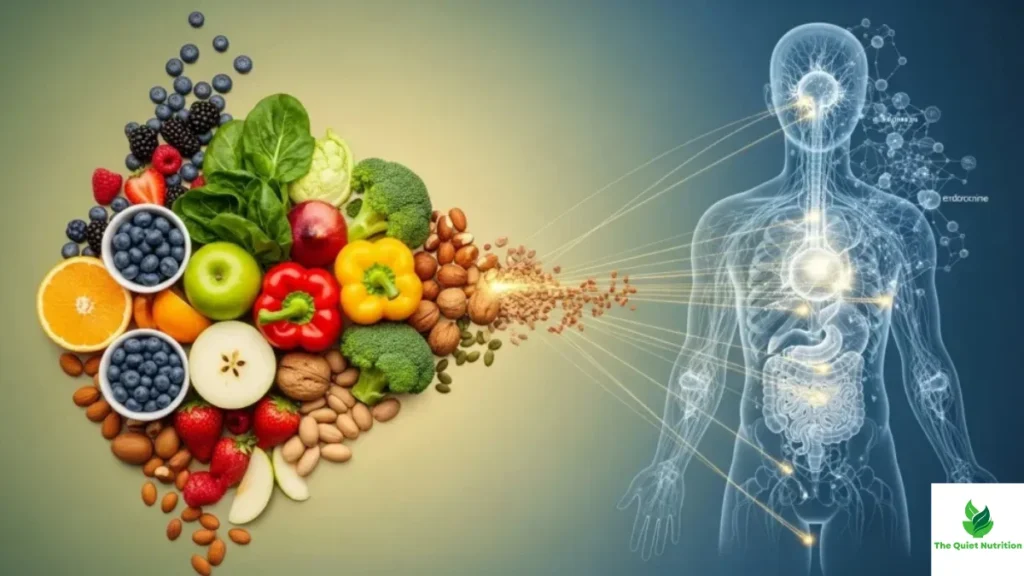
What’s easy to miss is how much of this system is a direct response to food. Every time you eat, you’re handing your body raw material it has to process, sort, and stabilize almost immediately. Eat in a way that makes that job easy, and the whole system runs smoothly in the background. Eat in a way that makes it hard, and you feel the turbulence — even if you can’t name why.
Why Some Days Feel Steady and Others Feel Chaotic
Ever notice how a meal heavy in refined carbs and sugar leaves you energized for twenty minutes and drained an hour later? That’s not random. Complex carbohydrates break down slowly and provide a steady source of energy without causing sharp blood sugar spikes, while simple carbs like white bread and sugary snacks are absorbed rapidly and lead to glucose surges. The fast spike is often followed by an equally fast drop — and that drop is what shows up as the crash, the sudden hunger, or the irritability that seems to come out of nowhere.
Meal timing plays a role too. Eating smaller, balanced meals at regular intervals helps prevent drastic drops or spikes in glucose, while skipping meals or eating large portions infrequently can lead to blood sugar imbalances. In other words, chaos in your eating schedule tends to show up as chaos in how you feel — not immediately, but reliably.
Protein has a stabilizing role that’s easy to underestimate. Research suggests that higher protein intake at a meal can have a stabilizing effect on blood glucose right after eating, and eating protein consistently across meals and snacks creates more stable blood glucose levels over the whole day. This is part of why a breakfast built around eggs or yogurt tends to keep people steadier through the morning than one built around cereal alone.
What Happens When the System Gets Pushed Too Far, Too Often
Homeostasis is resilient, but it isn’t infinite. Repeated stress on any regulatory system — especially glucose regulation — can wear down its ability to bounce back quickly.
>When carbohydrate-heavy meals are eaten frequently, insulin secretion stays constantly elevated, and over time the body can become resistant to that insulin, resulting in chronically elevated blood sugar. The body responds by producing even more insulin to achieve the same effect, which deepens the resistance further — a feedback loop that gradually erodes the very stability the system was built to protect.
This is the mechanical reason why “eating badly for years” and “eating badly for one week” produce such different outcomes. A single disruption gets absorbed and corrected. Constant disruption eventually changes the baseline itself, making the body’s normal state less stable than it used to be.
Predictability Is the Actual Reward
It’s worth reframing what “healthy eating” is really buying you. It’s not a dramatic transformation or a number on a scale — it’s a nervous system, a metabolism, and a mood that behave consistently, day after day, because you’re not constantly forcing your body to overcorrect.
A body that isn’t lurching between glucose spikes and crashes has more stable energy. A gut that isn’t constantly inflamed has more consistent digestion. A brain that isn’t running on erratic fuel has steadier focus and mood. None of that feels exciting in the moment. But it’s the quiet, reliable baseline that makes everything else in life — work, relationships, exercise, sleep — easier to manage.
That’s the real function of nutrition: not a quick fix, but a steady hand keeping your internal world predictable, so the rest of your life doesn’t have to compensate for a body that’s constantly swinging out of balance.
Sources:
- NCBI/NIH — Glucose Regulation and Utilization in the Body
- Utah State University Extension — Controlling Blood Glucose Levels Through Diet

Aarti Solanki, B.Sc. (Food Science), is a food science writer passionate about making nutrition simple and evidence-based. She creates well-researched, easy-to-understand articles on healthy eating, food science, and nutrition, using information from trusted scientific and public health sources.






Pingback: Your Brain Remembers How You Eat — Even When You Forget
Pingback: Why What You Eat Can Quiet an Overactive Mind
Pingback: How Everyday Food Choices Keep Your Body From Falling Apart
Pingback: Why Aging Reflects Efficiency Loss, Not Failure — The Nutrition Truth That Changes How We Age