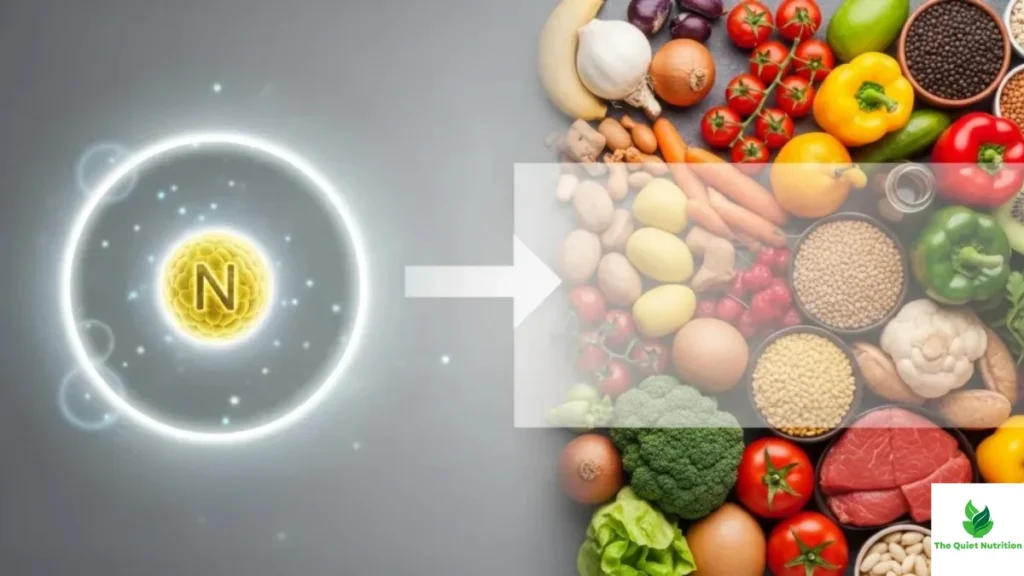
For decades, nutrition advice has moved in waves built around one villain or one hero at a time. Fat was the enemy, then it was sugar. Cholesterol was dangerous, then dietary cholesterol turned out to matter less than we thought. Protein became the obsession. Each wave gets simplified into a single number worth chasing or avoiding, printed boldly on a label, repeated in headlines, absorbed as fact. And each time, the fuller picture turns out to be more complicated than the single nutrient ever let on.
There’s a reason this keeps happening, and it isn’t that nutrition science keeps getting things wrong. It’s that studying one nutrient at a time is simply easier than studying a whole food, and the results of that convenience get marketed to you as if they were the whole truth.
We Don’t Actually Eat Nutrients — We Eat Food
Here’s the thing nutrition labels and buzzwords conveniently skip over: nobody consumes calcium, fiber, or vitamin C in isolation. We eat foods, and those foods break down into nutrients only after they enter the digestive system. Researchers studying this gap have pointed out plainly that people don’t consume nutrients in isolation but as part of a food — and treating nutrient-focused research as a stand-in for whole-food health has been described as a reductionist, narrowing way of understanding nutrition.
This idea even has a name in nutrition science: the food matrix. It refers to the physical structure of a food and how its nutrients interact with each other and with the food’s other components — fiber, fat, water content, cellular structure — in ways that change how your body actually processes them. Two foods can contain identical amounts of a given nutrient and still behave completely differently once digested, because the matrix surrounding that nutrient shapes how it’s absorbed, how quickly, and alongside what else.
The Dairy Aisle Is a Perfect Example of Why This Matters
Dairy research has become one of the clearest illustrations of this problem. For years, studies isolated specific dairy nutrients — calcium, saturated fat, specific proteins — and drew conclusions about dairy’s health effects based on those individual pieces. But intervention studies comparing whole dairy foods against isolated dairy nutrients have found the metabolic effects can be meaningfully different, particularly for outcomes like body weight, cardiometabolic risk, and bone health. Different dairy products — yogurt, cheese, milk — appear to carry distinct health associations even when their basic nutrient content looks similar on paper, largely because of how each product’s structure changes digestion and absorption.
The conclusion researchers have drawn from this is blunt: dairy’s nutritional value shouldn’t be treated as equivalent to its nutrient content alone. It has to be considered in terms of how those nutrients actually function within the food’s structure — something a single-nutrient claim on a label was never designed to capture.
Why “Nutritionism” Became a Term Nutrition Scientists Actually Use
This pattern of oversimplification is common enough that it has its own critical label: nutritionism, sometimes called nutritional reductionism. It describes the tendency to judge a food’s healthfulness — and a nutrient’s role in the body — based on its isolated chemical composition, rather than considering the food as a whole or the broader dietary pattern it’s part of.
Nutrition researchers pushing back on this approach have argued that decades of denigrating individual nutrients and food groups — cholesterol, saturated fat, sugar, gluten, salt, dairy, cereals, meat — has left the public in a state of confusion, precisely because each wave of nutrient-focused alarm oversimplifies what’s actually a much more layered story about whole foods and how processed they are. Their position is straightforward: we eat whole foods, not nutrients, and nutrition science makes the most sense when it treats that as the starting point rather than an inconvenient detail.
The Field Is Already Moving Past Single Nutrients
This isn’t just an academic complaint — it’s actively reshaping how nutrition research gets conducted. Large-scale studies are increasingly shifting away from asking “does nutrient X predict disease Y” and toward analyzing entire dietary patterns instead. One recent analysis using UK Biobank data, tracking half a million participants, examined whole dietary patterns against cardiovascular disease and mortality risk rather than isolating individual nutrients — part of a broader trend researchers describe as nutrition science moving from single-nutrient associations toward whole-diet approaches.
There’s a practical reason this shift matters for policy too. Much of food regulation has historically tinkered with “nutrients of concern” — sodium, sugar, trans fat — one at a time, rather than addressing overall dietary patterns. Some researchers argue that piecemeal approach is part of why decades of nutrient-focused public health messaging haven’t moved population-level diets as much as hoped.
What This Means When You’re Reading a Label
None of this means individual nutrient information is useless — knowing sodium or added sugar content still matters, especially for people managing specific health conditions. But a single-nutrient claim was never built to answer the question people actually want answered, which is “is this good for me, overall, as a food.” That question depends on the food’s full composition, its processing level, and how it fits into a broader pattern of eating — none of which a “high in fiber” sticker or a “low fat” claim can honestly capture on its own.
The next time a label leads with one flattering number, it’s worth remembering that the number is real, but it’s also just one ingredient in a much bigger, messier, more interesting story — the same story nutrition science itself has been slowly relearning to tell.
Sources:
- NCBI/PMC — The Dairy Matrix: Its Importance, Definition, and Current Application in Nutrition and Health
- NCBI/PMC — Perspective: Reductionist Nutrition Research Has Meaning Only Within the Framework of Holistic and Ethical Thinking
- NCBI/PMC — Nutritional Research Is Moving to a Whole-Diet Approach, Time for Food Policy
- Taylor & Francis — Overview: The Food Matrix and Its Role in the Diet

Aarti Solanki, B.Sc. (Food Science), is a food science writer passionate about making nutrition simple and evidence-based. She creates well-researched, easy-to-understand articles on healthy eating, food science, and nutrition, using information from trusted scientific and public health sources.





Pingback: How Front-of-Pack Labels Simplify Too Much — And Why “Easy” Nutrition Choices Often Miss the Truth
Pingback: Why Food Labels Highlight What Sells — Not What Truly Nourishes You