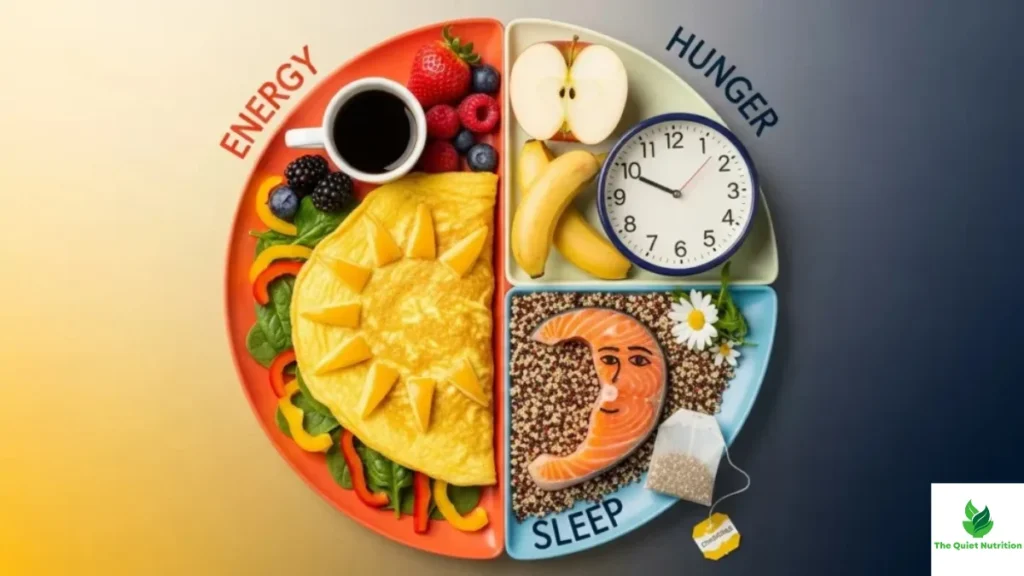
You already know that what you eat matters. What’s easier to miss is that when you eat is running its own quiet operation in the background — adjusting your blood sugar, your hormones, your sleep quality, and even how hungry you feel, hours before you notice anything’s off.
This is the territory of chrononutrition — the study of how meal timing interacts with your body’s internal clock. And the research shows that a schedule, not just a menu, is doing more work than most people realize.
Your Body Runs on More Than One Clock
Deep in your brain sits a master circadian clock that governs your roughly 24-hour sleep-wake cycle. But you also have peripheral clocks throughout your body — in your liver, your fat tissue, your gut — and these clocks are set largely by when you eat, not just by light exposure.
A controlled study on human circadian rhythms found that when researchers delayed meals by five hours, plasma glucose rhythms shifted by nearly six hours, and molecular clock activity in fat tissue shifted by almost an hour. The timing of food alone was enough to desynchronize how the body processed energy — even though the master brain clock, and rhythms like melatonin and cortisol, stayed on their usual schedule.
In other words: eating late doesn’t just mean going to bed on a full stomach. It measurably shifts how your peripheral organs are keeping time.
Why Late-Night Eating Hits Differently
If you’ve ever noticed that the same meal seems to affect you differently depending on when you eat it, that’s not your imagination. A meta-analysis of postprandial studies found that after an identical meal, glucose and insulin responses were significantly higher at night than during the day. A separate systematic review of clinical trials confirmed that carbohydrates eaten at night produced higher blood sugar spikes than the same carbohydrates eaten in the morning.
Your body is simply less efficient at processing food during the hours it’s biologically prepared for rest. Eating during that window asks your metabolic system to do daytime work on a night shift.
Hunger Has Its Own Built-In Rhythm
Hunger isn’t just a response to an empty stomach — it follows its own circadian pattern, independent of how long it’s been since you last ate. Laboratory studies isolating circadian effects from sleep and meal timing have found that appetite for food generally peaks in the biological evening and dips to its lowest point in the biological morning, tracking a rhythm tied to core body temperature.
Researchers studying meal timing and obesity note that these predictable peaks in hunger — occurring in the evening and morning — may actually serve a protective purpose: supporting energy balance across the day while reducing the odds of waking up hungry in the middle of the night.
The catch is that this same evening hunger peak lines up with the time many people are least equipped to manage it — tired, at home, surrounded by easy food, with the lowest reserves of willpower left in the day.
Irregular Eating Disrupts Sleep Hormones Too
The relationship runs in both directions. A cohort study on chrononutrition during pregnancy found that skipping breakfast was significantly associated with a greater amplitude in cortisol rhythm — meaning the stress hormone’s daily rise and fall became more exaggerated when a meal was skipped. The same body of research links irregular eating patterns — delayed meals, breakfast-skipping, late-night eating — to a cascade of circadian disruptions, including delayed glucose rhythms, phase-delayed body temperature, and blunted cortisol secretion.
Since cortisol and melatonin are two of the primary hormones that regulate your sleep-wake cycle, disrupting their rhythm through irregular eating doesn’t stay contained to digestion — it can ripple into how well, and how consistently, you sleep.
Chronotype Adds Another Layer
Not everyone’s internal clock runs on the same schedule. Genetic research has identified specific gene variants linked to whether someone is naturally a “morning lark” or a “night owl” — a trait known as chronotype. People with a later chronotype tend to eat more of their daily calories later in the day, and evidence from a study conducted during COVID-19 lockdowns found that evening chronotypes showed greater vulnerability to late meal timing, breakfast-skipping, and other circadian-disrupting habits.
This matters because it means “eat earlier” isn’t a one-size-fits-all instruction — chrononutrition research increasingly treats chronotype as a factor that should shape how meal timing advice is applied to a given person, rather than a detail to ignore.
What the Research Suggests, Practically
None of this requires an extreme approach — the research points toward a few consistent, low-effort adjustments:
- Anchor a regular eating window. Irregular meal timing is repeatedly linked to circadian disruption; consistency appears to matter as much as any single meal choice.
- Be cautious with late, carbohydrate-heavy meals. The data on nighttime glucose and insulin response suggests your body handles carbs less efficiently after dark.
- Don’t skip breakfast reflexively. Research links breakfast-skipping to disrupted cortisol rhythms, which can ripple into sleep and stress regulation.
- Expect an evening hunger peak — and plan for it. Since appetite naturally rises in the evening, having a plan for that window may matter more than trying to white-knuckle through it.
- Get morning light exposure. Natural light early in the day reinforces circadian alignment and has been linked to improved sleep quality, complementing the effects of meal timing.
The Bottom Line
Meal timing isn’t a minor variable sitting quietly behind the more obvious question of what’s on your plate — it’s actively shaping your glucose response, your hormone rhythms, your hunger cues, and your sleep, often without you noticing until the pattern has been off for a while. The schedule you eat on is, in a very real physiological sense, part of the diet itself.
Sources
- PubMed — Meal Timing Regulates the Human Circadian System
- Frontiers in Endocrinology — Meal Timing and Its Role in Obesity and Associated Diseases
- NCBI/PMC — Chrononutrition Is Associated with Melatonin and Cortisol Rhythm During Pregnancy
- NCBI/PMC — Chrononutrition and Energy Balance: How Meal Timing and Circadian Rhythms Shape Weight Regulation and Metabolic Health
- NCBI/PMC — No Effect of Chronotype on Hunger or Snack Consumption During a Night Shift with Acute Sleep Deprivation
- Institute for Functional Medicine — Chrononutrition: Food Timing, Circadian Fasting, and the Body’s Internal Clock
Disclaimer: This article is for general informational purposes and is not a substitute for professional medical advice. Consult a healthcare provider before making significant changes to your eating schedule, especially if you have diabetes, a sleep disorder, or work irregular shifts.

Aarti Solanki, B.Sc. (Food Science), is a food science writer passionate about making nutrition simple and evidence-based. She creates well-researched, easy-to-understand articles on healthy eating, food science, and nutrition, using information from trusted scientific and public health sources.