
It’s 3 p.m. You slept fine last night. You’re not sick. But somewhere between lunch and your next meeting, your thoughts turn to sludge. Reading the same email twice doesn’t help. Simple decisions feel harder than they should. Most people chalk this up to being “tired” in some vague, unavoidable way — the cost of being a busy adult.
But that afternoon fog usually isn’t a mystery of willpower or sleep alone. It’s your brain running on the wrong kind of fuel, delivered on the wrong schedule, and it’s happening at a biological level whether you notice it or not.
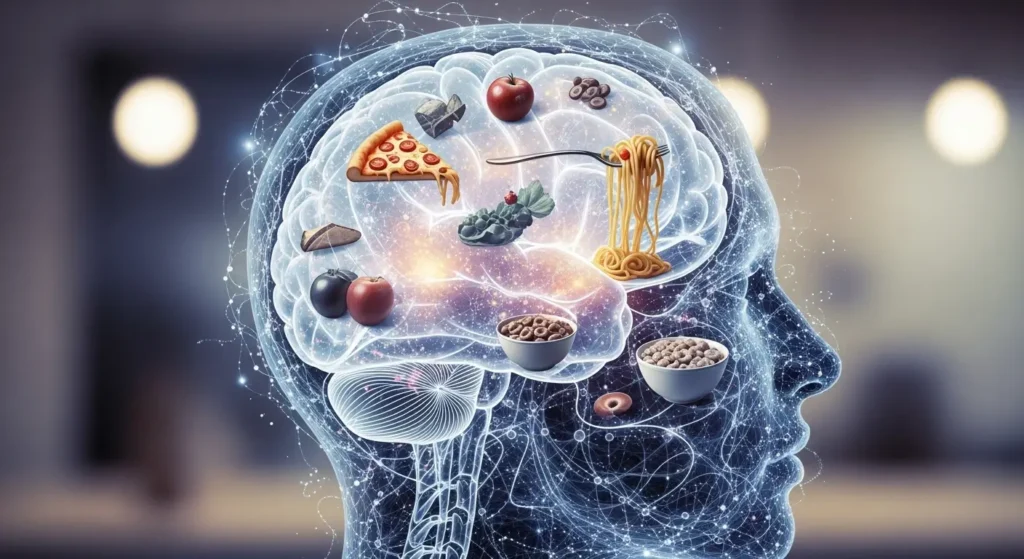
The brain doesn’t run on determination. It runs on glucose, oxygen, water, and a careful cocktail of nutrients — and it is astonishingly picky about how steadily that fuel arrives. Understanding that changes how you think about mental fatigue entirely. It’s not just in your head. It’s a supply chain problem, and food is the supply chain.
Your Brain Is the Most Expensive Organ You Own
Start with a number that surprises most people: the brain makes up about 2% of your total body weight, yet it burns through roughly 20% of your resting energy — all day, every day, whether you’re solving a hard problem or scrolling your phone. Scientific American has described this ratio as one of the more remarkable facts of human physiology, noting that this outsized energy demand exists at rest, not just during intense mental effort.
Harvard Medical School researchers put it even more directly: because the brain is so densely packed with neurons, it’s the single most energy-demanding organ in the body, consuming roughly half of all the sugar energy circulating in the bloodstream. That’s not a typo — half. Every thought, memory, and flicker of attention is quite literally metabolic work, funded by glucose your body converts from the food you ate hours earlier.
This is why “mental fatigue” isn’t a poetic exaggeration. Thinking clearly costs real, measurable energy, and unlike your muscles, your brain can’t store much of its own fuel reserve. It depends on a continuous, well-timed delivery system — which means the quality and rhythm of that delivery matters enormously.
The Blood Sugar Rollercoaster Is a Mental Energy Rollercoaster
Here’s where diet stops being background noise and starts directly steering your cognitive performance.
When you eat something high in refined carbohydrates — a pastry, a sugary coffee drink, white bread on its own — your blood sugar spikes quickly. Your body responds by releasing insulin to bring glucose levels back down, and often it overshoots, leaving you in a dip below where you started. Harvard Health has described this exact pattern: carbohydrate-heavy meals cause blood sugar to spike and then “nosedive,” leaving you feeling drained rather than fueled.
That nosedive isn’t just a metaphor for how you feel — it’s a real drop in the glucose available to your neurons, and your brain notices immediately. Because neurons can’t stockpile glucose the way muscles store fuel for later, a dip in blood sugar shows up almost instantly as poor concentration, sluggish thinking, or that unmistakable “can’t focus” feeling. Harvard Medical School’s research on sugar and cognition notes that when there isn’t enough glucose reaching the brain, the chemical messengers neurons use to communicate — neurotransmitters — aren’t produced properly, and communication between brain cells starts to break down. Hypoglycemia, or low blood sugar, has specifically been linked to poor attention and weakened cognitive function.
This is the biological reason so many people hit a wall an hour or two after a carb-heavy lunch. The energetic high you feel right after eating something sugary is often followed by a crash that’s entirely predictable — not a character flaw, not a lack of caffeine, but a direct consequence of how that meal was built.
The fix isn’t to fear carbohydrates. It’s to stop eating them in isolation. Harvard Health’s guidance on blood sugar stability points to a simple mechanism: meals and snacks that combine protein, fat, and carbohydrates together slow down how quickly glucose enters the bloodstream, which keeps energy levels — and by extension, mental clarity — far more consistent than eating fast-digesting carbs on their own.
Food Quality Shapes the Brain Over Weeks, Not Just Hours
Blood sugar swings explain the hour-to-hour crash. But there’s a slower, quieter effect happening too — one tied to overall diet quality rather than any single meal.
Harvard Health’s coverage of nutritional psychiatry, a growing field studying the link between food and brain function, describes the brain as needing a constant supply of high-quality fuel to build and maintain its own structure. Diets consistently high in refined sugar have been associated with impaired brain function and even a worsening of mood-disorder symptoms over time. By contrast, researchers comparing traditional dietary patterns — like the Mediterranean diet and traditional Japanese diet — to a typical Western diet have found meaningfully lower rates of depression among people eating the traditional pattern, a difference researchers attribute to the higher intake of vegetables, fruit, unprocessed grains, and seafood, paired with far less reliance on processed and refined foods.
Part of this connection runs through the gut. A striking portion of the body’s serotonin — the neurotransmitter tied to mood, sleep, and appetite regulation — is produced not in the brain but in the gastrointestinal tract, according to Harvard Health. That means the food feeding your gut bacteria is, indirectly, also shaping the chemical environment your brain depends on. A diet that neglects fiber, vegetables, and diverse whole foods isn’t just a “body” problem; it’s quietly shortchanging the biochemical system your mood and focus run on.
None of this means one salad fixes a bad week or one dessert ruins your brain. It means mental sharpness is cumulative — built from weeks of dietary patterns, not from any single virtuous or indulgent meal.
The Variable Everyone Forgets: Water
Nutrition conversations tend to focus entirely on food, but hydration plays an outsized and frequently overlooked role in mental energy.
A review of hydration research published through the National Institutes of Health’s PubMed Central database found that cognitive performance can begin to decline with as little as 1–2% loss of body water — a level of dehydration so mild it can happen during an ordinary day without anyone noticing they’re thirsty. The same review noted that the specific problems associated with this level of mild dehydration include poor concentration, slower reaction time, short-term memory trouble, and increased moodiness or anxiety — a cluster of symptoms that overlaps almost entirely with what people describe as “brain fog.”
A separate randomized controlled trial on mild dehydration in young men found measurable increases in fatigue and tension, along with slower response times on memory and vigilance tasks, after body water loss of just over 1%. For context, that’s an amount of fluid loss that can occur through nothing more dramatic than a warm room, a skipped water bottle, and a normal day of talking, walking, and working.
Most people troubleshoot an unfocused afternoon by reaching for more caffeine. Often, what the brain actually needed first was water.
Building a Diet That Keeps Your Brain’s Energy Steady
None of this requires an elaborate meal plan. It requires paying attention to a few patterns that consistently show up across the research on blood sugar, diet quality, and hydration.
Pair carbohydrates with protein, fat, or fiber, always. A bowl of cereal alone digests fast and spikes glucose quickly. The same bowl with nuts, yogurt, or eggs on the side digests more slowly, keeping blood sugar — and mental energy — on a flatter, steadier curve.
Don’t let long gaps turn into crashes. Skipping meals doesn’t save your brain energy; it just delays and intensifies the eventual dip. Regular, moderate meals tend to outperform long stretches of nothing followed by a large meal.
Treat water as a cognitive tool, not just a thirst response. Because mild dehydration can impair focus before you consciously feel thirsty, drinking water proactively through the day — rather than waiting for a dry mouth to prompt you — is a simple, evidence-backed way to protect concentration.
Think in weeks, not meals, for mood and focus. A single indulgent meal isn’t the enemy. A pattern of relying on refined, ultra-processed foods as the dietary default, week after week, is what the research consistently links to worse mood and cognitive outcomes over time.
Notice your own afternoon patterns. If a predictable slump shows up at the same time each day, it’s worth looking backward two to three hours to what you ate — often the pattern reveals itself once you start connecting meals to how you felt afterward.
The Bigger Point
Mental fatigue gets treated like a mood — something you either push through or wait out. But your brain is running a constant, expensive metabolic operation, and the food and water you give it are the literal raw materials for that operation. A steadier fuel supply doesn’t just affect how your body feels. It changes how clearly you think, how patient you are, and how much mental stamina you have left by the time it actually matters.
The fog isn’t random, and it isn’t weakness. It’s biology asking for better fuel, more consistently delivered.
Sources
- Harvard Medical School – Sugar and the Brain
- Harvard Health – The Case for Watching Your Blood Sugar
- Harvard Health – Nutritional Psychiatry: Your Brain on Food
- Scientific American – Does Thinking Really Hard Burn More Calories?
- National Institutes of Health (PMC) – The Hydration Equation: Update on Water Balance and Cognitive Performance

Aarti Solanki, B.Sc. (Food Science), is a food science writer passionate about making nutrition simple and evidence-based. She creates well-researched, easy-to-understand articles on healthy eating, food science, and nutrition, using information from trusted scientific and public health sources.







Pingback: Why Brain Fog Is Often a Fuel Issue, Not a Focus Problem (And How to Fix the Real Cause)
Pingback: Why the Brain Thrives on Predictable Nutrition (And Struggles When Food Is Uncertain)
Pingback: How Blood Sugar Stability Quietly Determines Your Mental Clarity, Focus, and Mood
Pingback: How Nutrition Powers the Body’s Repair System (And Why Healing Slows When Fuel Is Wrong)
Pingback: Why Energy Is Often the First System Affected — The Early Warning Signal Most People Ignore
Pingback: Why Your Memory Struggles Even When You’re Not Forgetful
Pingback: Why Your Mind Quits Long Before Your Body Does
Pingback: How Long-Term Eating Patterns Shape Brain Efficiency — The Quiet Nutrition Factor Behind Mental Clarity
Pingback: How Nutrition Affects Mental Processing Speed — The Hidden Fuel Behind a Faster Brain
Pingback: The Surprising Brain Benefits of Blueberries (What These Tiny Berries May Be Doing Inside Your Mind)
Pingback: Almonds Are a Daily Superfood — Here’s Why Your Body Loves Them
Pingback: Why Tart Cherries Are Becoming a Popular Natural Sleep Food