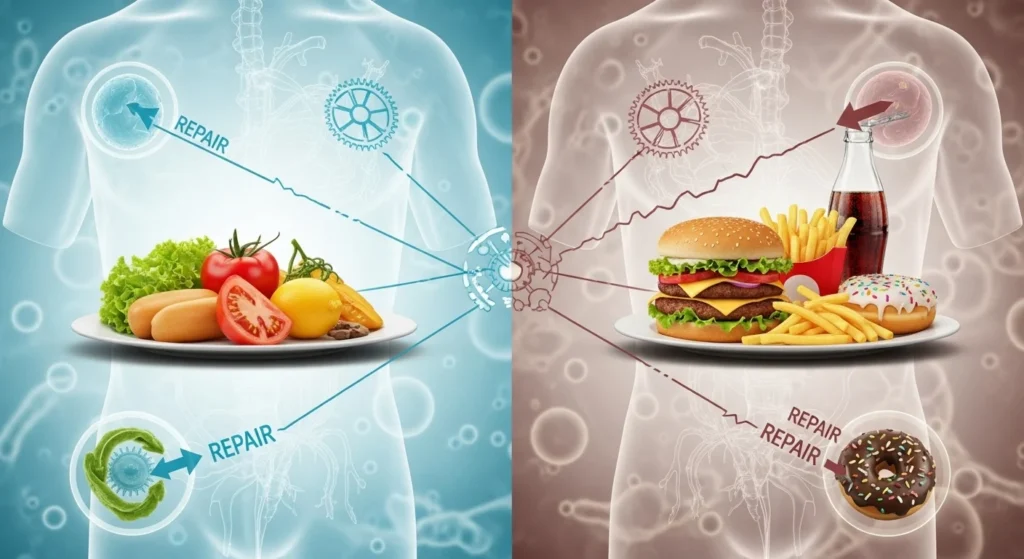
Ever wonder why a minor cut or pulled muscle seems to fade overnight in your twenties, but lingers for weeks later in life? Or why two people recovering from the exact same surgery heal at completely different speeds?
The instinct is to blame age or genetics. But at a cellular level, your tissue doesn’t just heal on a timer—it heals on fuel.
Every second, your body is engaged in a continuous effort of repair. It works like a 24/7 emergency construction zone, patching micro-tears in muscle, replacing worn-out skin cells, and knitting together connective tissue. But if the construction site runs out of high-grade steel, cement, and electrical cabling, the entire renovation comes to a grinding halt.
Understanding how targeted nutrition powers your body’s cellular repair engine—and identifying the hidden dietary saboteurs that stall recovery—can change how you heal.
The 4 Stages of Body Repair
Cellular tissue repair isn’t a single event; it’s a biological marathon consisting of four distinct, sequential phases. If a single nutrient is missing, your body gets stuck at one stage, transforming a temporary injury into chronic, low-grade discomfort.
Look closely at the timeline in the diagram above. Notice how each stage relies on specific cellular events to hand off control to the next:
- Hemostasis (Immediate): Blood clotting forms a temporary matrix. Platelets release signaling molecules that act as a distress signal, summoning immune cells to the scene.
- Inflammation (Days 1–4): White blood cells (neutrophils and macrophages) clean out dead debris and bacteria. This phase is vital, but if it lasts too long, it destroys healthy surrounding tissue.
- Proliferation (Days 4–21): Fibroblasts arrive to build fresh tissue and synthesize new collagen fibers, while new blood vessels form (angiogenesis) to deliver oxygen to the site.
- Remodeling (Weeks to Months): The disorganized, temporary collagen is restructured into resilient, strong tissue, restoring original function.
As documented by the National Institutes of Health (NIH), a deficiency in key nutrients during any of these stages halts the hand-off mechanism—keeping your body trapped in painful, prolonged inflammation.
The Blueprint: What Your Cells Need to Rebuild
To rebuild damaged cartilage, muscle fibers, or skin, your cells demand a steady supply of specific substrates.
       +-------------------------------------------------------+
       |             RECOVERY FUEL REQUIREMENT                 |
       +-------------------------------------------------------+
       |  [Protein & Amino Acids]  --> Structural Building Blocks
       |  [Vitamin C & Zinc]       --> Collagen Cross-Linking
       |  [Omega-3 Fatty Acids]    --> Inflammatory Resolution
       +-------------------------------------------------------+
1. Structural Building Blocks: Amino Acids
When tissue is damaged, protein synthesis skyrockets. Your body breaks down dietary protein into individual amino acids, specifically proline, glycine, arginine, and glutamine.
- Proline & Glycine: Make up nearly 50% of the amino acid structure in human collagen.
- Arginine & Glutamine: Fuel immune cell proliferation and stimulate growth factor release during the proliferation stage.
According to research published in PubMed Central, inadequate protein intake during recovery forces the body to break down existing lean muscle tissue to source these essential repair materials.
2. The Enzymatic Catalysts: Vitamin C and Zinc
Even with plenty of protein, collagen synthesis fails without its crucial enzymatic co-factors:
- Vitamin C: Acts as an essential cofactor for the enzymes prolyl hydroxylase and lysyl hydroxylase. Without it, collagen molecules cannot form their characteristic triple-helix structure, leaving tissue weak and fragile.
- Zinc: Required for cellular division, DNA synthesis, and protein production. A minor zinc deficiency can reduce wound strength by up to 50%.
3. The Resolution Signals: Omega-3 Fatty Acids
Acute inflammation is necessary to kick off healing, but it must be switched off once the cleanup is complete. Harvard Health Publishing emphasizes that Omega-3 fatty acids (EPA and DHA) produce specialized lipid mediators called resolvins and protectins. These compounds act as the “off switch” for inflammation, signaling macrophages to transition from cleanup mode to tissue-building mode.
Why Healing Slows: The “Wrong Fuel” Saboteurs
Just as the right nutrients accelerate repair, the wrong foods actively sabotage the process from the inside out.
Refined Sugars and Advanced Glycation End-Products (AGEs)
When circulating blood sugar is consistently elevated, sugar molecules bond non-enzymatically with proteins and lipids—a process called glycation. This creates toxic compounds known as Advanced Glycation End-products (AGEs).
How AGEs destroy repair: Glycation “cross-links” clean collagen fibers, rendering them rigid, brittle, and incapable of proper remodeling. Furthermore, high blood sugar impairs macrophage function, leaving tissue vulnerable to lingering microbial threats.
Ultra-Processed Foods and Trans Fats
Diets high in refined vegetable oils rich in unbalanced Omega-6 fatty acids (like corn or soybean oil) flood the body with precursor molecules for pro-inflammatory prostaglandins. This tilts your biochemistry into a state of chronic inflammation, locking your tissues in Phase 2 of repair.
Healing Accelerators vs. Healing Blockers
To optimize recovery, aim to shift your dietary pattern toward nutrient-dense, whole foods while limiting inflammatory blockers:
| Recovery Category | Healing Accelerators 🚀 | Healing Blockers 🛑 | Physiological Impact |
| Protein Sources | Wild salmon, bone broth, pasture-raised eggs, Greek yogurt | Processed deli meats with nitrites | High bioavailable amino acids vs. elevated oxidative stress |
| Fat Sources | Extra virgin olive oil, walnuts, avocados, sardines | Hydrogenated oils, deep-fried foods | Anti-inflammatory resolution vs. sustained tissue inflammation |
| Carbohydrate Quality | Berries, sweet potatoes, leafy greens, citrus fruits | Refined white flour, sugary drinks | High vitamin C & antioxidants vs. collagen-damaging glycation |
| Micronutrient Density | Pumpkin seeds (zinc), bell peppers (vit C), spinach | Ultra-processed snack foods | Essential enzymatic activation vs. nutrient depletion |
The Actionable Repair Blueprint
If you are recovering from an injury, intense workout block, or medical procedure, apply these four steps to optimize your body’s healing capacity:
- Target 1.5–2.0g Protein per kg Bodyweight: Spread your protein intake evenly across 3 to 4 daily meals to maintain a continuous pool of circulating amino acids for muscle and collagen synthesis.
- Prioritize Vitamin C Rich Foods Daily: Combine citrus fruits, bell peppers, or kiwi with protein-rich meals to maximize enzymatic collagen assembly.
- Incorporate Omega-3s: Eat fatty fish twice a week or consult a physician regarding high-quality fish oil supplementation, as recommended by the Mayo Clinic.
- Hydrate for Transport: Cellular repair relies on fluid balance to transport nutrients into damaged tissues and carry metabolic waste away. Aim for clear-to-pale-yellow urine throughout the day.
Your body possesses a remarkable, built-in system for repair and renewal. By providing high-quality biological materials while eliminating inflammatory interference, you give your cells the ideal conditions to repair stronger and faster.

Aarti Solanki, B.Sc. (Food Science), is a food science writer passionate about making nutrition simple and evidence-based. She creates well-researched, easy-to-understand articles on healthy eating, food science, and nutrition, using information from trusted scientific and public health sources.







Pingback: Why Aging Is a Gradual Nutritional Process (And Not Just Time Catching Up With You)
Pingback: How Nutrition Supports Cellular Renewal — The Daily Repair Process That Shapes How You Age
Pingback: How the Body Uses Nutrition to Slow Wear and Tear — The Repair System Most People Undervalue
Pingback: How Nutrition Quietly Controls the Speed of Aging (And Why It Matters More Than Genetics)
Pingback: Why Avocados Are Considered the Gold Standard of Healthy Fats