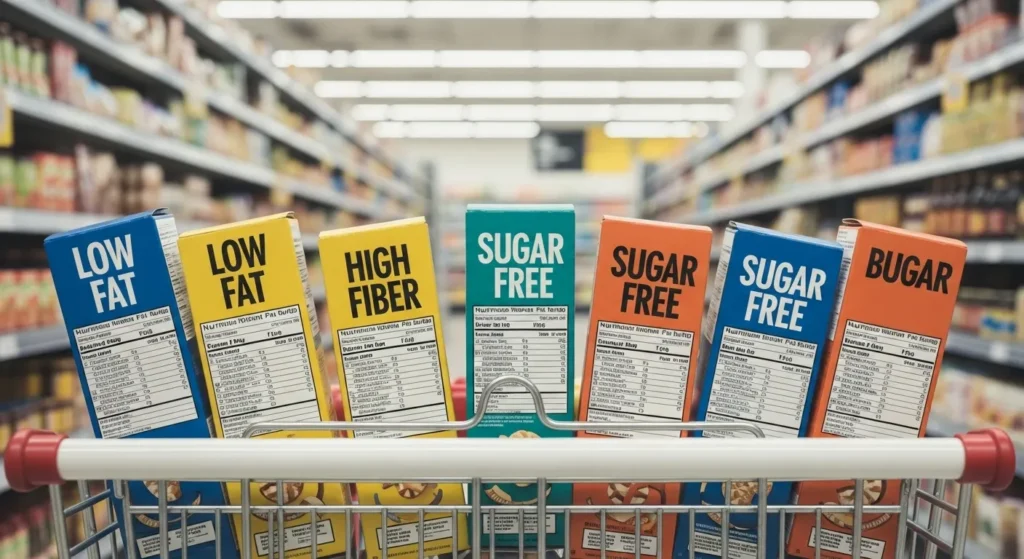
The Label That Feels Reassuring at First Glance
You pick up a packaged food.
Your eyes catch the bold words first:
- High Protein
- Source of Fiber
- With Added Vitamins
It feels comforting.
Responsible.
Like a smart choice has already been made.
But notice what didn’t stand out:
- Sugar levels
- Refinement
- Portion distortion
- Overall balance
This isn’t accidental.
Food labels are designed to spotlight strengths, not provide a complete story.
Why Labels Are Built Around Positives
Food packaging has one primary job:
Get chosen in seconds.
To do that, labels focus on:
- One or two appealing attributes
- Simple, emotionally positive cues
- Claims that feel universally beneficial
This approach is allowed—and regulated—by food authorities like the U.S. Food and Drug Administration and guided by international standards referenced by the World Health Organization.
But regulation controls accuracy, not context.
And context is where balance disappears.
The Health Halo Effect: One Good Thing Changes Everything
When a label highlights a single positive, your brain does the rest.
This is called the health halo effect.
One benefit:
- “High protein”
- “Low fat”
- “With whole grains”
…creates the impression that the entire product is healthy.
Even when:
- Sugar is high
- Fiber is low
- Processing is extensive
The mind fills in the gaps—optimistically.
Why Balance Is Hard to Sell on a Label
Balance is complex.
It involves:
- Nutrient ratios
- Food structure
- Portion context
- Overall dietary patterns
None of these fit neatly on the front of a box.
“Balanced nutrition” doesn’t trigger emotion.
“High protein” does.
So labels choose:
✔ What’s simple
✔ What’s positive
✔ What’s persuasive
Not what’s complete.
Real-Life Example: The Protein Bar Illusion
A protein bar claims:
- 20g protein
- Added vitamins
- Low fat
Sounds ideal.
But the same bar may contain:
- Refined syrups
- Minimal fiber
- Ultra-processed ingredients
Protein is emphasized.
Metabolic impact is not.
The label isn’t lying—but it isn’t balanced either.
What Labels Commonly Emphasize (And Why)
Food labels frequently highlight:
- Protein
- Vitamins and minerals
- “Low” or “free from” nutrients (fat, sugar, gluten)
- Single functional benefits
Because these:
- Are easy to quantify
- Sound scientific
- Feel universally good
What’s rarely emphasized:
- Degree of processing
- Glycemic impact
- Satiety quality
- Ingredient integrity
Comparison Table: Label Positives vs. Nutritional Balance
| Label Focus | What It Highlights | What It Often Ignores |
|---|---|---|
| High Protein | Muscle, fullness | Sugar, refinement |
| Added Vitamins | Deficiency prevention | Food quality |
| Low Fat | Calorie fear relief | Insulin response |
| Whole Grain | Fiber perception | Actual fiber amount |
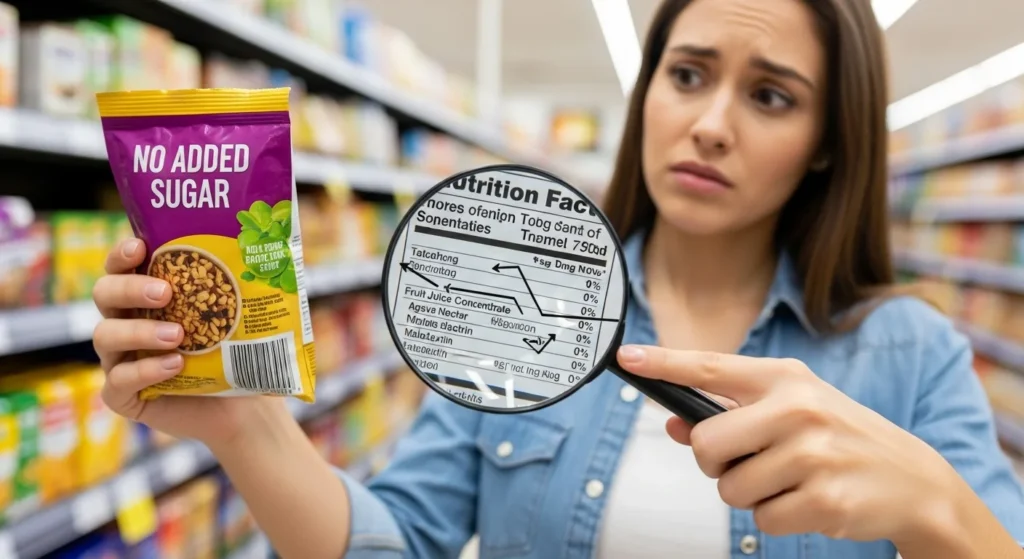
| No Added Sugar | Sweetness safety | Natural sugar load |
This selective emphasis shapes perception more than facts.
Why “Positive Framing” Changes How Much You Eat
Here’s a lesser-known effect:
Foods with positive health claims are often eaten in larger portions.
Why?
Because the brain feels:
- Safer
- Justified
- Less cautious
“I can have more—this is healthy.”
Studies repeatedly show that people:
- Underestimate calories in health-labeled foods
- Eat more when claims are present
- Feel less guilt afterward
Balance disappears not just on the label—but on the plate.
The Silent Problem: Nutrition Without Context
Nutrition is not additive.
It’s relational.
Protein behaves differently depending on:
- Fiber
- Carbohydrates
- Fat
- Food structure
A label that highlights one nutrient:
- Removes context
- Simplifies decisions
- Distorts impact
This isn’t deception—it’s selective storytelling.
When Positive Labels Are Actually Helpful
To be fair, positive claims aren’t useless.
They can help:
- Identify specific needs (iron, protein, calcium)
- Support certain populations
- Compare similar products
The issue isn’t the claim.
It’s treating the claim as the conclusion instead of the starting point.
Common Mistakes People Make With Label Positives
Mistake #1: Letting One Claim Decide Everything
A single benefit doesn’t define overall quality.
Mistake #2: Ignoring the Nutrition Panel
Front-of-pack claims distract from details.
Mistake #3: Overestimating “Healthy” Foods
Health halos lead to overeating.
Mistake #4: Forgetting Dietary Patterns
Balance exists across meals—not products.
How to Read Labels for Balance, Not Just Positives
You don’t need to avoid labeled foods.
You need to mentally rebalance the story.
Actionable Steps
- Ask: “What’s not being mentioned?”
- Scan sugar and fiber before claims
- Compare similar products side by side
- Treat positives as partial information
- Think in meals, not nutrients
This simple shift restores perspective.
Why This Matters Today (And Long-Term)
Modern food environments reward speed.
Labels are optimized for:
- Fast decisions
- Emotional reassurance
- Minimal thinking
But health isn’t built on highlights.
It’s built on:
- Consistency
- Context
- Balance over time
Understanding how labels frame positives helps you:
- Avoid false confidence
- Eat more intuitively
- Reduce confusion and guilt
- Build sustainable habits
This knowledge stays relevant—no matter how trends change.
Key Takeaways
- Food labels emphasize positives, not overall balance
- One health claim can overshadow the full nutrition picture
- Positive framing increases trust and portion size
- Balance depends on context, not isolated nutrients
- Reading labels critically restores control and clarity
Frequently Asked Questions
1. Are food labels misleading?
They are usually accurate, but selectively framed to highlight positives.
2. Should I ignore front-of-pack claims?
Use them as signals, not decisions.
3. Why do healthy-labeled foods feel safer to eat more of?
Because positive claims reduce perceived risk.
4. Is balance possible to show on labels?
Not fully—balance exists across meals and patterns.
5. What’s the best way to judge food quality?
Look at ingredients, fiber, sugar, and processing together.
Final Thought
Food labels don’t lie.
They edit.
They tell you what sounds good—
not what completes the picture.
When you learn to look beyond the highlights,
nutrition stops being confusing
and starts making sense again.
Disclaimer: This article is for general educational purposes and does not replace personalized nutrition or medical advice.

Pingback: Why Nutrition Claims Focus on Single Nutrients — And Why That’s Rarely the Full Health Story
Pingback: How Front-of-Pack Labels Simplify Too Much — And Why “Easy” Nutrition Choices Often Miss the Truth
Pingback: “High in Protein” But Still Unhealthy? How Nutrient Claims Distract From What Food Really Does to Your Body