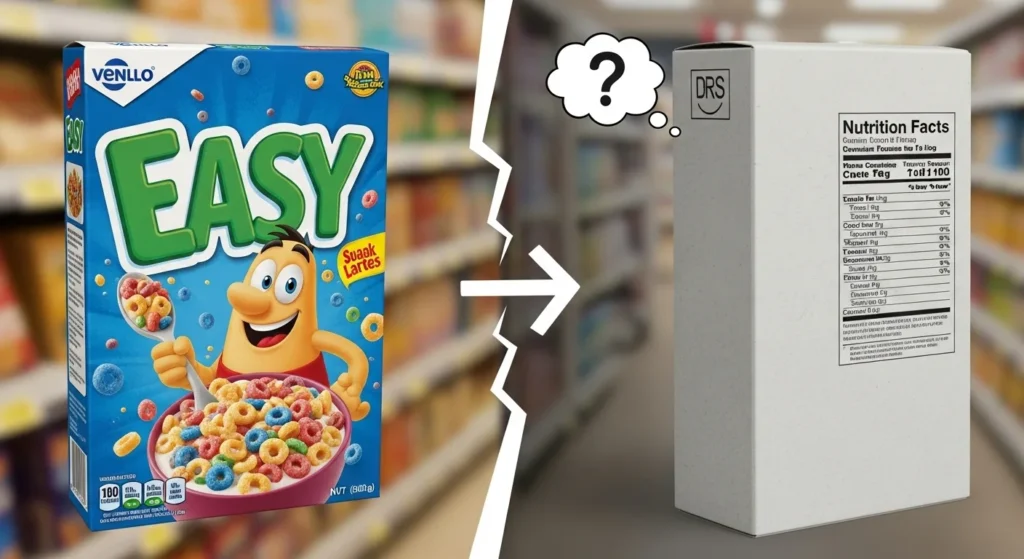
The Label That Makes the Decision for You
You’re in a hurry.
You glance at the front of a package and see:
- A green checkmark
- A star rating
- A bold “Healthy Choice” badge
You don’t flip the box.
You don’t read ingredients.
You trust the symbol—and move on.
That’s exactly what front-of-pack labels are designed to do.
They compress complex nutrition into a single signal.
Helpful? Sometimes.
Accurate? Not always.
What Front-of-Pack Labels Are Meant to Do
Front-of-pack (FOP) labels exist to:
- Reduce decision fatigue
- Help quick comparisons
- Guide large populations toward “better” options
They are encouraged or permitted by regulators such as the U.S. Food and Drug Administration and supported by public-health discussions from groups like the World Health Organization.
Their goal is simplicity.
Why Nutrition Is Hard to Simplify Safely
Nutrition is not binary.
Food affects:
- Blood sugar
- Hormones
- Satiety
- Gut health
- Long-term metabolic patterns
These effects depend on:
- Combinations of nutrients
- Degree of processing
- Portion size
- Individual context
No icon, color, or score can capture that.
Yet front-of-pack labels try.
How Simplification Turns Into Distortion
To work at a glance, FOP labels must:
- Reduce many variables into a few metrics
- Weight some nutrients more than others
- Ignore factors that are harder to measure
What usually gets emphasized:
- Calories
- Sugar
- Fat
- Sodium
What often gets minimized or ignored:
- Processing level
- Food structure
- Fiber quality
- Ingredient integrity
The result isn’t wrong—but it’s incomplete.
The Illusion of Objectivity
Stars, colors, and scores feel scientific.
They suggest:
- Neutral calculation
- Comprehensive evaluation
- Clear winners and losers
But every scoring system:
- Chooses what matters
- Assigns weights
- Leaves things out
Two foods with the same score can behave very differently in the body.
The label looks objective.
The assumptions behind it are not.
Real-Life Example: The “Green Label” Trap
Imagine two products:
Product A
- Ultra-processed
- Low sugar
- Added fiber and vitamins
Product B
- Minimally processed
- Naturally higher in fat
- No fortification
A front-of-pack system may rate Product A higher.
Why?
Because the system rewards numbers, not food context.
The label simplifies.
The metabolism doesn’t.
Why Front-of-Pack Labels Favor Processed Foods
Here’s a quiet truth:
Highly processed foods are easier to optimize for scoring systems.
Manufacturers can:
- Reduce one nutrient
- Add another
- Reformulate to hit thresholds
Whole foods don’t play by those rules.
They aren’t adjustable.
They aren’t engineered.
They aren’t scored easily.
So simplification often favors what can be manipulated—not what’s inherently balanced.
Comparison Table: What Front-of-Pack Labels Show vs What They Miss
| What Labels Show | What They Often Miss |
|---|---|
| Calories | Satiety quality |
| Sugar amount | Sugar type and timing |
| Fat quantity | Fat quality |
| Sodium | Overall processing |
| Score or color | Whole-diet context |
This gap is where confusion lives.
The Health Halo Effect Gets Stronger With Symbols
When nutrition is reduced to a badge or score:
- Trust increases
- Scrutiny decreases
- Portion sizes grow
People often:
- Eat more of “approved” foods
- Underestimate calories
- Skip reading full labels
The simpler the signal, the stronger the halo.
When Front-of-Pack Labels Are Genuinely Useful
Despite their limits, FOP labels can help:
- Compare similar packaged foods
- Identify extreme outliers
- Support basic public-health goals
They are starting points, not verdicts.
Problems arise when:
- The label replaces thinking
- The score replaces context
Common Mistakes Shoppers Make With Front-of-Pack Labels
Mistake #1: Treating the Label as a Final Answer
It’s only a summary—often a narrow one.
Mistake #2: Ignoring Ingredients Completely
A good score doesn’t guarantee good composition.
Mistake #3: Eating More Because It Feels “Approved”
Health halos reduce natural stopping cues.
Mistake #4: Forgetting Meal-Level Balance
No single food determines diet quality.
How to Use Front-of-Pack Labels Without Being Misled
You don’t need to reject them.
You need to downgrade their authority.
Actionable Steps
- Use FOP labels only to compare similar products
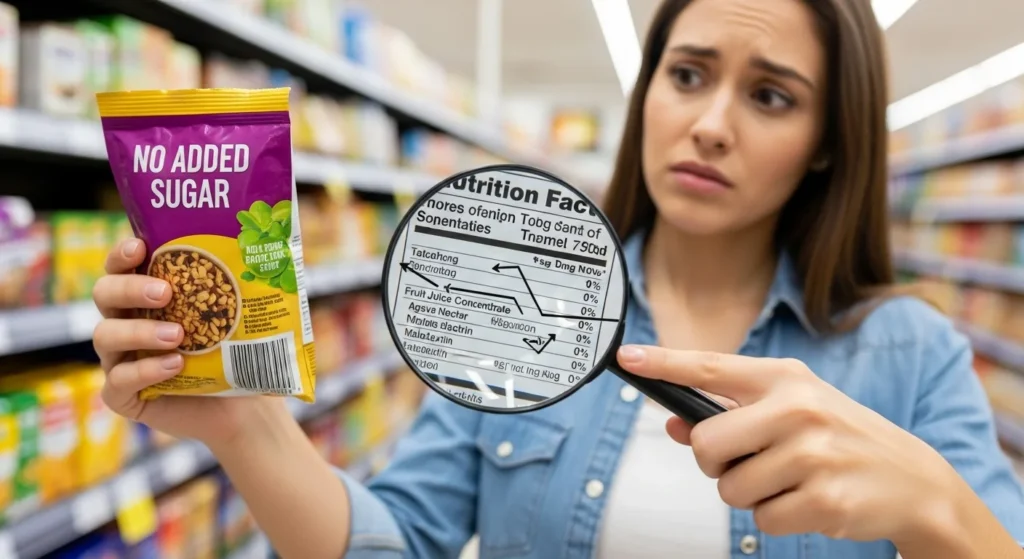
- Always flip the package at least once
- Check fiber and sugar together
- Notice ingredient length and refinement
- Think in meals, not products
This keeps simplicity from becoming oversimplification.
Why This Matters Today (And Long-Term)
Modern food environments are fast.
Front-of-pack labels promise relief:
- Less thinking
- Faster decisions
- Clear guidance
But long-term health isn’t built on shortcuts.
It’s built on:
- Pattern recognition
- Context awareness
- Consistent, informed choices
Understanding the limits of simplification protects you from false confidence—and quiet nutritional drift.
Key Takeaways
- Front-of-pack labels simplify nutrition to enable fast choices
- Simplification often removes balance and context
- Scoring systems reflect assumptions, not full physiology
- Processed foods adapt better to scoring than whole foods
- Using labels as tools—not authorities—restores clarity
Frequently Asked Questions
1. Are front-of-pack labels misleading?
They’re usually accurate but incomplete.
2. Should I ignore them entirely?
No—use them as quick comparisons, not conclusions.
3. Why do processed foods score well?
They can be engineered to meet scoring criteria.
4. Do these labels help public health?
They can help at scale, but not for nuanced individual choices.
5. What’s the best way to judge food quality?
Combine ingredient quality, fiber, sugar, processing, and overall diet patterns.
Final Thought
Front-of-pack labels make nutrition feel simple.
But health isn’t simple—it’s layered.
When you understand what these labels compress and leave out,
you stop outsourcing decisions
and start choosing with clarity instead of symbols.
Disclaimer: This article is for general educational purposes and does not replace personalized nutrition or medical advice.

Pingback: Why Clean-Looking Packaging Instantly Builds Trust — Even Before You Read the Label
Pingback: “Free From” Doesn’t Mean Healthy: Why Food Labels Obsess Over What’s Missing Instead of What Matters