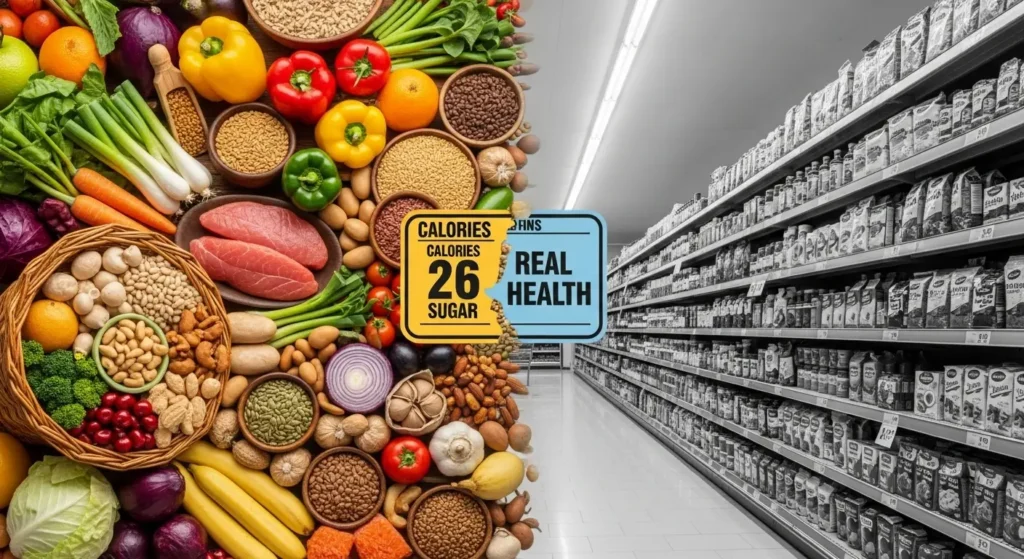
The Numbers Look Clear — But Something Feels Wrong
You read the label.
You check the calories.
You scan the macros.
On paper, everything looks reasonable.
Yet after eating, you don’t feel satisfied.
Your energy dips sooner than expected.
Hunger returns quickly.
This disconnect isn’t imagination.
It happens because food labels compress complex nutrition into a few simplified numbers, while real nutrition quality is layered, contextual, and deeply human.
Labels aren’t lying—but they’re leaving a lot out.
Nutrition Quality Is Complex by Nature
Nutrition quality isn’t just what a food contains.
It’s also:
- How nutrients are packaged
- How food is processed
- How it’s digested
- How it affects hunger and energy
- How it fits into eating patterns
Labels reduce all of this into:
- Calories
- Grams
- Percentages
Useful? Yes.
Complete? Not even close.
Calories Flatten Very Different Foods Into One Metric
Calories are often treated as the ultimate measure of food value.
But calories don’t tell you:
- How full a food makes you
- How quickly it digests
- How it affects cravings
- How it influences later eating
Two foods with the same calories can behave completely differently in the body.
Labels treat them as equals.
Your body does not.
Macros Ignore Food Structure
Proteins, fats, and carbohydrates are listed as if they exist independently.
In real food, they don’t.
- Whole grains vs refined flour
- Intact nuts vs nut flours
- Whole fruit vs juice
When structure is broken down, digestion speeds up and satiety drops.
Labels report quantity, not form.
That missing detail is huge.
Protein Quality Is Reduced to a Number
A label might say “10g protein.”
But it doesn’t tell you:
- Protein digestibility
- Amino acid balance
- Whether protein is naturally occurring or added
- How well it supports satiety
Protein added to ultra-processed foods behaves differently than protein embedded in whole foods.
Labels treat them as identical.
Fiber Numbers Hide Function
Fiber is another example of oversimplification.
Labels show:
- Total fiber grams
They don’t show:
- Whether fiber is natural or isolated
- Whether it slows digestion
- Whether it supports fullness
Some foods add isolated fiber solely to boost numbers—without improving eating experience.
The label improves.
The food doesn’t.
Micronutrients Don’t Equal Absorption
Food labels highlight vitamins and minerals as percentages.
What they don’t show:
- Bioavailability
- Synergy between nutrients
- Losses from processing
A fortified food can look nutritionally impressive, while delivering far less functional benefit than a whole food with lower numbers.
Nutrition quality isn’t just presence—it’s usability.
Processing Level Is Completely Invisible
One of the biggest gaps in food labels is processing.
Labels don’t indicate:
- Industrial refinement
- Ingredient isolation
- Structural breakdown
- Additive dependence
Highly processed foods can match whole foods on paper—while behaving very differently in the body.
Processing changes how food interacts with hunger, energy, and satisfaction.
Labels ignore this entirely.
Comparison Table: What Labels Show vs What They Oversimplify
| What Labels Show | What They Oversimplify or Miss |
|---|---|
| Calories | Satiety and fullness |
| Protein grams | Protein quality |
| Fiber grams | Fiber function |
| Fat grams | Fat source and oxidation |
| Sugar grams | Glycemic impact |
| Vitamins %DV | Absorption and synergy |
| Sodium mg | Processing context |
| Macros | Food structure |
This gap explains much modern nutrition confusion.
Why This Matters Today
Food environments are more processed, convenient, and engineered than ever.
Labels haven’t evolved to match that reality.
When nutrition quality is oversimplified:
- People chase numbers instead of nourishment
- “Healthy” foods feel unsatisfying
- Eating becomes stressful and confusing
Understanding what labels leave out restores confidence—and reduces self-blame.
Real-Life Example: Two Breakfasts, Same Calories
Breakfast A:
- Sweetened cereal
- Fortified nutrients
- Low fat
Breakfast B:
- Oats
- Nuts
- Fruit
Calories are similar.
But hunger response, energy stability, and satisfaction are not.
Labels see sameness.
Your body feels difference.
Common Mistakes People Make With Nutrition Labels
Many people unknowingly fall into these traps:
- Equating low calories with high quality
- Trusting macro balance alone
- Ignoring processing level
- Overvaluing fortification
- Feeling guilty when “perfect labels” fail
These mistakes aren’t ignorance—they’re design outcomes.
How to Judge Nutrition Quality Beyond Labels (Actionable Steps)
You don’t need to abandon labels.
You need to contextualize them.
Practical Steps
- Look at ingredients before numbers
- Notice how food affects hunger afterward
- Favor intact foods over refined ones
- Treat fortification as neutral, not superior
- Trust eating patterns over single products
Quality reveals itself over time—not on paper.
Hidden Tip: Ask the Satiety Question
Instead of asking:
“Is this low calorie?”
Ask:
“Will this keep me satisfied for a few hours?”
Labels can’t answer that.
Experience can.
Key Takeaways
- Nutrition quality is complex and contextual
- Labels flatten food into simplified metrics
- Calories and macros miss structure and function
- Processing level is invisible on labels
- Real eating experience matters more than numbers
Once you stop expecting labels to tell the whole story, nutrition feels simpler—not harder.
Frequently Asked Questions
1. Are nutrition labels useless?
No. They’re reference tools—not quality guarantees.
2. Why do foods with good labels leave me hungry?
Because satiety isn’t captured by numbers.
3. Is fortified food nutritionally equal to whole food?
Not always—absorption and structure matter.
4. Should I ignore macros entirely?
Use them for awareness, not decision-making alone.
5. What best reflects nutrition quality?
Ingredients, processing level, and how food makes you feel.
Conclusion: Nutrition Can’t Be Reduced to a Panel
Food labels simplify nutrition because they have to.
Human biology doesn’t.
When you understand how labels oversimplify nutrition quality, you stop chasing perfect numbers—and start choosing foods that actually support you.
That shift brings relief, clarity, and long-term consistency.
Disclaimer: This article is for general educational purposes only and does not replace personalized nutrition or medical advice.

Pingback: Why Nutrition Panels Don’t Tell the Whole Truth — And What Food Labels Leave Out
Pingback: Why “Zero” Claims on Food Labels Can Be Misleading — And What They Don’t Tell You