A Word That Instantly Feels Reassuring
You’re scanning a food label.
One word jumps out:
“Fortified.”
It feels protective.
Scientific.
Responsible.
Almost like someone already took care of your health for you.
But here’s the uncomfortable truth:
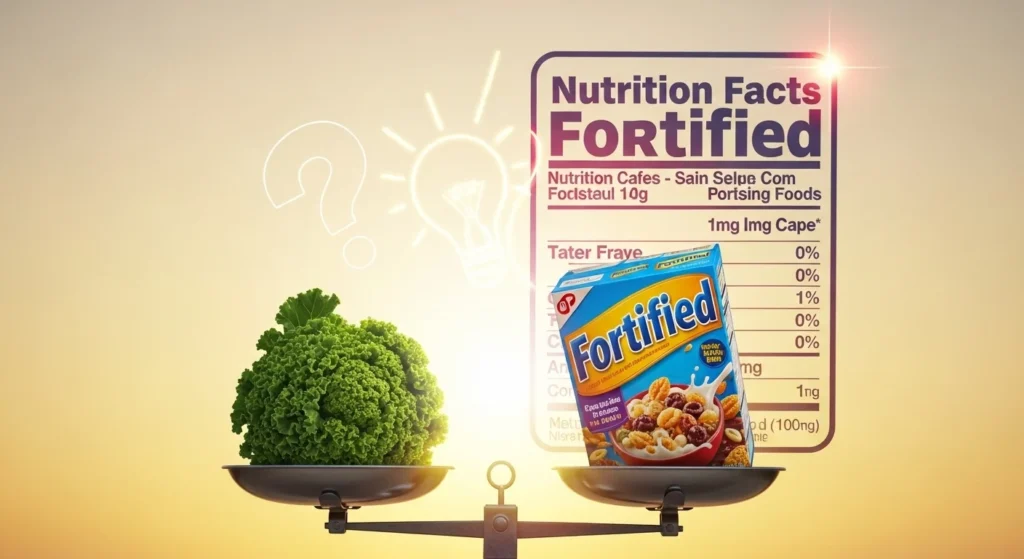
“Fortified” doesn’t automatically mean nutritious — it means something was missing and then added back.
And that difference matters far more than most people realize.
What “Fortified” Actually Means (By Definition)
At its simplest, food fortification means:
Adding vitamins or minerals to a food that didn’t originally contain them — or lost them during processing.
This practice is recognized and regulated in many countries, with guidance from organizations like the World Health Organization and oversight by bodies such as the U.S. Food and Drug Administration.
Fortification exists for a good reason:
- Prevent population-wide nutrient deficiencies
- Improve baseline public health
- Support vulnerable groups
But the intention behind fortification and the way it’s marketed are not the same thing.
Why the Word “Fortified” Triggers Trust Instantly
Your brain associates fortification with:
- Medical care
- Public health programs
- Scientific intervention
- Protection against deficiency
So when you see:
- “Fortified with vitamins”
- “Iron-fortified”
- “Calcium-enriched”
Your brain quietly concludes:
“This food is doing something good for me.”
That’s called a health halo effect — when one positive feature overshadows everything else.
The Missing Context Most Labels Don’t Give You
What “fortified” does not tell you:
- How processed the food is
- How much sugar, refined starch, or sodium it contains
- Whether your body absorbs those nutrients well
- Whether you even need those added nutrients
Fortification answers one question only:
“What was added?”
It does not answer:
“What else came with it?”
Real-Life Example: Fortified Breakfast Cereals
Let’s take a common scenario.
A cereal box proudly claims:
- Fortified with iron
- Added B-vitamins
- Source of vitamin D
Sounds ideal.
But the same cereal may also contain:
- Highly refined grains
- Added sugars
- Minimal fiber
- Artificial flavors
Nutrient deficiencies are addressed — metabolic quality is not.
This is where confusion begins.
Why Fortification Often Follows Heavy Processing
Here’s a key detail many people miss:
The more a food is processed, the more nutrients it loses.
During refining:
- Fiber is stripped away
- Natural vitamins are removed
- Minerals are reduced
Fortification often acts as a repair step, not an upgrade.
The food wasn’t designed to be nutrient-rich — it was rebuilt to meet minimum standards.
Comparison Table: Whole Foods vs. Fortified Foods
| Aspect | Whole Foods | Fortified Processed Foods |
|---|---|---|
| Nutrients | Naturally occurring | Added after processing |
| Absorption | Generally higher | Varies by form |
| Fiber content | Intact | Often low |
| Processing level | Minimal | Moderate to high |
| Health perception | Less flashy | Strong marketing appeal |
Fortification can help — but it doesn’t replace food quality.
When Fortification Actually Helps
To be clear: fortification is not useless.
It has played a major role in reducing:
- Iodine deficiency (iodized salt)
- Neural tube defects (folic acid in grains)
- Iron deficiency anemia in some populations
Public health success stories exist — especially at scale.
But individual food choices are not the same as population policy.
Why “Fortified” Can Create a False Sense of Security
One hidden downside of fortified labels:
They can make people feel nutritionally covered, even when diets lack balance.
Common mental shortcuts:
- “I had fortified cereal, so I’m good today.”
- “This snack has added vitamins — it’s basically healthy.”
- “I don’t need vegetables if my food is fortified.”
Over time, this mindset:
- Reduces diet diversity
- Lowers fiber intake
- Increases reliance on ultra-processed foods
Fortified vs. Naturally Nutrient-Dense: Not the Same Thing
A fortified snack bar and a whole food may show similar vitamin numbers on paper.
But the body experiences them differently.
Why?
Because nutrients don’t work in isolation.
Whole foods provide:
- Natural nutrient combinations
- Fiber for absorption
- Bioactive compounds
- Slower digestion
Fortified foods provide:
- Isolated nutrients
- Faster digestion
- Fewer synergistic effects
Numbers don’t tell the full story.
Common Mistakes People Make With Fortified Foods
Mistake #1: Treating Fortified as “Healthy Enough”
Fortified does not equal balanced.
Mistake #2: Ignoring Sugar and Refinement
Added vitamins don’t cancel out metabolic stress.
Mistake #3: Overestimating Absorption
Not all added nutrients are absorbed equally.
Mistake #4: Replacing Whole Foods
Fortification should supplement, not substitute.
How to Read Fortified Labels Smarter
You don’t need to avoid fortified foods.
You need to reframe how you interpret them.
Actionable Steps
- Check why fortification exists
– Was nutrition lost during processing? - Look at sugar and fiber first
– These shape long-term health more than added vitamins. - Use fortified foods as backups
– Not dietary foundations. - Prioritize food structure
– Whole, minimally processed foods still matter most.
Why This Matters Today (And Long-Term)
Modern food environments are built for convenience.
Fortification makes processed foods feel safer, smarter, and more complete.
But when health feels “handled,” awareness drops.
Understanding fortification:
- Restores decision-making power
- Reduces marketing confusion
- Encourages nutrient diversity
- Supports long-term metabolic health
This isn’t about fear.
It’s about clarity.
Key Takeaways
- “Fortified” means nutrients were added, not that food is inherently healthy
- Fortification often follows heavy processing and nutrient loss
- Added vitamins don’t offset excess sugar or low fiber
- Fortified foods can help — but shouldn’t replace whole foods
- Reading labels with context restores nutritional confidence
Frequently Asked Questions
1. Are fortified foods bad for you?
No. They can help address nutrient gaps, but quality and balance still matter.
2. Is natural nutrition better than fortification?
In most cases, nutrients from whole foods are better absorbed and more balanced.
3. Should children eat fortified foods?
They can be helpful, but variety and whole foods remain essential.
4. Do fortified foods prevent deficiencies?
They help at a population level, but individual needs vary.
5. How often should I rely on fortified products?
Occasionally — not as the main source of nutrition.
Final Thought
“Fortified” sounds like protection.
But real nourishment isn’t something added after the fact —
it’s built into food from the start.
When you understand the difference, labels lose their power
and your choices gain clarity.
Disclaimer: This article is for general educational purposes and does not replace personalized nutrition or medical advice.