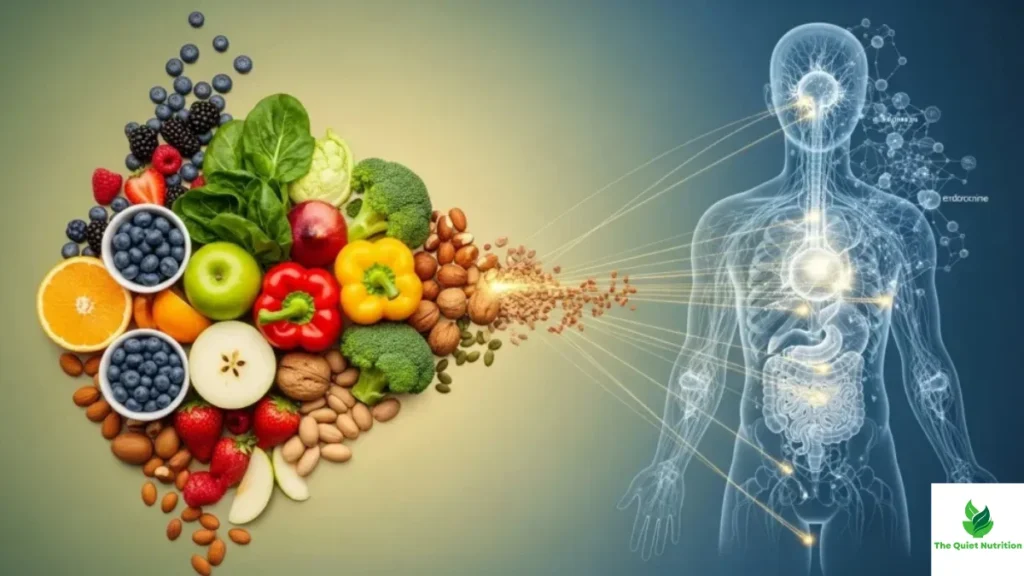
For decades, we’ve been told a simple story about food: it’s just fuel.
In this traditional view, your body is an engine, food is gasoline, and calories are the units of energy you burn. If you want to lose weight or stay healthy, the math seems straightforward — balance the calories coming in with the calories burned coming out.
But modern nutritional science has uncovered a far more fascinating truth: your body does not treat food as simple fuel. It treats food as biological information.
Every bite you eat acts as a stream of chemical instructions — a complex code of molecular signals that speaks directly to your genes, instructs your gut bacteria, modulates your hormones, and dials your immune system up or down.
When you sit down to a meal, you aren’t just topping off an energy tank. You are updating your body’s cellular software.
1. The Molecular Software: How Food Talks Directly to Your DNA
For generations, scientists believed that our genetic code was fixed — a rigid blueprint set at birth. While your underlying DNA sequence doesn’t change, the way your cells read that DNA changes continuously based on environmental inputs.
This field of study, known as nutrigenomics (how nutrients interact with gene expression), reveals that bioactive compounds in food can turn specific genes “on” or “off” through epigenetic signaling mechanisms.
Consider these powerful real-world examples of dietary signals at work:
- Sulforaphane (found in broccoli and cruciferous vegetables): Triggers the Nrf2 pathway in your cells, unleashing a cascade of over 200 protective genes that manufacture endogenous antioxidants and clear cellular toxins.
- Epigallocatechin gallate / EGCG (found in green tea): Binds to enzymes that alter DNA methylation, suppressing genes involved in tumor growth and systemic inflammation.
- Curcumin (found in turmeric): Inhibits NF-kB, a primary genetic “master switch” that initiates chronic inflammatory responses throughout the cardiovascular system.
When you eat nutrient-dense plants, you aren’t just absorbing vitamins; you are delivering biochemical software patches that bolster cellular defense. Research published by the National Institutes of Health (NIH) confirms that dietary phytochemicals directly alter epigenetic marks, altering disease susceptibility in real time.
2. The Microbiome Network: How Fiber Sends Messages to Your Brain
Your gastrointestinal tract is home to roughly 38 trillion microorganisms — a dense ecosystem known as the gut microbiome. These microbes act as the master decoders of your dietary code.
When you consume complex carbohydrates and dietary fiber, your human digestive enzymes cannot break them down. Instead, your gut bacteria ferment these fibers into tiny, highly potent signaling molecules called short-chain fatty acids (SCFAs) — primarily acetate, propionate, and butyrate.
Once created, these SCFAs don’t stay in the gut — they enter systemic circulation, crossing the blood-brain barrier to promote neurogenesis, dampen neuroinflammation, and stimulate satiety hormones.
According to research in Nature Reviews Gastroenterology & Hepatology, these short-chain fatty acids perform vital signaling tasks across the body:
- Reinforcing the Gut Barrier: Butyrate provides energy to colon cells, strengthening tight junction proteins to prevent harmful bacteria and undigested proteins from leaking into the bloodstream.
- Modulating Immunity: SCFAs signal immune cells (T-regulatory cells) to reduce systemic inflammation and prevent autoimmune overreactions.
- Brain Communication via the Vagus Nerve: SCFAs stimulate enteroendocrine cells in the gut to release satiety signals directly to the brain’s hypothalamus, regulating appetite and mood.
3. Hormonal Messaging: Why 100 Calories of Sugar Is Not 100 Calories of Broccoli
The “a calorie is a calorie” paradigm falls apart completely when we look at food through the lens of hormonal signaling chemistry.
To understand why, let’s contrast the hormonal cascade triggered by 100 calories of refined table sugar versus 100 calories of broccoli and wild salmon:
| Physiological Signal | 100 Calories of Refined Sugar (Soda) | 100 Calories of Broccoli + Wild Salmon |
| Blood Glucose Impact | Rapid spike in blood glucose | Steady, minimal glucose curve |
| Insulin Response | Massive surge (signals fat storage, blocks fat burning) | Low, controlled release |
| Satiety Hormones | Suppresses leptin; leaves ghrelin (hunger hormone) high | Triggers GLP-1 and PYY, shutting down hunger |
| Cellular Stress | Drives oxidative stress and liver lipogenesis | Delivers anti-inflammatory omega-3s and antioxidants |
Both meals deliver the exact same amount of thermal energy (100 calories). Yet, the information code in the sugar meal tells the body: “Store fat, trigger inflammation, and remain hungry.”
Meanwhile, the code in the salmon and broccoli meal tells the body: “Build tissue, repair cells, turn on fat oxidation, and signal fullness.”
As researchers at the Harvard T.H. Chan School of Public Health emphasize, the endocrine response to food dictates metabolic health far more than simple caloric quantity.
4. Ultra-Processed Foods: The Danger of “Bad Code”
If whole foods represent clear, harmonious code, ultra-processed foods (UPFs) are the equivalent of computer malware.
Modern food manufacturing strips natural fiber and micronutrients while combining refined carbohydrates, industrial seed oils, and chemical additives into hyper-palatable formulations. These combinations do not exist in nature, and they send confusing, contradictory signals to human physiology:
- Emulsifiers (e.g., polysorbate 80, carboxymethylcellulose): Act like detergents, stripping away the gut mucosal layer and triggering low-grade chronic inflammation.
- Hyper-Palatable Fat-Sugar Hybrids: Overrides the brain’s natural “stop eating” feedback loops in the striatum, causing continuous craving signals regardless of energy abundance.
- Artificial Sweeteners: Can disrupt gut bacterial diversity and confuse metabolic signaling by decoupling sweet taste reception from actual glucose delivery.
A clinical study conducted by scientists at Cell Metabolism found that when participants were offered diets matched precisely for calories, sugar, fat, fiber, and sodium, those on the ultra-processed diet spontaneously consumed 500 additional calories per day simply because the synthetic food code disrupted normal appetite signaling pathways.
5. How to Upgrade Your Daily Food Code
Shifting your mindset from “How many calories am I eating?” to “What signals am I sending my body?” changes everything about how you approach nutrition.
Here are four actionable ways to optimize your biological signals starting today:
1. Aim for Diversity (30+ Plants per Week)
Each plant species contains a unique profile of polyphenols and prebiotic fibers. Consuming a wide diversity of colorful vegetables, berries, herbs, nuts, and legumes seeds a highly diverse microbiome, maximizing your production of protective short-chain fatty acids.
2. Eat in the Correct Sequence
Clinical insights from researchers at Stanford Medicine demonstrate that eating fiber and protein before carbohydrates significantly reduces blood glucose and insulin spikes. Fiber coats the intestinal wall, slowing glucose absorption and sending a smooth, stable hormonal signal to your pancreas.
3. Choose Whole, Unrefined Information
Prioritize foods that retain their natural cellular matrix. Whole fruits, vegetables, intact grains, and unprocessed proteins carry the structural code your digestive tract evolved to read over millions of years.
4. Respect Circadian Signaling
Food isn’t just a chemical signal; it’s a temporal signal. Your peripheral organs (liver, gut, pancreas) have their own peripheral circadian clocks. Eating late at night sends conflicting signals to a brain expecting sleep, impairing glucose tolerance and metabolic efficiency.
The Bottom Line
Your body is an extraordinarily complex, self-regulating ecosystem that responds continuously to every signal you feed it.
The next time you sit down to eat, take a moment to reframe your meal. Beyond the calories, macros, and energy, ask yourself: What message am I giving my cells today?

Aarti Solanki, B.Sc. (Food Science), is a food science writer passionate about making nutrition simple and evidence-based. She creates well-researched, easy-to-understand articles on healthy eating, food science, and nutrition, using information from trusted scientific and public health sources.







Pingback: What “Balanced Nutrition” Actually Means Inside the Body — Why It’s Not What Most People Think
Pingback: How the Body Uses Food to Maintain Balance — The Quiet Intelligence Behind Every Meal
Pingback: Why Nutrition Is About Signals, Not Just Substances — How Food Actually Communicates With Your Body
Pingback: Why Aging Is About Maintenance, Not Decline — The Nutrition Truth That Changes How You Age
Pingback: How the Body Protects Balance Through Nutrition, Not Willpower
Pingback: Almonds Are a Daily Superfood — Here’s Why Your Body Loves Them