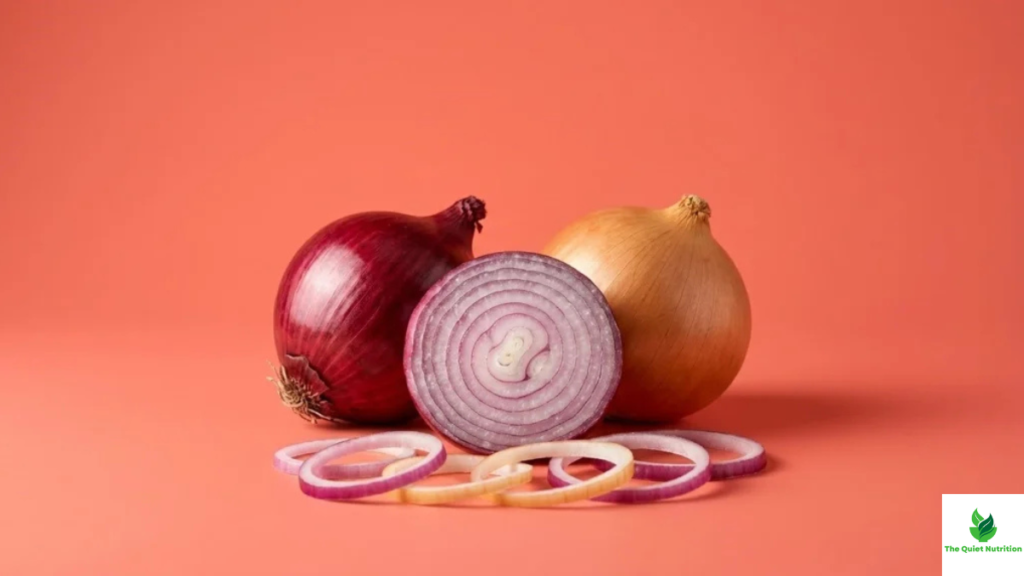
You’ve cooked with them your whole life. Here’s what they’ve quietly been doing for your body the entire time.
When King Ramses IV was mummified around 1150 BCE, embalmers placed onions in his eye sockets. It wasn’t an oversight — ancient Egyptian priests believed the vegetable’s tight, concentric layers mirrored eternal life, and tombs across the Nile Valley were stocked with onions as funerary offerings.
Three thousand years later, researchers are still taking the onion seriously, just for very different reasons. Strip away the mythology and you’re left with a genuinely well-studied vegetable, one that shows up in cardiology journals, cancer epidemiology, and bone-density research almost as often as it shows up in a stir-fry. Most of what it does for your body has nothing to do with taste. Here’s what the science actually shows.
A Compound Called Quercetin Does More Than You’d Guess
Onions are one of the richest dietary sources of quercetin, a plant flavonoid that acts as both an antioxidant and an anti-inflammatory agent. A 100-gram serving — roughly one small onion — contains about 59 milligrams of quercetin on average, and red and yellow varieties carry noticeably more of it than white onions do.
What makes quercetin stand out isn’t just that it neutralizes free radicals. Research has linked it to reduced production of the inflammatory compounds involved in allergic reactions, and in animal studies, more than a quarter of absorbed quercetin ends up localized in lung tissue, part of why it keeps showing up in allergy and asthma research alongside its cardiovascular work.
Here’s the detail most people miss entirely: the highest concentration of quercetin isn’t in the part you eat. It’s in the papery outer skin you peel off and throw away. Simmering a few of those skins into stock or broth pulls the flavonoids into the liquid, along with a rich amber color, before you strain them back out.
Your Gut Bacteria Are Quietly Grateful
There’s a second story here that has nothing to do with antioxidants: fiber. Onions are loaded with fructans, specifically inulin and fructooligosaccharides (FOS), a type of soluble fiber your digestive enzymes can’t actually break down. Instead, it travels intact to your colon, where it becomes food for beneficial bacteria, particularly Bifidobacteria.
That fermentation produces short-chain fatty acids like butyrate, which help maintain your intestinal lining and appear to calm gut inflammation. A cup of chopped raw onion has roughly 3 grams of fiber, and red onion extract specifically yields about 3.7 grams of inulin and FOS per 100 grams. Using lab-based gut fermentation modeling, a 2024 study found that onion extract meaningfully reshaped microbial community structure and increased production of beneficial metabolites.
It’s also, not coincidentally, exactly why onions give some people gas and bloating. The same fermentation that feeds good bacteria produces gas as a byproduct, which is why people with IBS are often told to cook their onions rather than eat them raw.
The Blood Sugar Connection Nobody Talks About
Diabetic rats given a diet spiked with 5% dried onion powder over an eight-week period, according to a 2020 study, came out the other side with lower fasting blood sugar and better triglyceride and cholesterol numbers than rats on a standard diet. It’s one of the least-discussed onion benefits, and one of the more consistently replicated ones across both animal and human research.
Human data points the same direction. In one trial, women undergoing chemotherapy for breast cancer who ate fresh yellow onion daily for eight weeks had lower fasting blood glucose than a placebo group — notable because the chemotherapy drug involved is known to reduce insulin sensitivity. Broader research across both type 1 and type 2 diabetes patients has found that eating onion in various forms, fresh, cooked, powdered, or as juice, for eight weeks consistently lowered fasting glucose.
Nobody’s suggesting you swap medication for onion rings. But the sulfur compounds and quercetin in onions appear to meaningfully influence glucose metabolism, which is a big part of why researchers keep circling back to alliums in diabetes nutrition studies.
What Onions Do for Your Heart, By the Numbers
Cardiovascular research is where onion studies get specific enough to be genuinely useful. One meta-analysis pooling ten randomized controlled trials — 446 participants combined — found that people taking onion supplements ended up with meaningfully better numbers across the board: HDL (“good” cholesterol) rose by about 2.3 mg/dL, LDL (“bad” cholesterol) fell by about 6.6 mg/dL, and total cholesterol dropped by roughly 5.4 mg/dL, compared to control groups.
Blood pressure research tells a similar story. In one 12-week trial, overweight and obese adults with prehypertension or stage 1 hypertension who took onion skin extract twice daily saw a measurable drop in systolic blood pressure compared to placebo. In a smaller, much shorter study, adults with prehypertension who ate fresh onion soaked in olive oil saw systolic pressure drop by about 10 mmHg and diastolic pressure drop by about 8 mmHg, within five hours.
Researchers also point to onions’ organosulfur compounds as having a mild effect on blood clotting, supporting healthy circulation. That’s especially relevant if you’re on blood-thinning medication — food and drug interactions are always something to flag with your doctor.
The Bone Health Link Researchers Didn’t Expect
Nobody thinks “bone density” when they think “onion,” which is exactly why this research deserves more attention. An analysis of National Health and Nutrition Examination Survey data on perimenopausal and postmenopausal women found a connection between onion consumption and bone density. Researchers pointed to compounds like quercetin, kaempferol, and a sulfur compound unique to onions that appear to influence bone remodeling, by encouraging bone-building osteoblasts and slowing the osteoclasts that break bone down.
A small trial took this further, giving 24 subjects 100 mL of onion juice or a placebo daily for eight weeks while tracking antioxidant activity and bone turnover markers. By the end, three of the postmenopausal women in the onion group showed measurable improvement in bone mineral density.
That’s a tiny sample, and this doesn’t mean onion juice replaces calcium, vitamin D, or weight-bearing exercise for bone health. But paired with lab work showing how these compounds affect bone-remodeling cells, it’s a genuinely underreported area of onion research.
A Complicated Relationship With Cancer Risk
Worth an upfront caveat: none of what follows means onions prevent cancer, and this research doesn’t replace screening or treatment. What it does show is a consistent pattern across a lot of population data.
One meta-analysis covering 19 case-control and 2 cohort studies, more than 543,000 people in total, found that high onion and allium vegetable intake was associated with roughly half the risk of gastric cancer compared to low intake. A hospital-based study in China found colorectal cancer odds were 79% lower among adults with high allium vegetable consumption compared to low. A larger, multi-country pooled analysis of more than 6,000 gastric cancer cases found a similar pattern, roughly 31% lower odds at the highest intake levels, though the association was notably stronger in Asian populations than in European or American data. That nuance tends to get lost whenever this research gets flattened into a headline.
The leading theory involves the same sulfur compounds behind onions’ pungency. Researchers believe they help the body process and clear certain potential carcinogens, though the exact mechanism is still being worked out.
The Hair-Growth Claim That’s Half True
You’ve probably seen the stat: 87% of people regrew hair after rubbing onion juice on their scalp. It comes from one real study, a small 2002 trial out of Baghdad that found 20 of 23 alopecia areata patients regrew hair after applying raw onion juice twice daily for six weeks, compared to just 2 of 15 in a tap-water control group.
Here’s what usually gets left out of the retelling. The study had 38 total participants, nearly half the treatment group dropped out before it ended, and true blinding was essentially impossible, since you can’t really disguise the smell of onion juice. Reviewers have rated the study’s methodology quite low, and in more than two decades, nobody has replicated it at a larger scale.
It’s also important to know exactly what condition was tested: alopecia areata, an autoimmune condition that causes patchy hair loss, not the far more common pattern baldness. The viral stat doesn’t really extend to general thinning hair, even though that’s usually how it gets shared. Onion juice does have measurable antimicrobial activity on the scalp, so it’s not nothing. It’s just not the slam-dunk the citation count suggests.
Getting the Most Out of Every Layer
Knowing the research doesn’t help much without knowing how to use it.
- Color matters for antioxidants. Red and yellow onions carry meaningfully more quercetin than white onions, so reach for those first if that’s a priority for you.
- Don’t overcook them. A quick sauté or light roast preserves more flavonoid content than hours of simmering.
- Save the skins. Simmer a couple of outer skins into stock or broth for concentrated quercetin and color, then strain them out before serving.
- Cook onions if raw ones bother your gut. Cooking breaks down some of the fermentable fructans, which tends to be gentler on digestion than eating them raw.
The Layers Add Up
Ancient Egyptians got the metaphor right even if they got the mechanism wrong. There really is more to an onion than what’s on the surface, just not for the reasons they thought. It’s the quercetin, the fructans, and the organosulfur compounds, and researchers are still finding new uses for all three.
None of this makes onions a miracle cure. That’s not how nutrition science works, and it’s not what any of these studies claim. It just means the humble onion earns its keep in more ways than most people realize, one modest study at a time.
Sources
- Healthline – Onion Benefits: Nutrients, Antioxidants, and Cooking Ideas
- NIH/PMC – Recent Advances in Potential Health Benefits of Quercetin
- PubMed – Onion Juice (Allium cepa L.), A New Topical Treatment for Alopecia Areata
- British Journal of Cancer – Allium Vegetables Intake and Gastric Cancer Risk (StoP Project)
- NIH/PMC – Effect of Onion on Blood Lipid Profile: A Meta-Analysis of RCTs
- Food & Function (RSC) – Onion Juice, Oxidative Stress, and Bone Disorders in Postmenopausal Subjects

Aarti Solanki, B.Sc. (Food Science), is a food science writer passionate about making nutrition simple and evidence-based. She creates well-researched, easy-to-understand articles on healthy eating, food science, and nutrition, using information from trusted scientific and public health sources.