The Label That Feels Like Safety
Walk down any grocery aisle today and you’ll see one phrase everywhere:
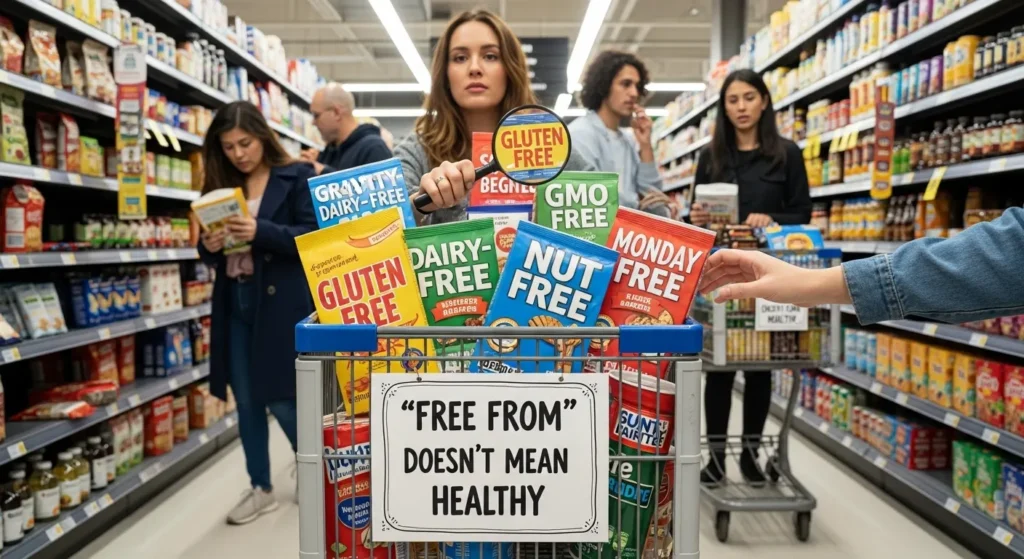
“Free From.”
Free from sugar.
Free from gluten.
Free from dairy.
Free from preservatives.
Free from guilt.
It sounds comforting.
It feels like protection.
Like the food is doing something responsible on your behalf.
But here’s the truth most people never hear:
“Free from” doesn’t automatically mean better… it just means something was removed.
And what gets removed isn’t always the problem.
Sometimes, the replacement is worse.
Sometimes, the restriction isn’t needed.
And sometimes, “free from” is more about marketing than health.
Let’s unpack why this matters.
What “Free From” Labels Really Mean (And What They Don’t)
The phrase “free from” has become one of the most powerful food marketing tools.
Because it implies:
- Purity
- Safety
- Cleanliness
- Superiority
But nutritionally, it only tells you one thing:
This product excludes a specific ingredient.
It does not tell you:
- How processed the food is
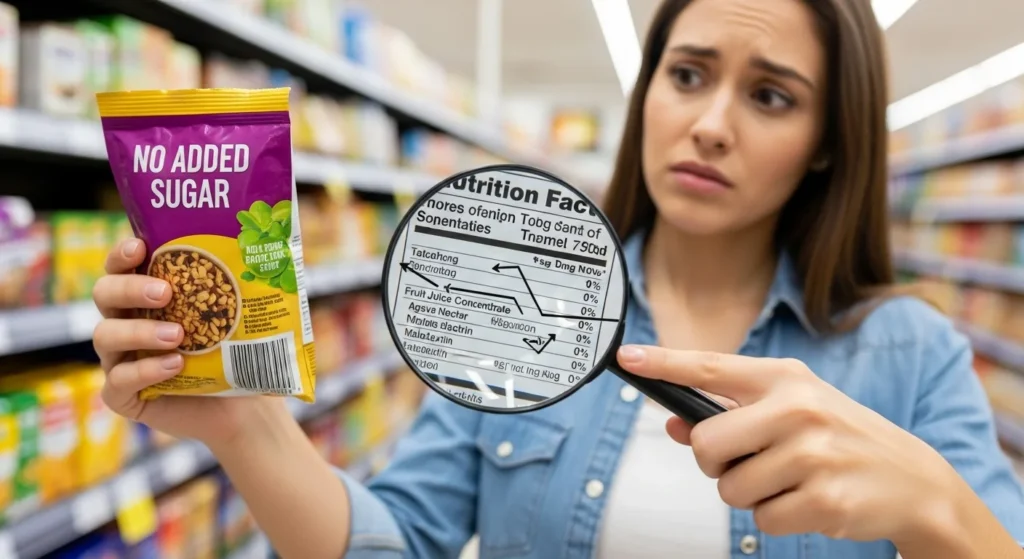
- What replaced the missing ingredient
- Whether it’s healthier overall
- Whether your body benefits from avoiding it
“Free from” is a spotlight.
And whatever it highlights… distracts from what’s still in the shadows.
The Health Halo Effect: Why “Free From” Feels Automatically Healthy
Behavioral researchers call this the health halo effect.
When a product emphasizes one “healthy” feature…
People assume the entire product is healthy.
So:
- “Gluten-free” cookies feel cleaner
- “Sugar-free” soda feels safer
- “Dairy-free” ice cream feels lighter
Even if the product is still ultra-processed.
“Free from” becomes an emotional shortcut:
If it removed something bad, it must be good.
But nutrition is never that simple.
Real-Life Example: Gluten-Free Isn’t Automatically Better
Gluten-free diets are essential for people with:
- Celiac disease
- Medically diagnosed gluten sensitivity
But for most people?
Gluten is not harmful.
The issue is that many gluten-free packaged foods are made with:
- Refined rice flour
- Starches
- Added sugars
- Additives for texture
So gluten-free bread can sometimes have:
- Less fiber
- Higher glycemic impact
- Lower nutrient density
The label solves a fear…
Not necessarily a health problem.
Sugar-Free Products: The Replacement Problem
Sugar-free sounds like an obvious upgrade.
But here’s the hidden truth:
When sugar is removed, something replaces it.
Often:
- Artificial sweeteners
- Sugar alcohols
- Highly refined starches
- Flavor enhancers
These products may still:
- Trigger cravings
- Encourage sweet taste dependence
- Cause digestive discomfort for some people
A sugar-free candy isn’t a health food.
It’s still candy with a different chemistry.
Dairy-Free: Helpful for Some, Unnecessary for Many
Dairy-free is critical for those with:
- Lactose intolerance
- Dairy allergy
But many people avoid dairy because it feels “cleaner.”
The problem?
Dairy-free alternatives are often highly engineered.
For example, plant milks may contain:
- Added oils
- Stabilizers
- Gums
- Fortified nutrients to replace what was lost
Some are great options.
But some are ultra-processed substitutes marketed as purity.
Removing dairy isn’t automatically a health upgrade.
Quality matters more than absence.
“Free From Preservatives”: The Fear Marketing Strategy
One of the most emotionally powerful claims is:
No preservatives
It implies:
- Natural
- Fresh
- Safer
But the truth is:
Preservation is not inherently harmful.
Many preservatives exist to prevent:
- Mold growth
- Foodborne illness
- Spoilage
Also, foods labeled “preservative-free” may still contain:
- Natural preservatives under different names
- Other additives with similar functions
This claim often plays more on fear than science.
Why This Matters Today: “Free From” Is Now a Business Model
The modern wellness marketplace thrives on removal.
Because avoidance sells.
Food companies know that consumers fear:
- Sugar
- Gluten
- Additives
- Carbs
- Dairy
So they create products that promise relief.
But many “free from” foods are still:
- Highly processed
- Low in satiety
- Easy to overeat
- Nutritionally shallow
They just wear a cleaner costume.
Comparison Table: “Free From” vs Whole Food Reality
| “Free From” Label | Sounds Like | What It Often Means | Better Question to Ask |
|---|---|---|---|
| Gluten-Free | Healthier choice | Refined starch replacement | Do I medically need this? |
| Sugar-Free | Better for weight | Sweeteners, craving triggers | What replaces the sugar? |
| Dairy-Free | Cleaner eating | Added oils and gums | Is it minimally processed? |
| Preservative-Free | More natural | Different additives still present | How long is the ingredient list? |
| Fat-Free | Lighter option | More carbs, less fullness | Does it actually satisfy? |
The Biggest Mistake: Avoiding Ingredients Instead of Choosing Foods
The most common nutrition trap today is this:
People shop for what food lacks… instead of what food provides.
Health becomes a checklist of avoidance:
- No sugar
- No gluten
- No dairy
- No additives
Instead of asking:
- Does this food nourish me?
- Is it minimally processed?
- Does it keep me full?
- Is it built from real ingredients?
Real nutrition is about presence, not purity.
Hidden Tip: “Free From” Foods Can Increase Food Anxiety
Many people feel overwhelmed because every label suggests danger.
Food starts to feel like risk management.
That leads to:
- Over-restriction
- Confusion
- Fear of normal meals
- Trusting packaging over intuition
The healthiest diets are sustainable.
Not anxious.
“Free from” should be a medical tool when needed…
Not a lifestyle default driven by fear.
Actionable Steps: How to Use “Free From” Labels Wisely
Here’s a balanced approach that works in real life.
The Smart “Free From” Checklist
- Ask if you truly need to avoid it
- Medical intolerance? Yes.
- Trend-based fear? Maybe not.
- Check what replaces the missing ingredient
- Sugar removed → sweeteners added?
- Gluten removed → starch added?
- Prioritize whole foods first
Foods naturally free from many things:- Vegetables
- Fruit
- Beans
- Eggs
- Nuts
- Look for minimal ingredient lists
The shorter, the better. - Choose satisfaction over perfection
Foods that keep you full reduce cravings and stress.
Real-Life Examples of Better Swaps
Instead of:
- Gluten-free cookies
Try: - Oats with nuts and fruit
Instead of:
- Sugar-free candy
Try: - Dark chocolate + berries
Instead of:
- Dairy-free dessert bars
Try: - Greek yogurt (if tolerated) or simple coconut yogurt
Instead of:
- Fat-free snacks
Try: - Nuts or avocado-based meals for real fullness
Simple foods win long-term.
Key Takeaways
- “Free from” labels highlight absence, not necessarily quality
- These products are essential for some medical needs, not everyone
- Removal often comes with replacements that may be equally problematic
- Many “free from” foods are still ultra-processed
- Whole foods are naturally “free from” without marketing
- The best nutrition comes from balance, not fear-driven restriction
FAQ: Common Questions People Ask
1. Are “free from” foods unhealthy?
Not always. Some are helpful and well-made. But they aren’t automatically healthier.
2. Do I need gluten-free foods if I don’t have celiac disease?
No. Most people tolerate gluten fine, and gluten-free processed foods may be less nutritious.
3. Is sugar-free always better for weight loss?
Not necessarily. Sugar-free products can maintain sweet cravings and may still encourage overeating.
4. Are dairy-free products healthier?
Only if you need them or choose minimally processed versions. Many are highly engineered substitutes.
5. How can I shop smarter without fear?
Focus on whole foods first, and treat “free from” claims as context—not a health guarantee.
Clean Conclusion: Better Isn’t About What’s Missing
“Free from” is one of the most powerful labels in modern food culture.
Because it feels like safety.
But health isn’t built on subtraction alone.
It’s built on:
- Whole ingredients
- Satisfying meals
- Balanced patterns
- Food you can trust without fear
Sometimes, avoiding an ingredient is necessary.
But for most people…
The best food isn’t the one that removes the most.
It’s the one that nourishes the most.