The Quiet Anxiety Built Into the Grocery Aisle
You’re not imagining it.
Shopping for food feels more stressful than it should.
You pick up a product…
And the label whispers:
No sugar.
No chemicals.
No additives.
Guilt-free.
Clean.
Suddenly, regular food feels suspicious.
And “safe” food feels rare.
That’s not an accident.
Modern food marketing doesn’t just sell snacks…
It sells relief.
Because one of the most powerful tools in food advertising isn’t taste.
It’s fear — subtle, polished, and wrapped in wellness language.
Once you see it, you can’t unsee it.
The Emotional Strategy: Fear Works Better Than Facts
Most people assume food marketing is about cravings.
But increasingly, it’s about concern.
Fear-based marketing doesn’t shout:
“This will hurt you.”
It gently suggests:
“This other food might.”
That small shift changes everything.
Food companies know that fear creates urgency.
When you feel uncertain, you want control.
So labels offer comfort through avoidance:
- Avoid sugar
- Avoid fat
- Avoid gluten
- Avoid additives
- Avoid guilt
Fear sells “solutions” faster than nourishment sells balance.
How “Free From” Became the Loudest Language in Food
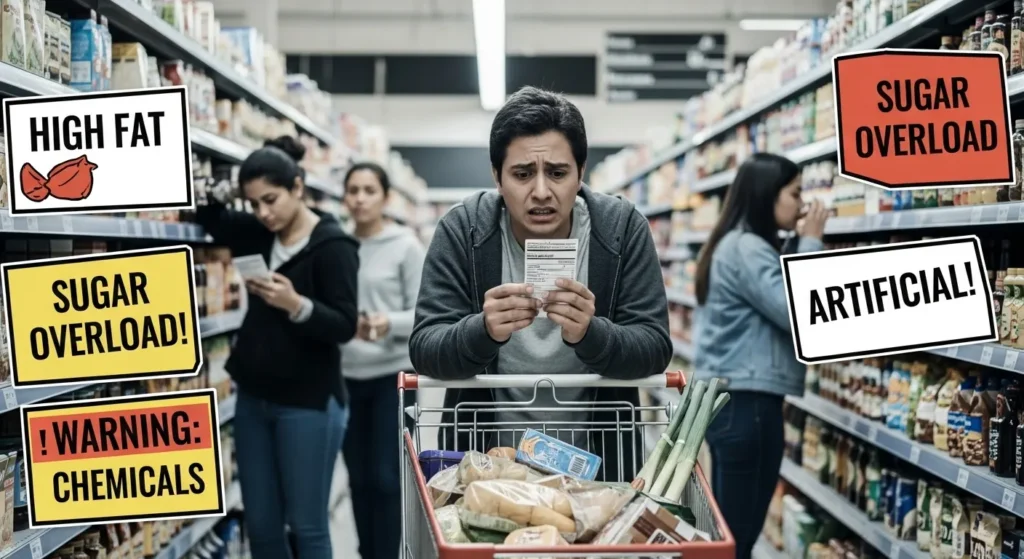
Walk through any store and count how many packages emphasize absence.
You’ll see:
- Sugar-free
- Dairy-free
- Gluten-free
- Preservative-free
- Fat-free
- Artificial flavor-free
These claims sound healthy.
But they also plant a quiet message:
Something is dangerous.
Even when it isn’t for most people.
This creates a modern nutrition mindset built not on nourishment…
But on avoidance.
Food becomes less about eating well…
And more about eating safely.
The Psychology Behind Subtle Food Fear
Behavioral science shows that humans are wired to notice threats more than benefits.
This is called:
Negativity Bias
Our brains respond faster to:
- Danger
- Risk
- “Bad ingredients”
- Health warnings
So when packaging says:
“NO sugar”
Your brain hears:
“Sugar is a threat.”
When packaging says:
“NO chemicals”
Your brain hears:
“Other foods are unsafe.”
Marketing leverages biology.
Not nutrition.
Real-Life Example: The “Clean Eating” Trap
“Clean” is one of the most emotionally loaded food words ever created.
It implies:
- Pure
- Safe
- Virtuous
- Superior
And it quietly implies the opposite:
Other foods are dirty.
But here’s the truth:
“Clean” has no regulated definition.
A highly processed protein bar can be labeled “clean”…
While an ordinary homemade pasta dish feels “unclean.”
That’s fear-based framing.
Not health.
How Food Marketing Creates Ingredient Villains
Fear-based marketing works best when it gives you an enemy.
Common villains include:
- Sugar
- Carbs
- Fat
- Gluten
- Seed oils
- “Chemicals”
- Preservatives
Sometimes these concerns are medically relevant…
But often they’re exaggerated for mass marketing.
Because when people fear an ingredient…
They buy the product that promises protection.
Food becomes a battlefield.
And companies sell armor.
Why This Matters Today: Fear Is Replacing Food Literacy
Most shoppers don’t want perfection.
They want peace.
But modern food marketing makes peace feel conditional:
“You can relax… if you avoid the wrong thing.”
That leads to:
- Confusion
- Food anxiety
- Distrust of normal meals
- Overreliance on packaged “safe” foods
The tragic irony?
Many fear-marketed foods are still ultra-processed.
They just wear a better costume.
The Processing Distraction: Fear Keeps You From Seeing the Real Issue
Here’s what’s rarely advertised:
Ultra-processing matters more than single ingredients.
A cookie can be:
- Gluten-free
- Sugar-free
- Vegan
- Clean-labeled
And still be:
- Highly refined
- Engineered for overeating
- Full of additives and starches
- Structurally broken
Fear-based labels keep attention on one removed ingredient…
Instead of the overall food reality.
Comparison Table: Fear Marketing vs Real Nutrition
| Fear-Based Claim | What It Triggers Emotionally | What It Often Hides | Better Way to Think |
|---|---|---|---|
| “Sugar-Free” | Sugar is dangerous | Artificial sweeteners, cravings | Focus on whole-food sweetness |
| “No Preservatives” | Chemicals are scary | Still ultra-processed | Processing level matters more |
| “Low Fat” | Fat causes weight gain | Added starch, low satiety | Healthy fats improve fullness |
| “Gluten-Free” | Gluten is harmful | Refined gluten-free flours | Only needed for intolerance |
| “Clean Label” | Other foods are dirty | Marketing term, no standard | Choose simple ingredients |
Hidden Tip: Fear Marketing Often Creates False Control
Fear-based products don’t just sell health…
They sell certainty.
When life feels chaotic, labels feel like rules:
- Eat this, not that
- Avoid this ingredient
- Choose the “safe” option
That creates what psychologists call:
The Illusion of Control
It feels like you’re managing your health…
When you may just be responding to anxiety-based cues.
Real health is not fear management.
It’s nourishment, consistency, and balance.
Common Mistakes People Make Under Fear-Based Marketing
Even smart people fall into these traps:
1. Thinking “free from” automatically means better
Removing one ingredient doesn’t make a food nourishing.
2. Distrusting normal foods
Bread becomes scary. Fruit feels suspicious. Fat feels wrong.
3. Ignoring the ingredient list
Fear claims distract from the real processing story.
4. Turning eating into moral purity
Food becomes “good” or “bad” instead of helpful or unhelpful.
5. Overpaying for comfort
Fear-marketed foods often cost more while offering less satisfaction.
Actionable Steps: How to Shop Without Fear
You don’t need to ignore labels.
You just need to read them differently.
The Calm Shopper Checklist
- Pause when a label feels emotionally reassuring
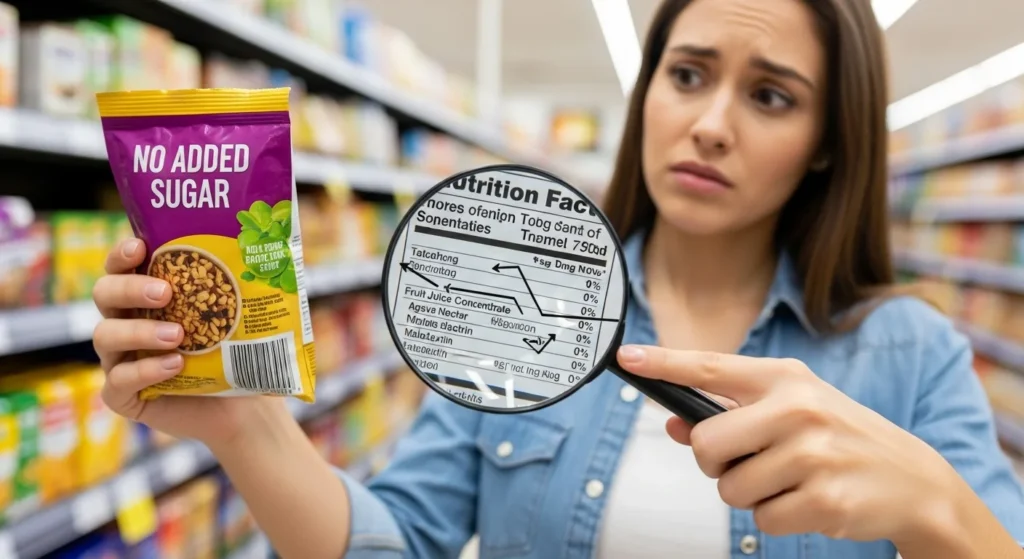
Ask: What fear is this relieving? - Flip to the ingredient list immediately
Marketing is front-facing. Truth is on the back. - Choose foods that don’t need to advertise safety
Whole foods don’t scream “clean.” - Focus on patterns, not villains
One ingredient rarely determines health alone. - Build meals, not avoidance strategies
A balanced plate beats anxiety-driven restriction.
Real-Life Example: The Snack Swap That Changes Everything
Instead of buying:
“Clean, sugar-free protein cookies”
Try:
- Greek yogurt + berries
- Nuts + fruit
- Oats + peanut butter
- Hummus + vegetables
These foods don’t need fear marketing.
They satisfy naturally.
And they build trust with your body again.
Key Takeaways
- Food marketing often uses subtle fear to influence buying decisions
- “Free from” labels trigger safety emotions more than nutrition clarity
- Fear creates ingredient villains that oversimplify health
- Many fear-marketed foods are still ultra-processed
- Real nourishment comes from food structure, ingredients, and balance
- The best diet is built on confidence, not anxiety
FAQ: Common Questions People Ask
1. Is fear-based food marketing intentional?
Yes. Avoidance messaging is proven to drive purchasing because it taps into safety instincts.
2. Are “free-from” foods always unhealthy?
Not always, but they aren’t automatically better. Processing and ingredients matter more.
3. Why do labels make normal ingredients feel scary?
Because fear marketing creates villains to make products feel like solutions.
4. How can I shop smarter without getting overwhelmed?
Focus on whole foods first, then use labels only as secondary tools.
5. What matters more than avoiding ingredients?
Diet patterns, minimally processed foods, satisfaction, and long-term balance.
Clean Conclusion: The Healthiest Food Doesn’t Need Fear
The loudest food labels aren’t always the healthiest.
They’re often the most emotional.
They don’t just sell nutrition…
They sell relief from imagined danger.
But real health is not built on fear.
It’s built on trust:
- Trust in simple foods
- Trust in balanced eating
- Trust in patterns over panic
So next time a label whispers “safe”…
Take a breath.
The calmest foods are usually the real ones.
And the best choices don’t come from fear…
They come from understanding.