
A colleague once tracked her actual eating for a week, out of sheer curiosity after a nutritionist asked her to, and brought the results into the office with the slightly stunned look of someone who’d just seen a photo of themselves from an angle they’d never noticed before. She’d been reading labels carefully for years, always checking the per-serving numbers before buying anything. What the week of honest tracking revealed was that she rarely ate a single serving of anything. Cereal poured “by feel” was closer to two and a half servings. The granola bar she assumed was one serving was, per the box, actually one and a half. None of her label-reading had been wrong, exactly. It had just been describing a person who didn’t resemble how she actually ate.
That gap — between the eating a label imagines and the eating that actually happens — turns out to be one of the more overlooked reasons nutrition information so often fails people who are, by any reasonable standard, trying hard to get it right.
Serving Sizes Describe a Fictional Eater
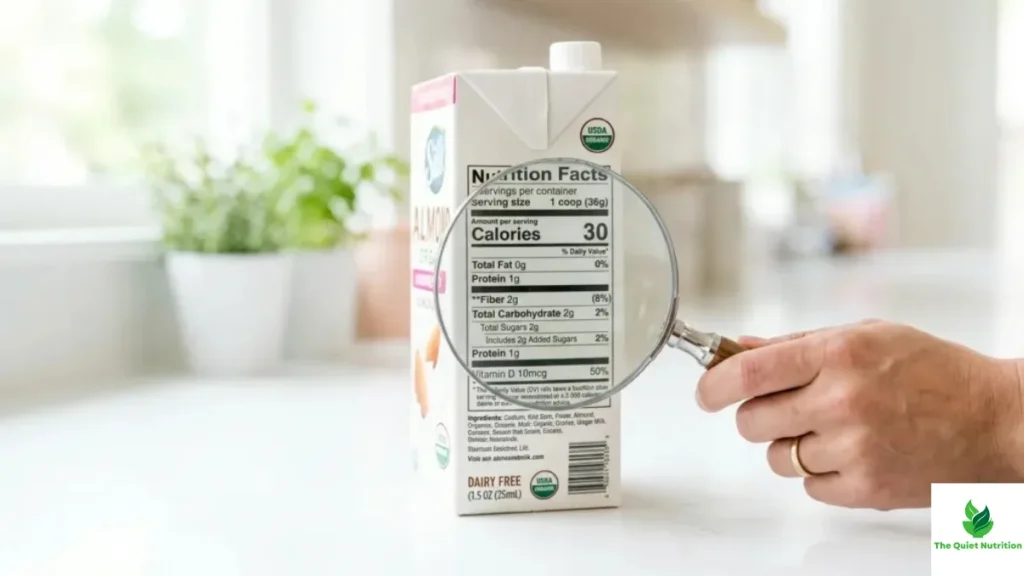
Serving sizes on nutrition panels are set by regulatory reference amounts, originally established using national consumption survey data from decades ago, and they’re revised only occasionally. In principle, they’re meant to reflect realistic portions. In practice, they often describe a portion size that predates significant shifts in how food is actually packaged, sold, and eaten. A “serving” of soda defined years ago as eight ounces sits inside bottles now commonly sold in twenty-ounce single units, consumed in full, in one sitting, by almost everyone who buys them. The label isn’t wrong about the eight ounces. It’s just describing a drinking pattern that stopped being typical a long time ago.
This creates a strange, quiet dishonesty baked into the system — not because anyone is lying, but because the reference point the entire panel is built around has drifted further and further from the reality it’s supposed to represent, while the format pretends nothing has changed.
People Don’t Eat in Isolated Units
Labels are built product by product, but eating happens as combinations — a sandwich, not bread and cheese and condiment evaluated separately; a bowl of cereal with milk, not cereal alone, the way the panel presents it. This matters more than it sounds. Milk adds calories, protein, and sugar that shift the total nutritional picture the cereal box, on its own, has no way of representing. A person diligently reading the cereal label in isolation is working with an incomplete equation by design, since the panel was never required to account for what typically accompanies the product.
Restaurant and prepared foods complicate this further, since combination eating is the norm there and labeling requirements, where they exist at all, are considerably less rigorous than packaged retail food. A meal built from three or four separately-labeled components, each individually reasonable, can add up to something the diner never actually evaluated as a whole, because no single label was ever responsible for the total.
The Gap Between Reading and Behavior
Perhaps the most human piece of this mismatch is one behavioral economists have studied directly: people consistently underestimate how much they eat, particularly with foods eaten quickly, in front of a screen, or directly from a shared package rather than a measured portion. Studies using photographed food diaries against self-reported intake find a persistent gap, often significant, between what people believe they consumed and what they actually did. Labels assume a level of measured, deliberate portioning that doesn’t reflect how most eating actually happens — standing at a counter, scooping by feel, finishing what’s left because the alternative is putting it away.
This isn’t a failure of honesty. It’s simply how eating behaves in real, unstructured life, and it’s precisely the behavior nutrition labels, built around neat per-serving math, were never designed to accommodate.
Why the Mismatch Actually Matters
None of this is an argument that labels are pointless — they remain the most standardized tool available, and for people managing specific conditions requiring precise numeric tracking, that standardization genuinely matters. But for the much larger group of people using labels as a general compass rather than a precise instrument, the mismatch between labeled servings and lived eating creates a quiet, cumulative distortion. Someone can follow label guidance faithfully, feel confident in their choices, and still end up consuming meaningfully more sugar, sodium, or calories than the numbers they were tracking suggested, simply because the unit of measurement never matched the unit of actual behavior.
My colleague’s fix wasn’t more careful label-reading. It was recalibrating her sense of what a serving actually looked like in her own bowl, her own glass, her own hand — a small, almost embarrassingly obvious adjustment that did more for her accuracy than any amount of squinting at the fine print ever had. The label had never been lying to her. It had just been describing someone else’s plate the whole time.
Sources:
- U.S. Food and Drug Administration — Food Labeling Guide: https://www.fda.gov/food/food-labeling-nutrition
- Harvard T.H. Chan School of Public Health — Nutrition Source: https://www.hsph.harvard.edu/nutritionsource/
- National Institutes of Health — Portion Size and Eating Behavior Research: https://www.ncbi.nlm.nih.gov/pmc/
- World Health Organization — Healthy Diet Fact Sheet: https://www.who.int/news-room/fact-sheets/detail/healthy-diet
- Cornell Food and Brand Lab — Consumer Perception and Labeling Research: https://www.brandlab.cornell.edu/

Aarti Solanki, B.Sc. (Food Science), is a food science writer passionate about making nutrition simple and evidence-based. She creates well-researched, easy-to-understand articles on healthy eating, food science, and nutrition, using information from trusted scientific and public health sources.






Pingback: Why “Zero” Claims on Food Labels Can Be Misleading — And What They Don’t Tell You